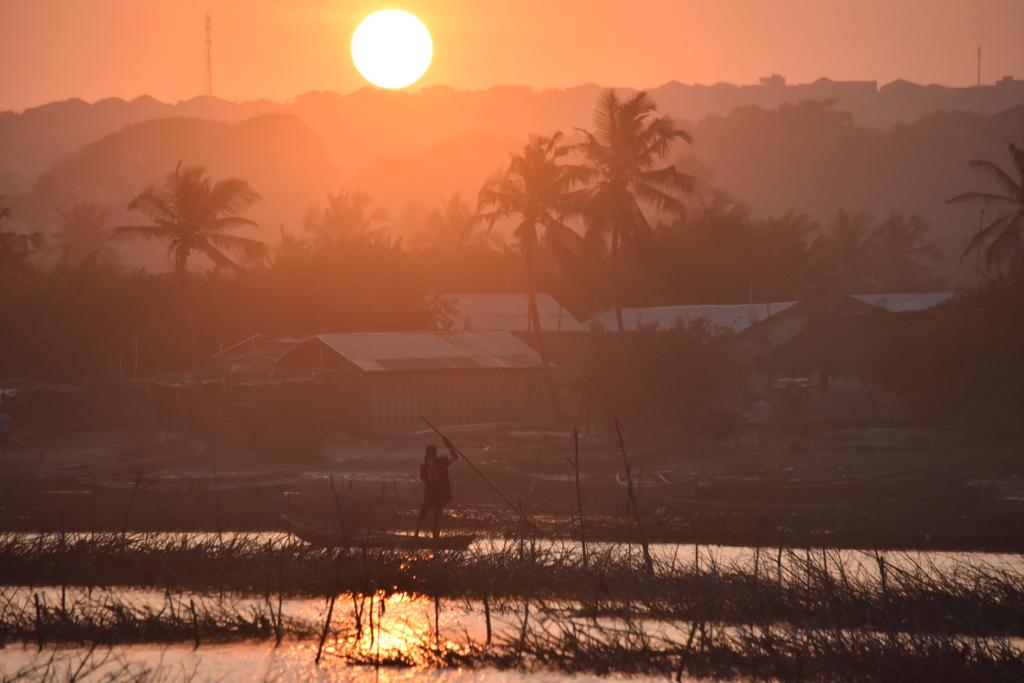
Returning to Accra, Ghana

This past month, I’ve been in Ghana studying health systems, services, and education. Last summer I attended this program as a student, so I was thrilled to have the opportunity to return as a TA and revisit many of the same sites I enjoyed so much last year. Throughout the month, our group travels to four different cities visiting hospitals, clinics, and schools to learn about health care structure and delivery in Ghana. Given the fact that there are SO many activities are packed into our program, my Ghana blog recounts a few of the highlights or experiences that stuck out to me.

outside of the U.S. Embassy

Our month started in Accra, the capital and largest city of Ghana. On our first day, we visited the U.S. Embassy which was such an informative experience. We spoke with the U.S. Health Service Officer for Ghana as well as a few other public health and USAID department heads. I thoroughly enjoyed learning about the role and involvement of the U.S. Foreign Service Officers since this is a career I am interested in pursuing. I find it really interesting to learn about US government aid and involvement in low to middle income countries, particularly areas with histories with Western involvement or colonization. The officer spoke to us about the USAID efforts to alleviate the burden of infectious disease in Ghana, particularly in rural communities suffering from high rates of malaria and HIV/AIDS. This experience was so valuable and great to hear about these efforts first-hand.
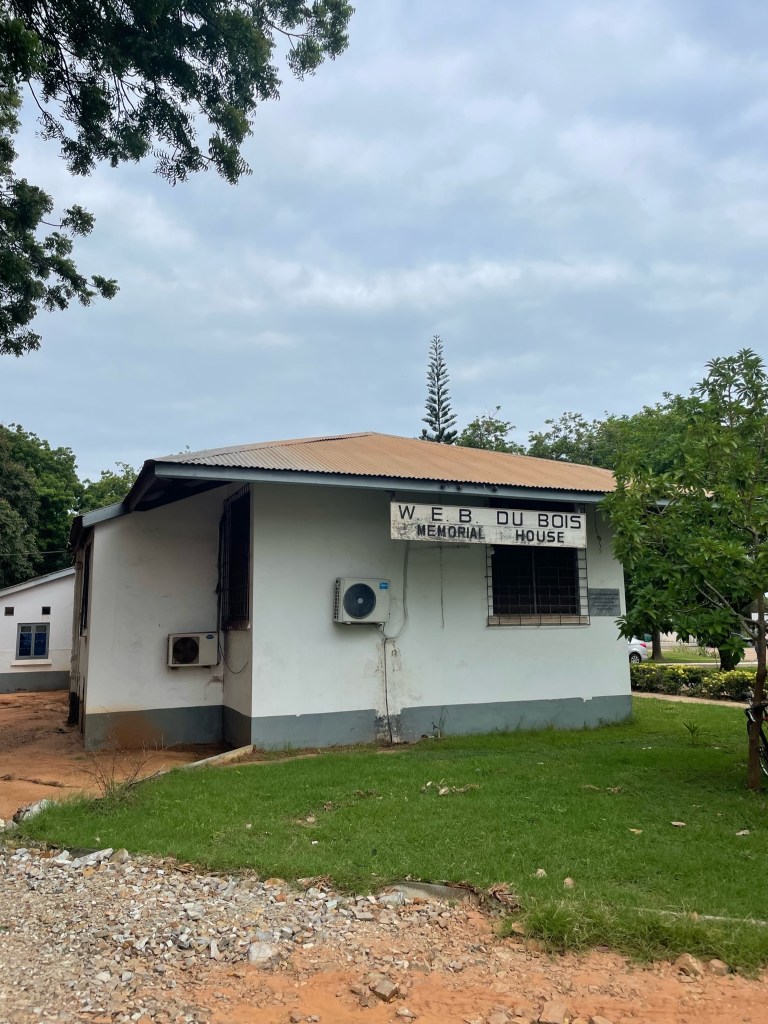
W.E.B. du Bois’ original house

Another main attraction in Accra is W.E.B. du Bois’ house, which has now been converted into a museum. W.E.B. du Bois was a Pan-Africanist and founder of the NAACP who widely advocated for Black American rights and fought in the US Civil Rights Movement. At the age of 91 he moved to Ghana, where he continued to work with African leaders. His home is filled with amazing memorabilia and literature from his lifetime.
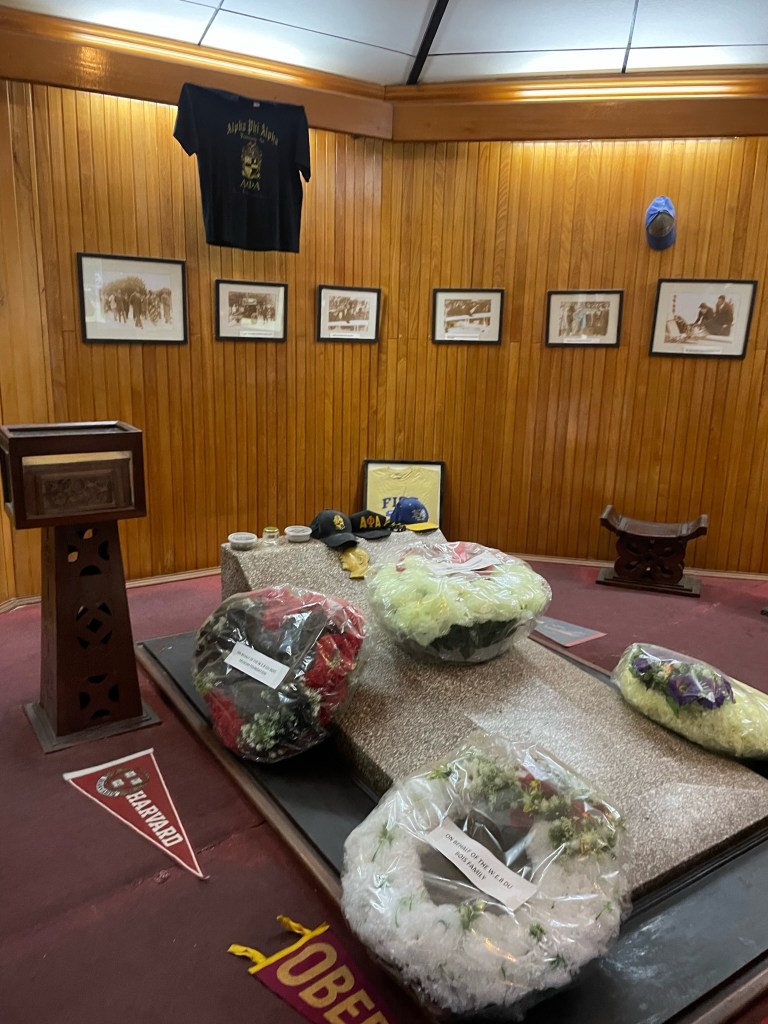
the gravesite

His gravesite his held in a building shaped like a spider’s web (also a word play on his name, W.E.B). This web is symbolic for the web of impact W.E.B du Bois built around the world and is a lesson for us to follow his ways of spreading unity and justice in our own communities. One of my favorite quotes by him is, “Mobilize science and the arts to render shattering blows to the myth of white superiority in every area of our cultural life”.
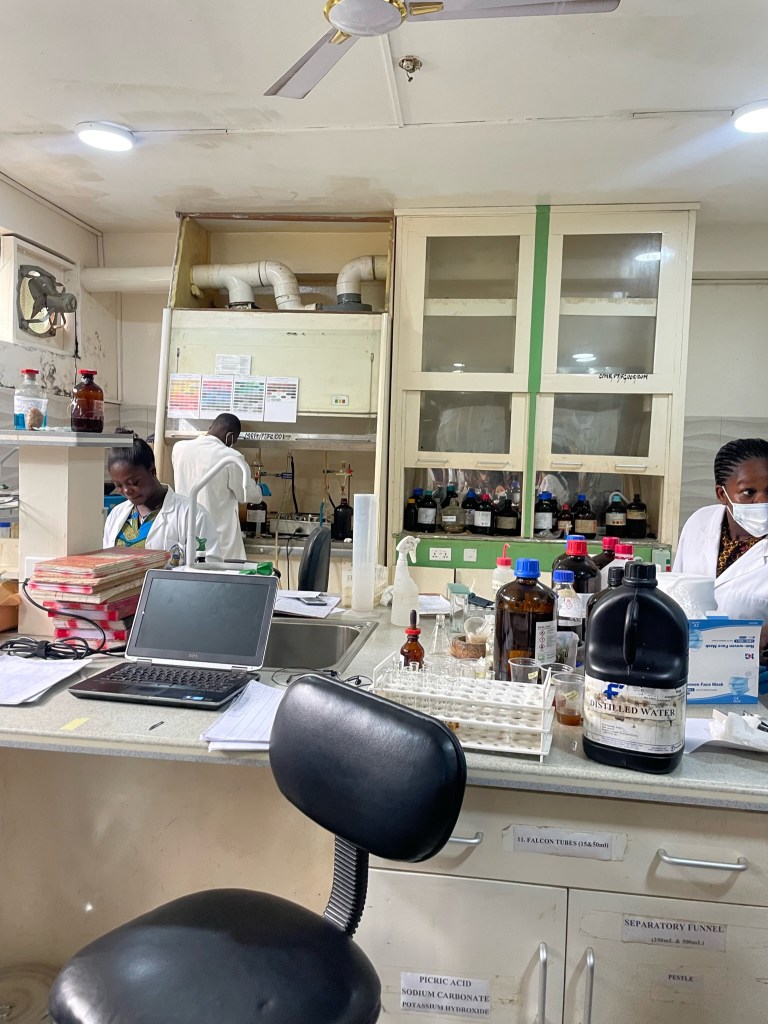
one of the plant research labs

On one of the mornings, our group traveled to visit the Akropong Centre for Plant Medicine Research. In Ghana, 70% of people still use traditional healing remedies including herbalism and plant medicine. At this research center and clinic, they perform toxicology and pharmacology testing of plants and develop safe, plant-based products like teas, creams, pills, and vitamins.
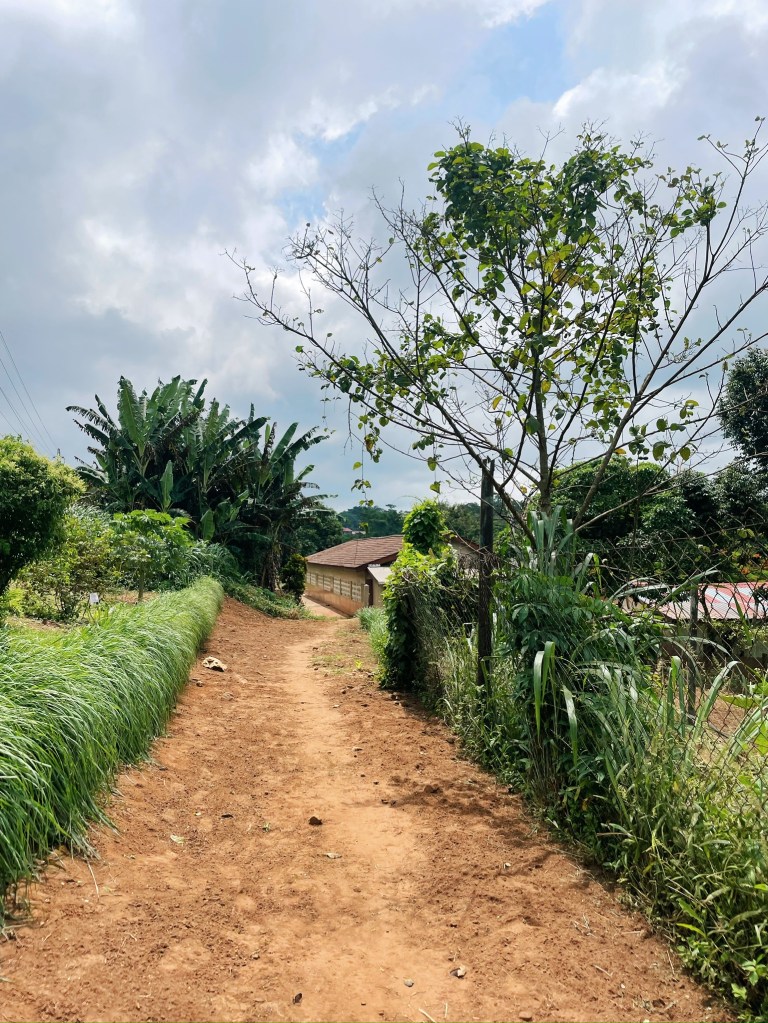
the plant gardens

This site visit is so interesting to me because of their efforts to blend traditional and modern medicine. In rural Ghanaian communities, many people do not engage with modern or scientific medicine and use traditional healing methods based on thousands of years of cultural, spiritual, and religious roots. By the time they end up seeking professional care, many of their medical conditions have become fatal and are very difficult to treat. This is why it is crucial for to embrace medical pluralism, which allows traditional communities to still utilize medical practices that are culturally and spiritually significant, but incorporates elements of scientific, researched medicine that are safe and effective. For me, it’s a reminder to not dismiss traditional medicine, but instead incorporate it into the medical knowledge we have today.
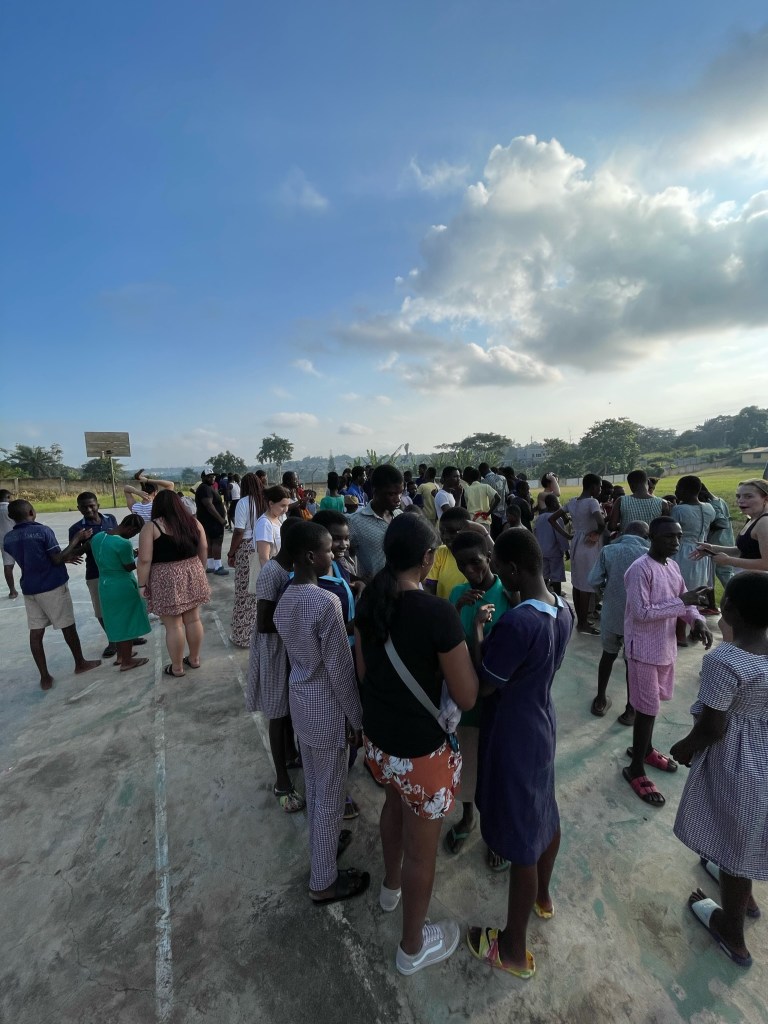
our students interacting with the Deaf students

One of my favorite visits during the program is our trip to the Demonstration School for the Deaf. As an American Sign Language minor, it was such a mutually beneficial experience to interact with the Deaf students. We were able to have full conversations with one another because much of Ghanaian Sign Language is based off of ASL. About 0.4% of Ghana’s population is deaf and there are many forms of indigenous sign language used around the country. However, there is no formalized sign language policy in Ghana, which makes it extremely difficult for Deaf schools to receive funding or services for Deaf students. For many of our students, this was their first time engaging with a fully Deaf community. This trip is an amazing way to learn about Deaf stigma while also learning some sign language in Ghana! It’s also a great reminder that there are so many ways to overcome language barriers through games, dancing, and playing sports.
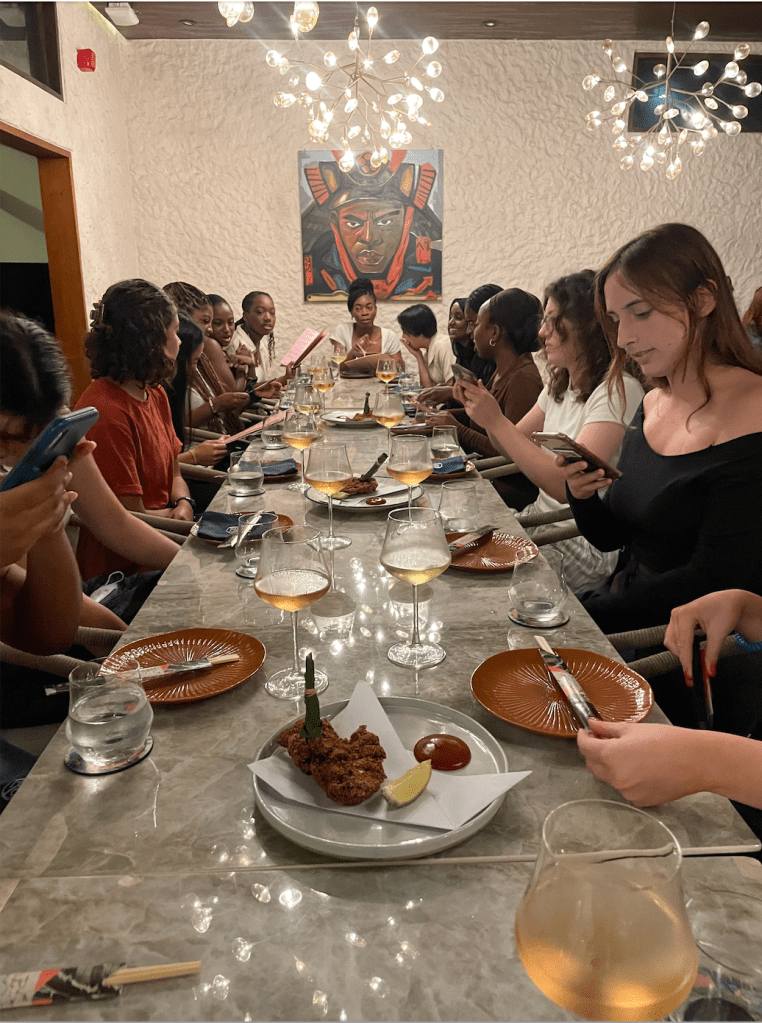
our delicious dinner at Kozo

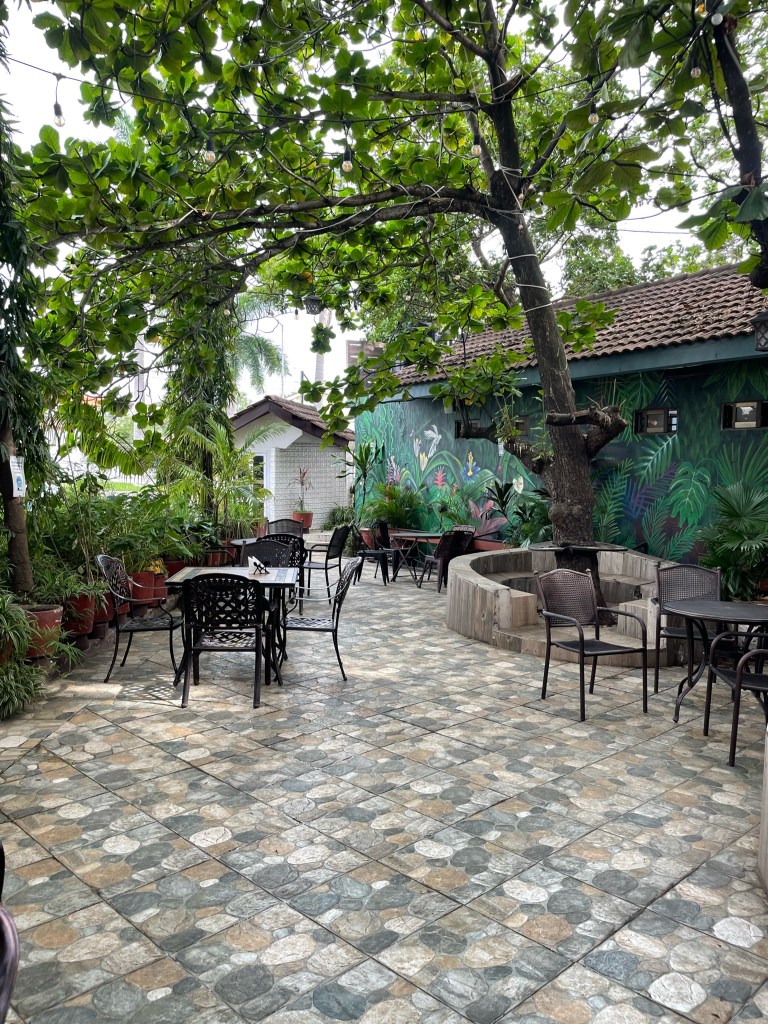
For one of our group dinners, we had the opportunity to go to Kozo, a restaurant serving Afro-Asian fusion cuisine. Funny enough, the restaurant was started by a Northeastern University alumni, who was kind enough to host our group! The food was unbelievably delicious and such a unique spin on traditional African and traditional Asian food. The restaurant had such a cool atmosphere as well and it was one of the best dinners we had in Ghana!

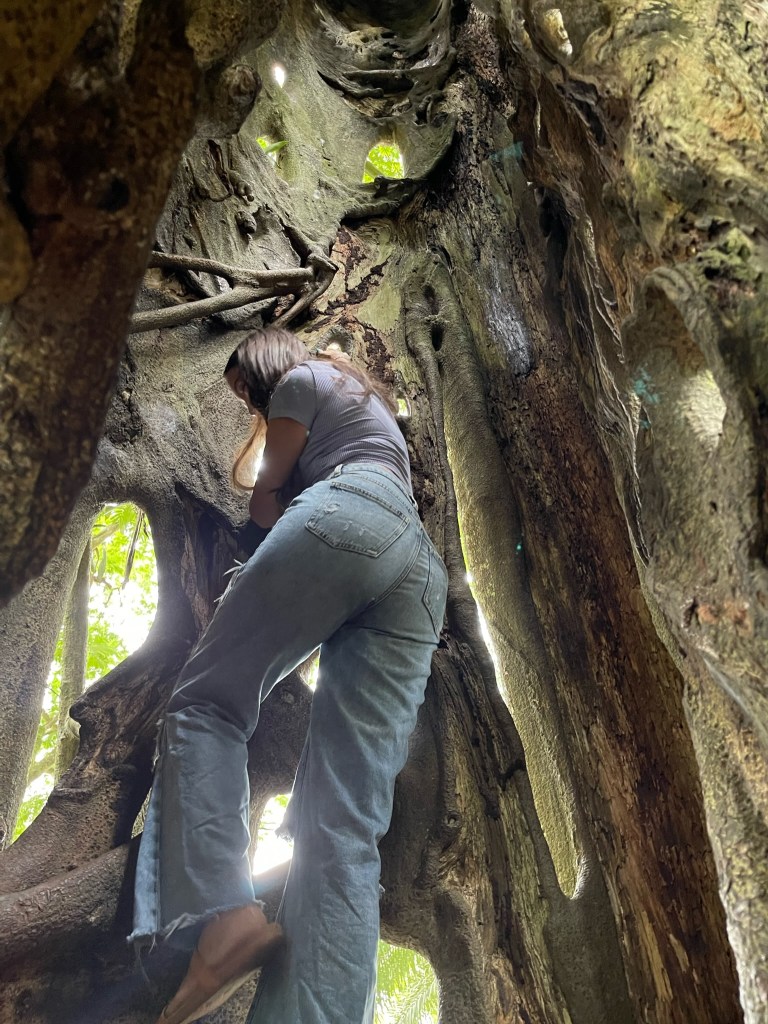
The Aburi Botanical Gardens are a popular attraction in Accra, located on a mountain in the north. This area is over 160 acres wide and is a garden with a variety of unique plants, trees, and species native to Ghana. One of the most unique phenomena are the trees that have been overcome by parasitic plants that have completely eaten away at the actual tree, leaving them hollow. You can even climb inside these hollow trees; they are so large! The gardens are filled with school groups and family picnics, making it such a beautiful, peaceful communal space for visitors.

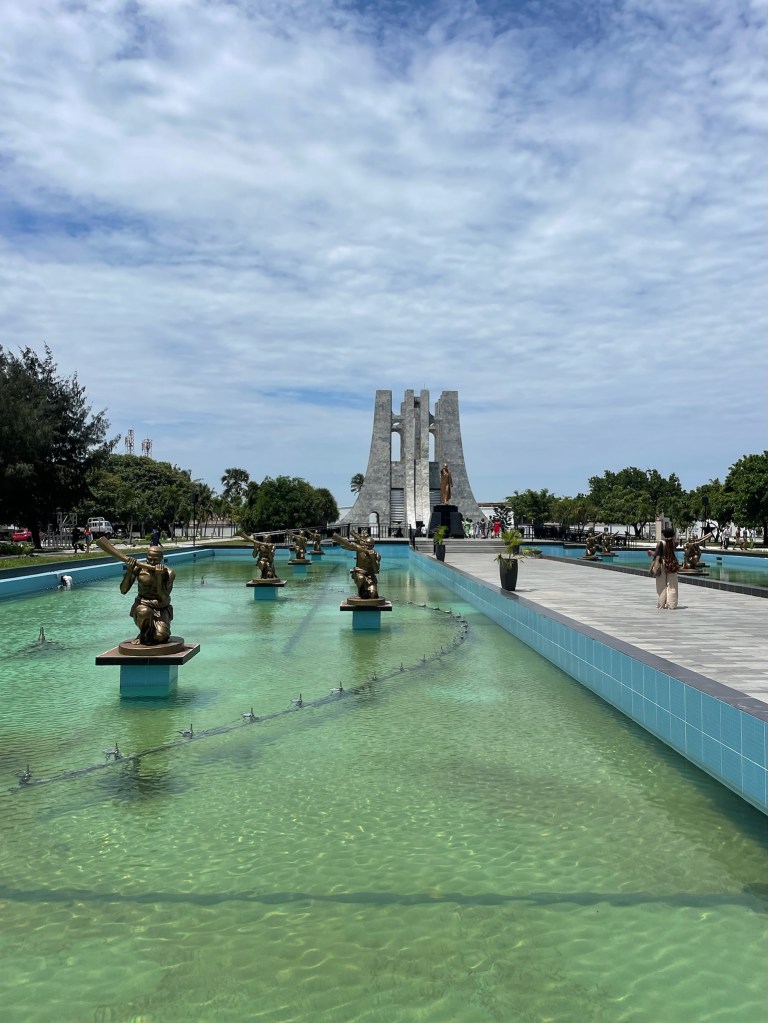
part of the memorial site

This year, our group was finally able to visit the Kwame Nkrumah Memorial Park, which is a museum and mausoleum for Dr. Kwame Nkrumah, the first president of Ghana. Kwame Nkrumah led the Gold Coast to independence from Britain in 1957 and was a remarkable fighter for Pan-Africanism and decolonization. He was instrumental in African international relations and led Ghana to play a leading role in other African countries receiving their independence from European powers. He believed that “the independence of Ghana is meaningless unless it is linked up with the total liberation of Africa”.
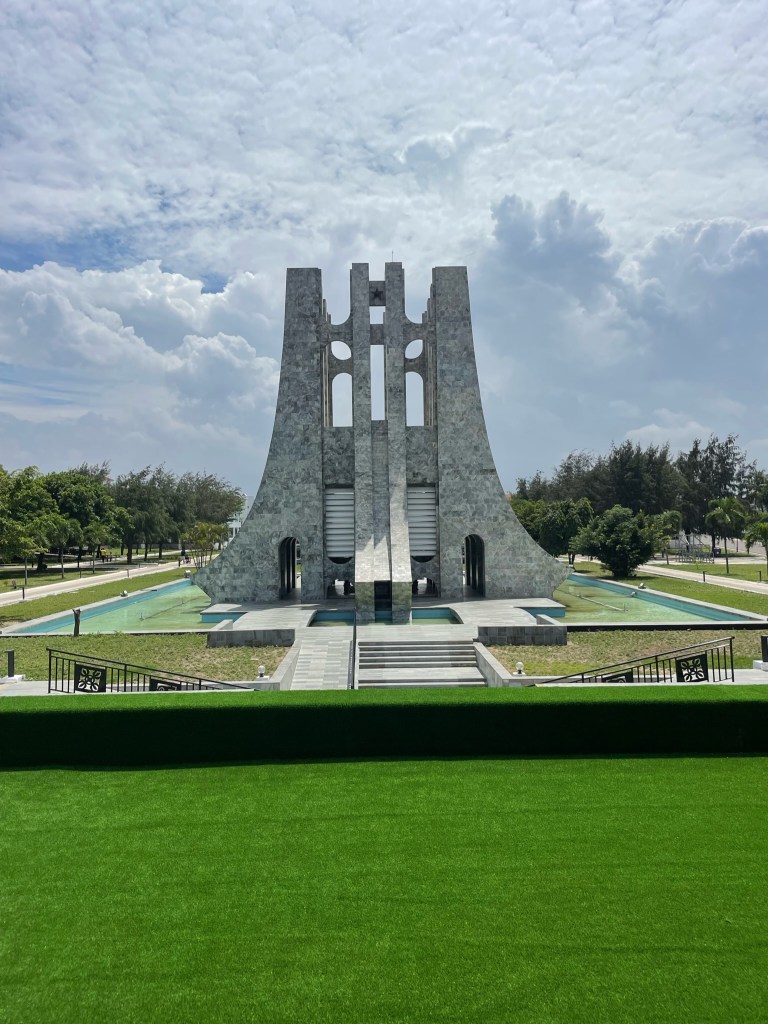
Kwame Nkrumah’s mausoleum

His mausoleum was built as an upside-down Akan symbol of peace and is surrounded by water, the symbol of life. It also looks like an upside-down tree, symbolizing the unfinished works of Kwame Nkrumah. The museum was extremely informational and taught us so much about Kwame Nkrumah’s life and his contributions to Ghana in political, economic, social, cultural, and historical spheres. One of my favorite quotes from Kwame Nkrumah is: “Those who would judge us merely by the heights we have achieved would do well to remember the depths from which we started”. This quote still feels so relevant to this day. Many people still have preconceived judgments about African countries in comparison to Western regions of the world. However, so many of the issues in these regions are a direct result from European colonization which have underdeveloped African society in many different contexts. This history is complicated, but visits to sites like this are a great reminder of how Ghana and Africa’s progress in uniting to overcome those challenges. I really admire Nkrumah’s fight for independence, rights, and justice in Ghana and his efforts to unite Africa during the decolonization period.
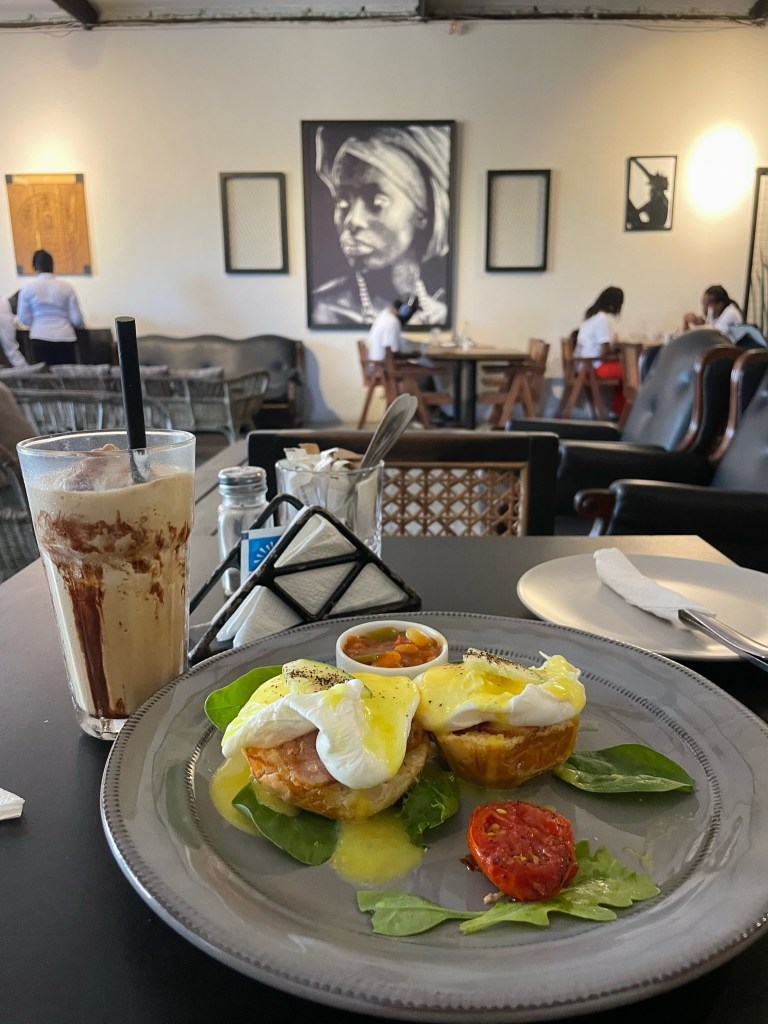
delicious breakfast at Jamestown

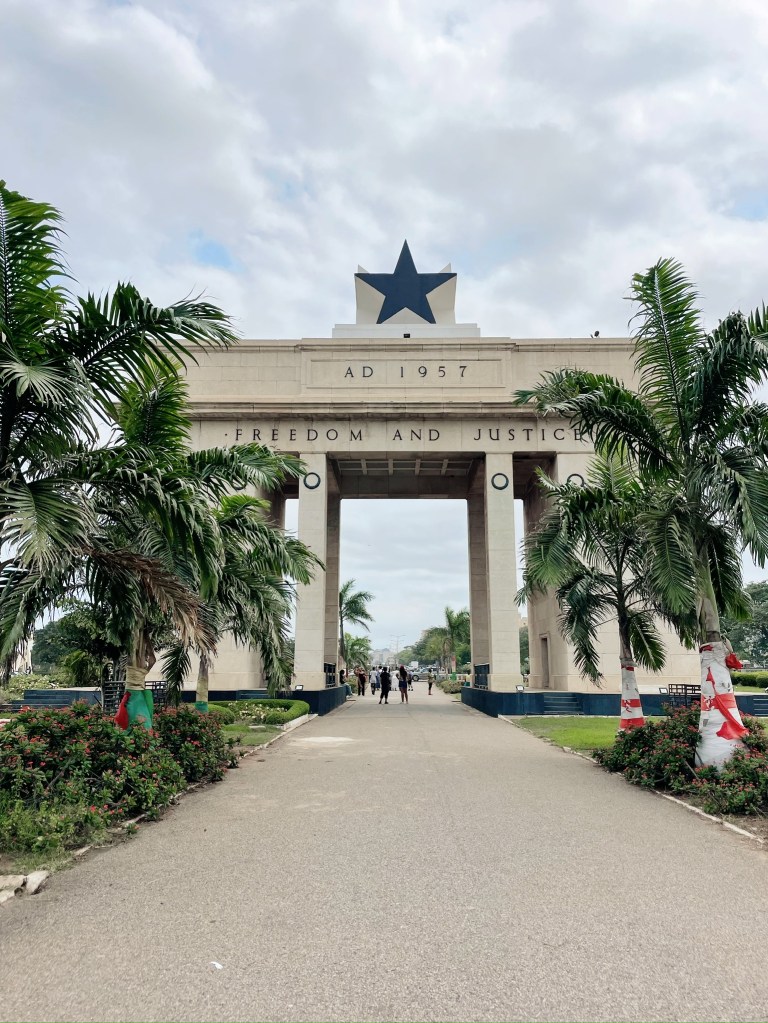
This year as a TA, I had a few days off, where I was able to go off on my own and explore the city! This was such a nice break from the trip and a nice opportunity to explore new areas. On my off-day, I had breakfast and coffee at Jamestown Coffee Roasters, a super cute café. I had the most delicious eggs benedict which I had been craving for so long! I then walked to the beach and sat for a while, enjoying the peacefulness by the water. After, I visited the Black Star Gate located in the Independence Square of Accra. This landmark was commissioned by Kwame Nkrumah and is symbolic of Ghana’s power to control their own affairs. It has the inscription, “AD 1957” (the independence year) and “Freedom and Justice”. The Black Star is a popular symbol in Ghana for Pan-Africanism and anti-colonialism. I’ve only ever driven past the gate, so I was really excited to finally be there up-close and visit such a significant site of Ghana. For the rest of the day, I hopped around a few cafes to just sit and read. This was such a wonderful day of the trip, and I loved getting to explore Accra on my own for a bit.
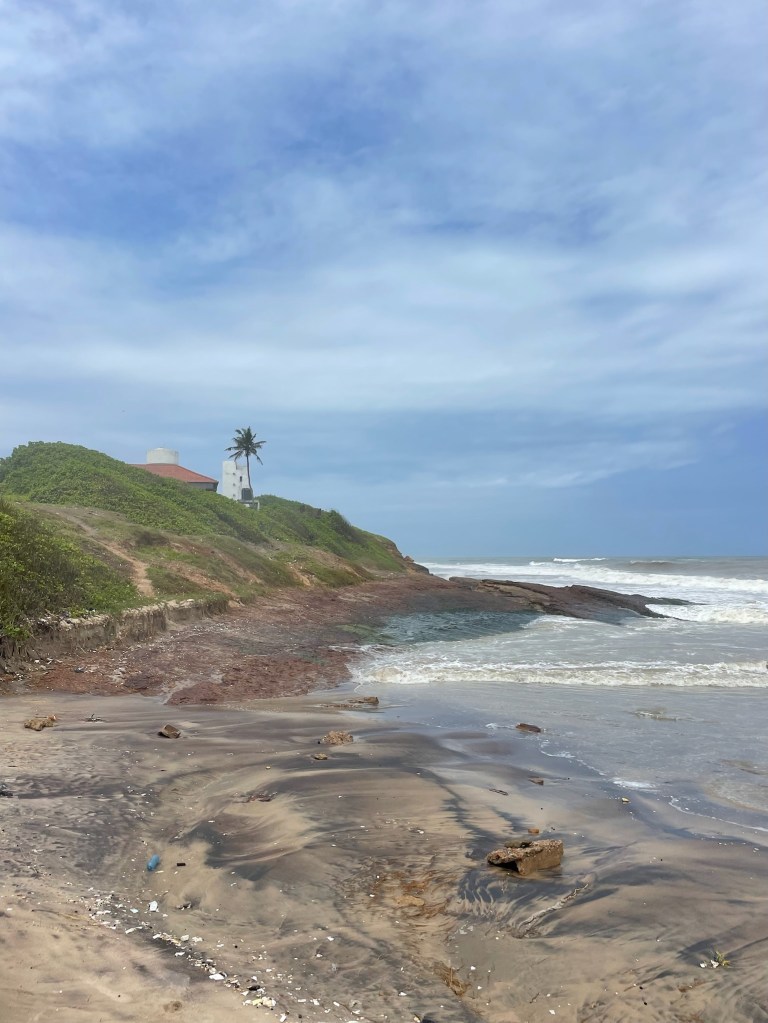
Bojo Beach

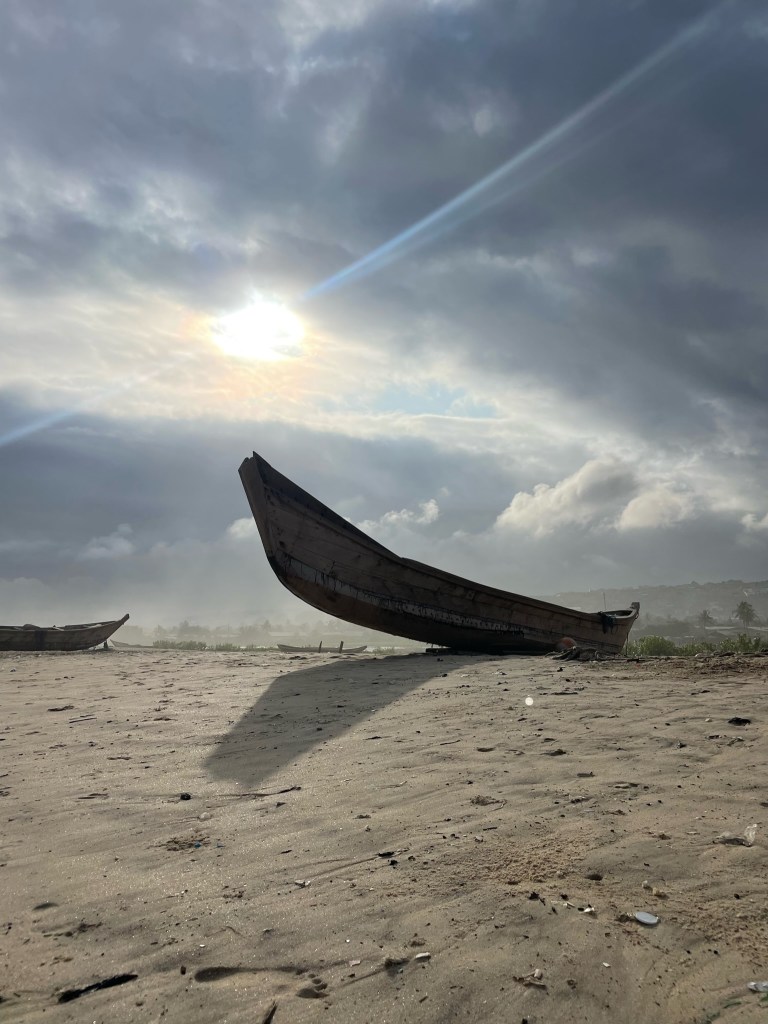
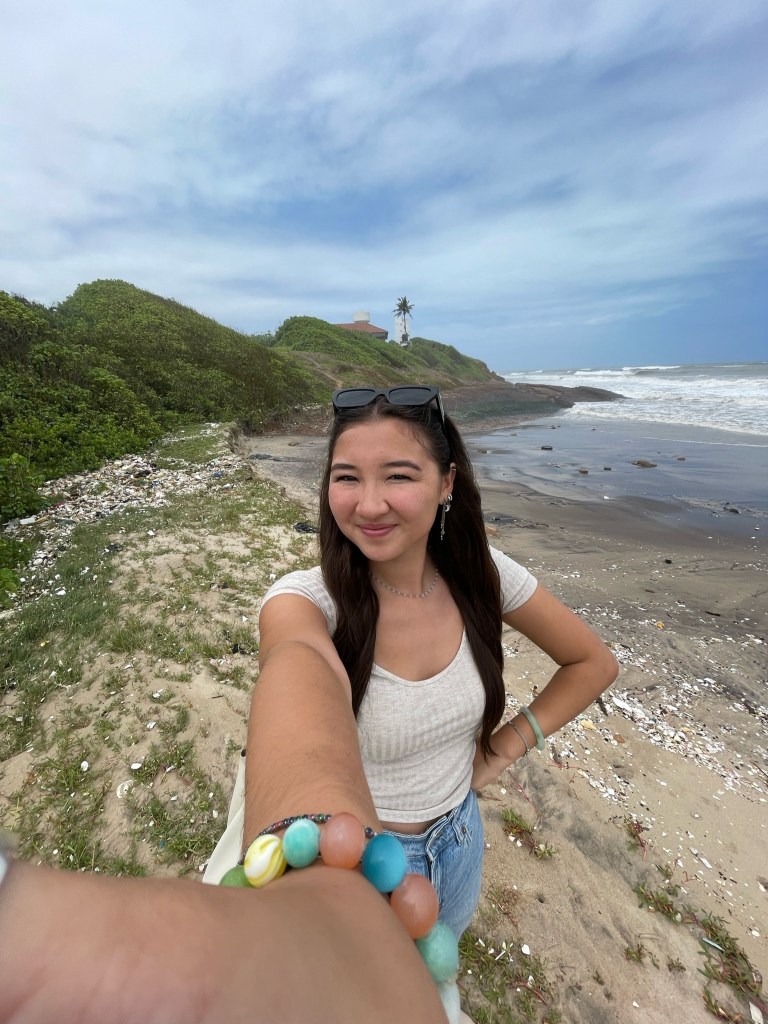
Another favorite day of the trip is our afternoon at Bojo Beach! From land, we take a small boat over to the actual beach. It’s so nice to spend time on the sand and by the water relaxing after the business of our program. The beach is lined with massive ships and its common to see horses running around. This year, it was a pretty cloudy day on our visit, but in past years, the sunset is absolutely beautiful over the water.
I am so grateful for the opportunity to have returned to Accra and return to so many familiar sites. Despite the familiarity, I was able to have so many new takeaways and return with new perspectives and knowledge. Ghana continues to fascinate me with its history and culture and never fails to reveal new insights and beauty to African life. Stay tuned for the rest of my trip in Kumasi, Cape Coast, and Winneba!
Petra to Wadi Rum: Jordan Part 2

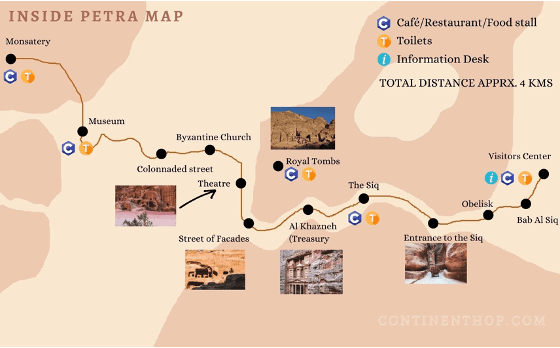
trail map of our Petra walk

Our Jordan travels from Amman and the Dead Sea continued as we arrived in Petra! Petra is a historic and archaeological city and one of Jordan’s most popular tourist attractions. In the 4th century, the Nabateans (an ancient Arab people group) flourished in Petra, massively developing the city. They established Petra as a major regional trading hub, became accustomed to living in desert and canyon caves, and were known for their advanced skills in harvesting rainwater, agriculture, and stone carving. Throughout the years, Petra fell into control of the Romans, was largely destroyed by an earthquake in 363, and was eventually abandoned. The city was “rediscovered” in 1812 and designated as a UNESCO World Heritage Site in 1985. In 2007, Petra was also named one of the 7 Wonders of the World
the entrance to Petra

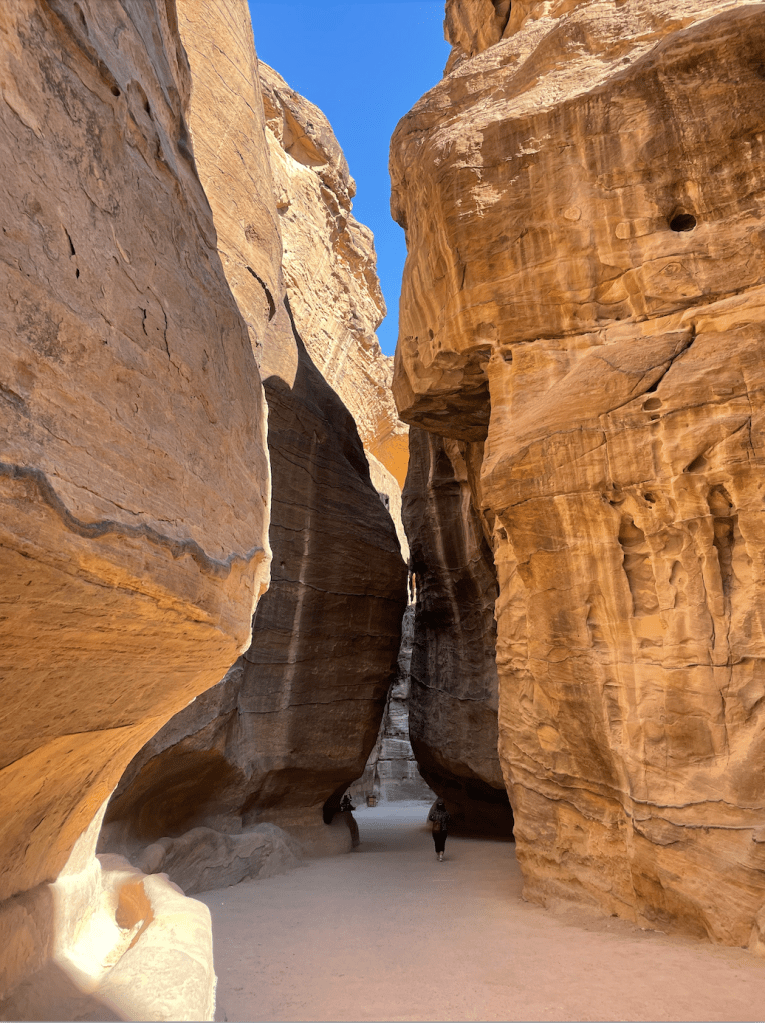
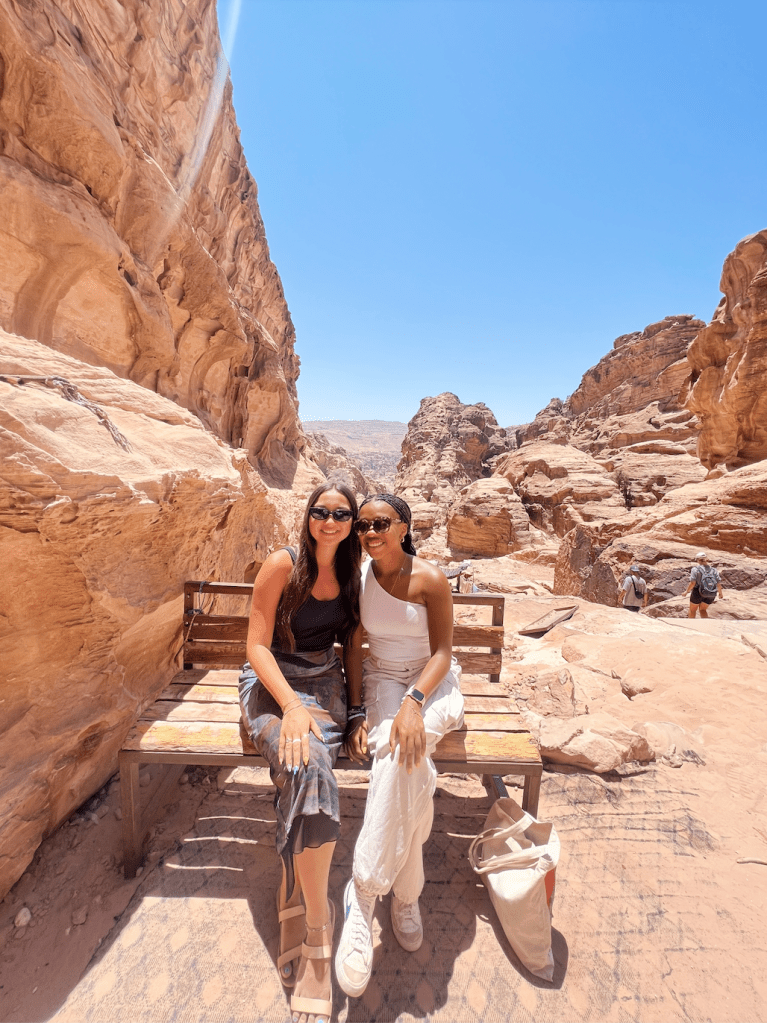
We stayed at a hotel right next to the main entrance of historical Petra, making it super easy to get around. We woke up early on our first morning to meet our tour guide and enter the city and beat some of the crowds. We started our trek walking through dirt roads and narrow passageways sandwiched between ginormous canyons. While the walk was long, it was amazing to stroll through such incredible rock structures. At some points, the gorge was no more than about 3 meters wide! I found it particularly fascinating that almost everywhere you looked were ruins of niches, carvings, tombs, statues, or aqueducts. It was super helpful to have a guide point out all of the unique sights since you certainly would miss them if you weren’t looking carefully.
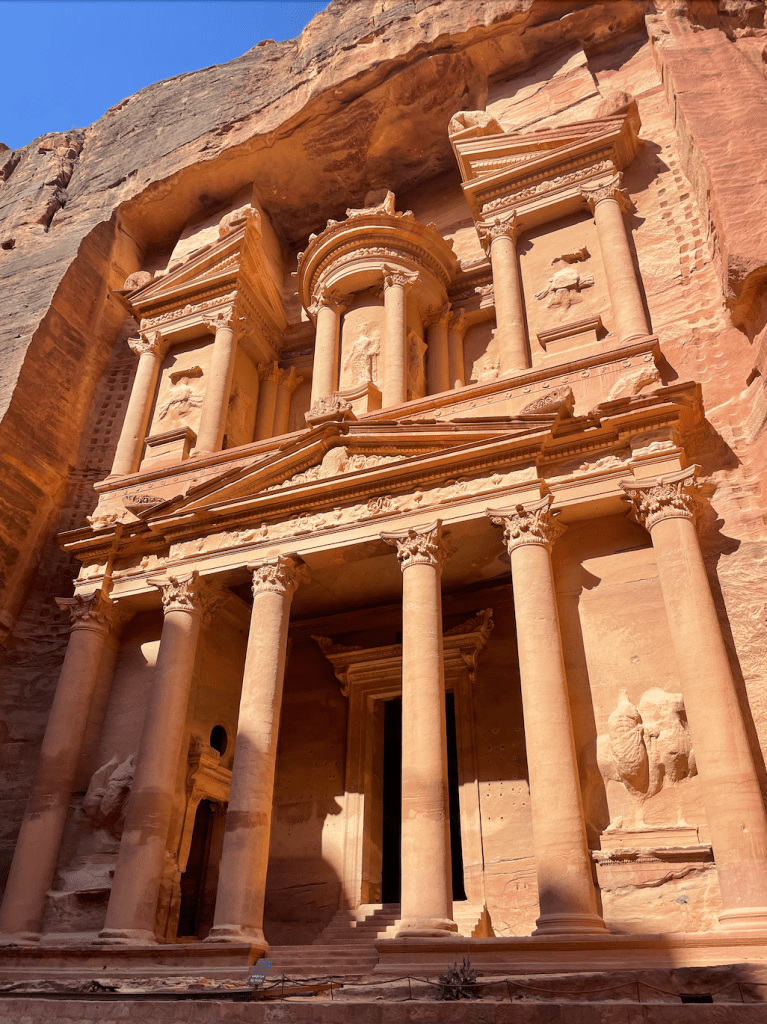
the Treasury

Finally, we reached the Siq, or the main entrance to the ancient Nabatean city. The narrow opening brought us to the most famous site: Al-Khazneh or The Treasury. The Treasury was built in the 1st century, carved out of sandstone rock face as a mausoleum for the ruling Nabatean King. Seeing the incredible detail, carvings, and sheer magnitude of the Treasury in person was unbelievable! It was amazing to see such an architectural feat that has been preserved for thousands of years right in front of us.

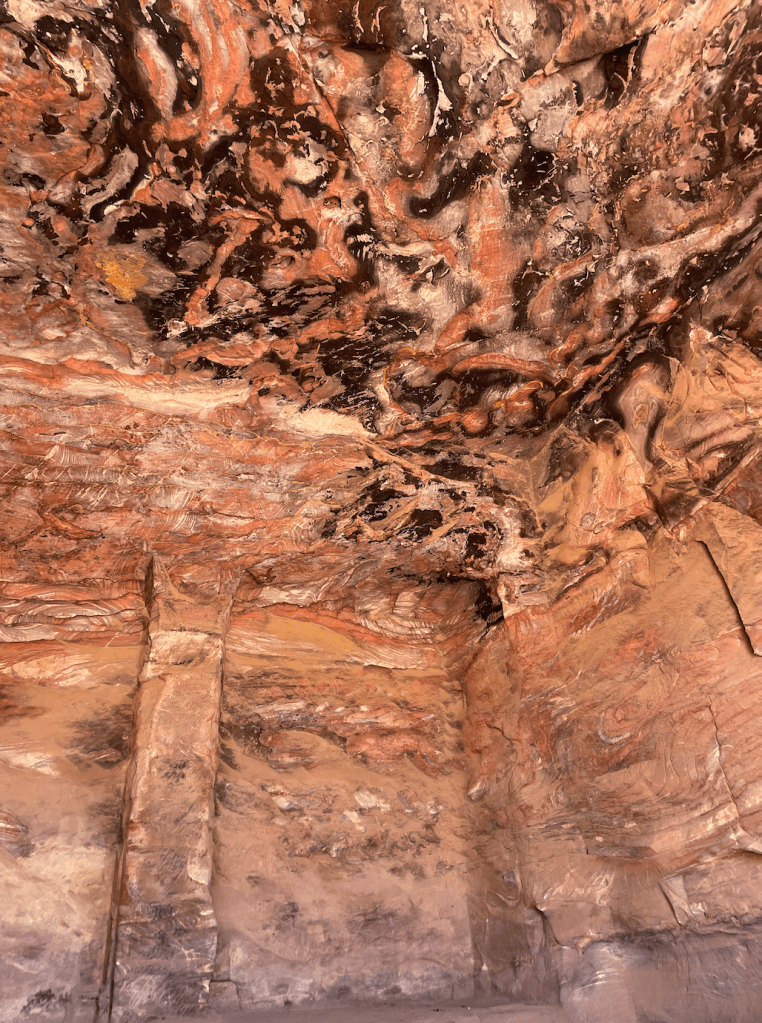
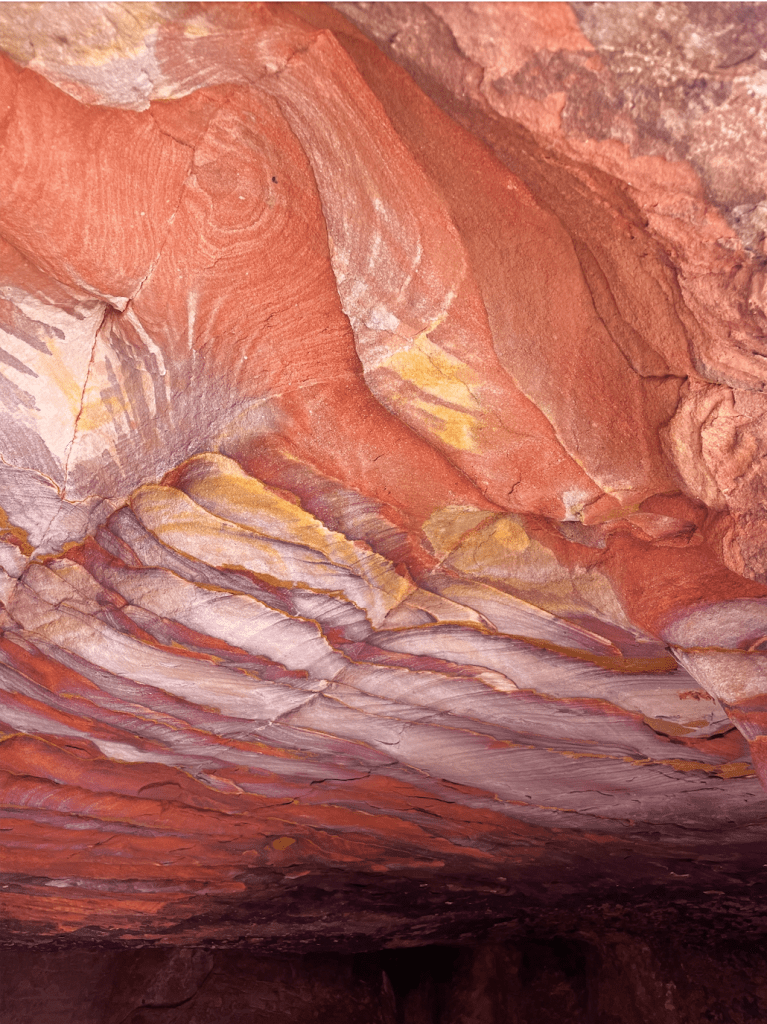
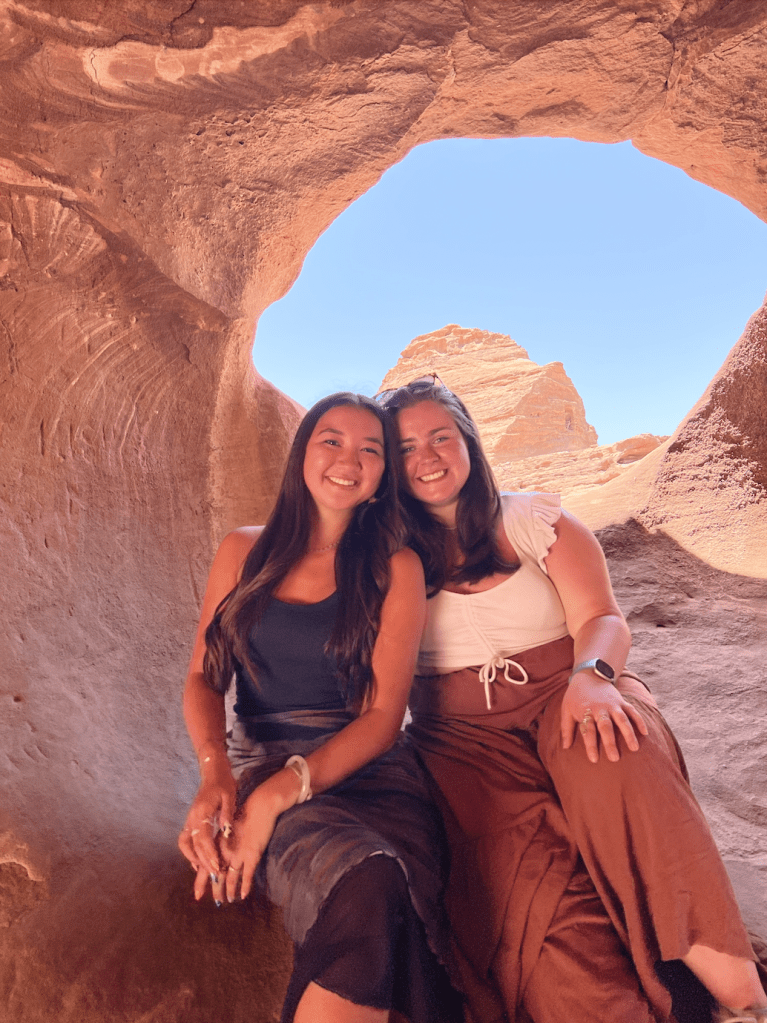
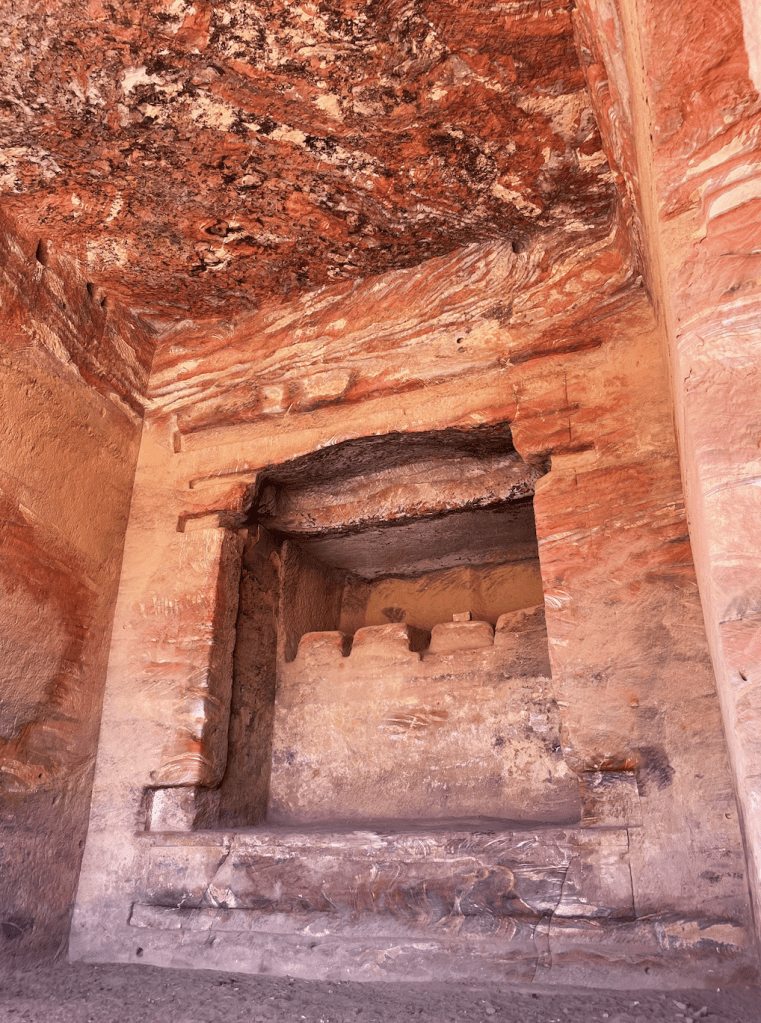
The area surrounding the Treasury was pretty chaotic with tourists, camels, and locals trying to entice you with rides and photos, so we moved on from the Treasury to explore the rest of Petra. Our guide took us down the main road, pointing out more unique caves and tombs, even taking us inside of a few. I was so surprised by the beautiful rock formations inside of the caves. Across the walls and ceilings, it looked as if the rock formations were flowing with bands of red, pink, yellow, and purple. It turns out that the Petra sandstone contains a mixed composition of quartz, feldspar, sulphur, iron oxide, and manganese, which causes the colorful variations. And the flowing designs were created by the flow of river water systems that deposited the sand minerals almost 500 million years ago. Crazy!

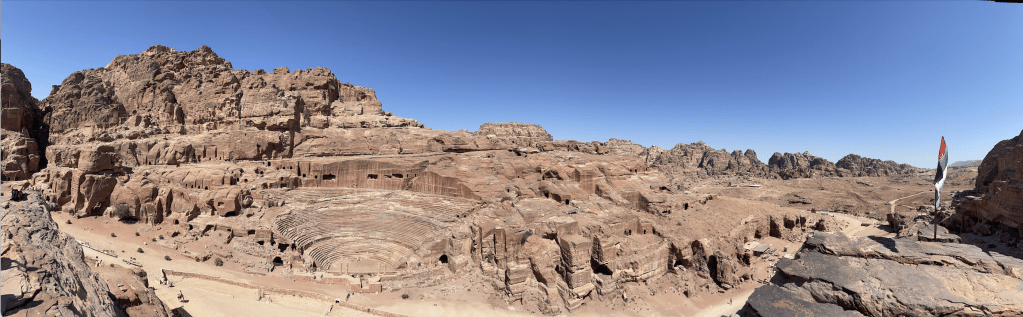
We continued walking through an area known as the Street of Facades, which led to the Theatre Necropolis. The theatre looked similar to the one we visited in Amman and holds around 8,500 people. Poetry readings, plays, and supposedly gladiator fights were held here. We took a slight detour to get a higher viewpoint of the street and theatre which involved a lot of climbing. The view was amazing and showcased the incredible craftsmanship of the Nabatean and Bedouin people.

overlooking the Street of Facades
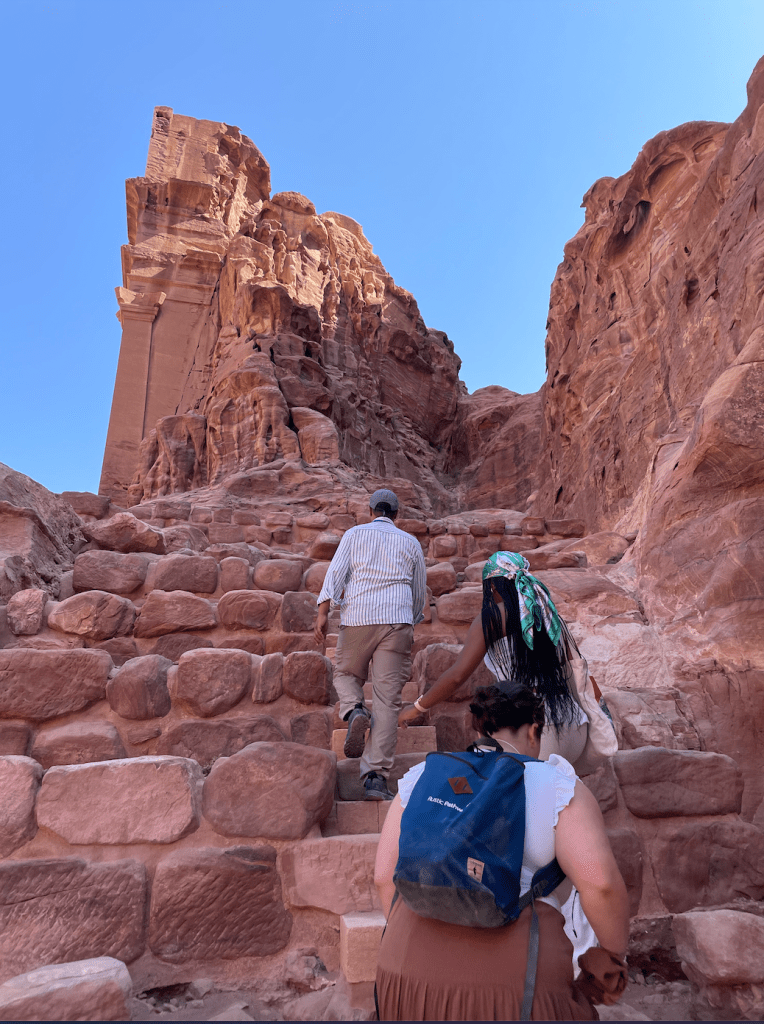
walking up to the Monastery

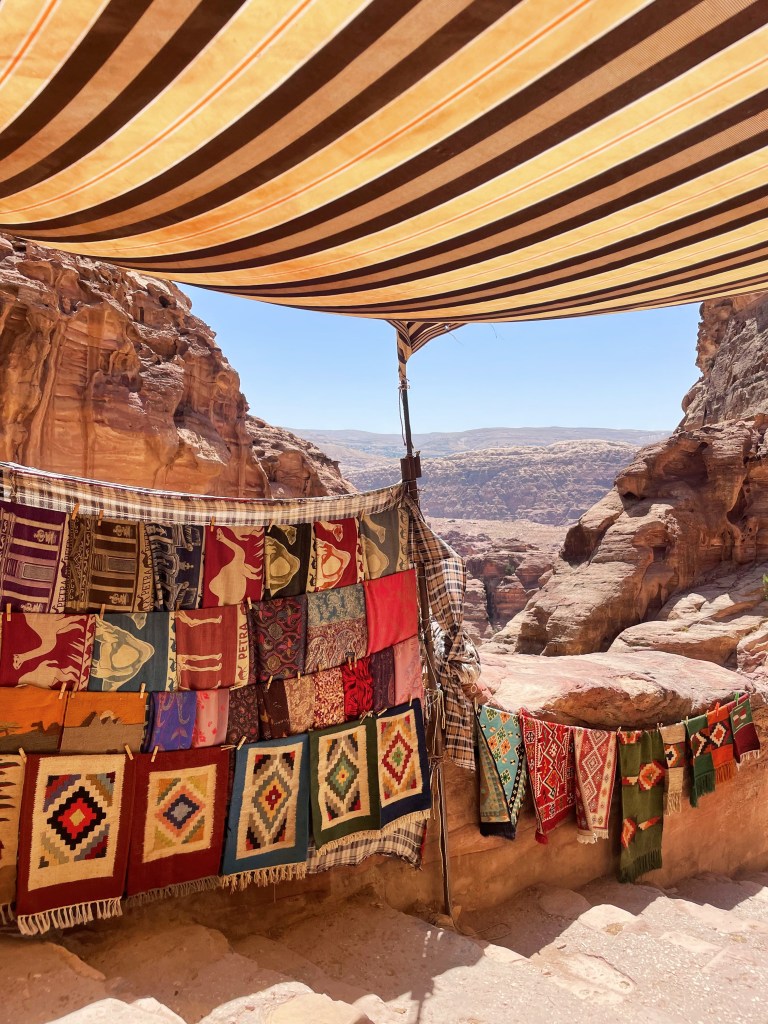
From this point, we said bye to our tour guide and continued exploring on our own. Our next trek was to Ad Deir or The Monastery. The walk up to the Monastery was more like a hike of 800 steps. I slightly underestimated how exhausting this walk up would be, as we were in the hot sun and the “stairs” were more like huge rocks to climb. Despite the workout, the view as we walked up to the Monastery was beautiful and there were lots of little shops on the way to look at.

Finally, we reached the Monastery which was 100% worth the hike! Located in the high hills and similar to the Treasury, the Monastery was cut out of a rock façade and used for various religious purposes. Personally, I liked this site the best because there wasn’t a ton of people around and the view was just as spectacular as the Treasury. I’m so glad we had pushed through the heat and exhaustion to make it up to this site.

After the long walk all the way back down to the base of Petra, we stopped for lunch and to rest our feet. We then got right back into exploring as we walked down the Colonnaded Street which used to be one of the main shopping streets of ancient Petra. At the end of the street was a Byzantine church and Petra’s Royal Tombs. The Royal Tombs are a series of huge mausoleums cared out of the base of a sandstone mountain. You can actually go inside a few of the tombs, and again, it was remarkable to see the beautiful, colorful rock formations.

found a donkey friend!

By this point, we had hit well over 20,000 steps in the hot sun, and I was unfortunately battling a bit of heat exhaustion. We made the long walk back to the entrance of Petra and our hotel, where we rested and packed up for the rest of the night. This day was truly a highlight within our entire trip! I’m so grateful to have been able to experience to such an architecturally, historically, and culturally rich city that has withstood years of occupation and natural disaster.

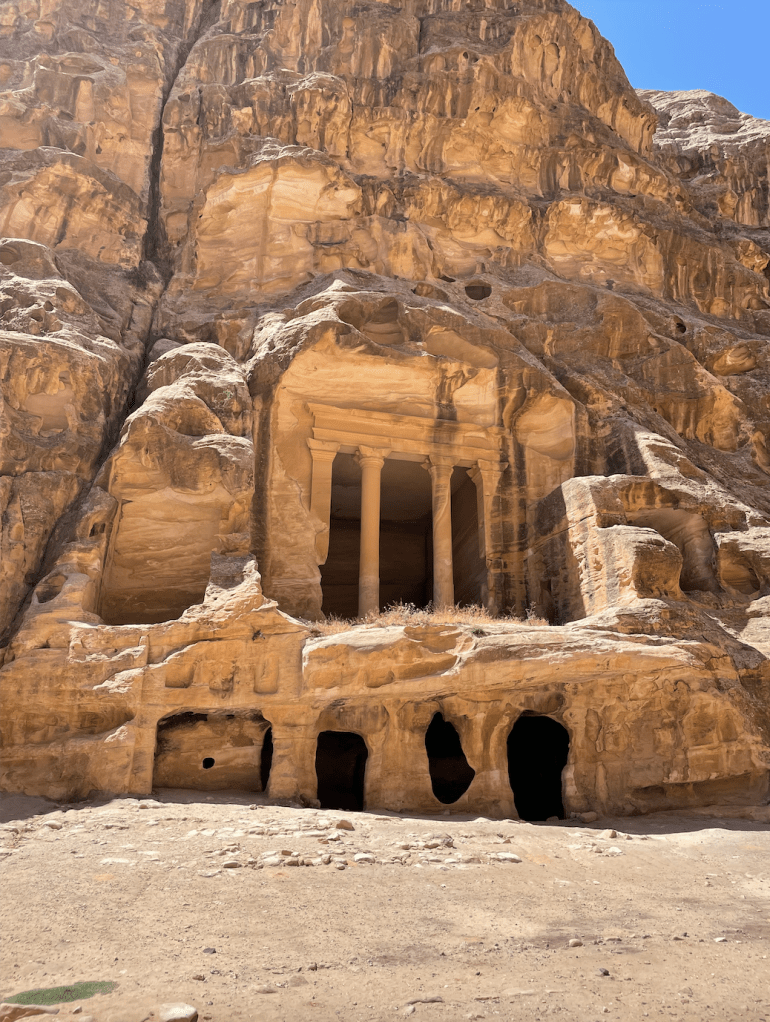
Little Petra tombs

The next day, we packed up and drove to Little Petra. Little Petra is also a Nabatean city with buildings carved into sandstone facades, however it is much smaller than the main city area of Petra. We briefly walked around here in the morning exploring more of the tombs and caves.

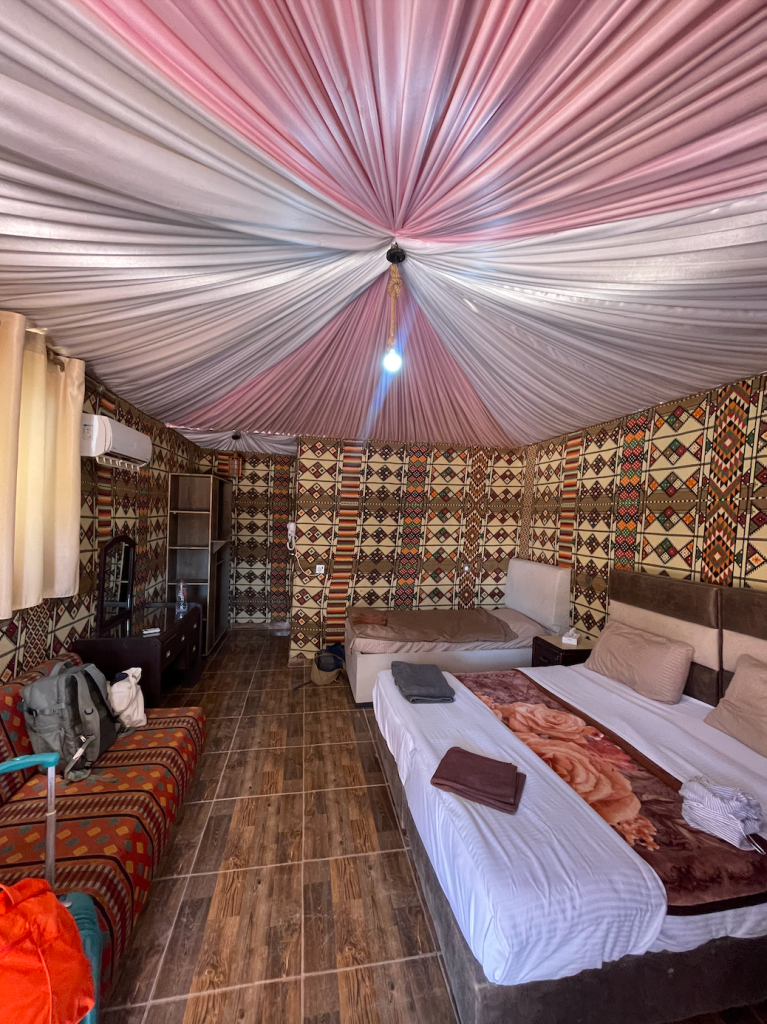
our tent at Hasan Zawaideh camp

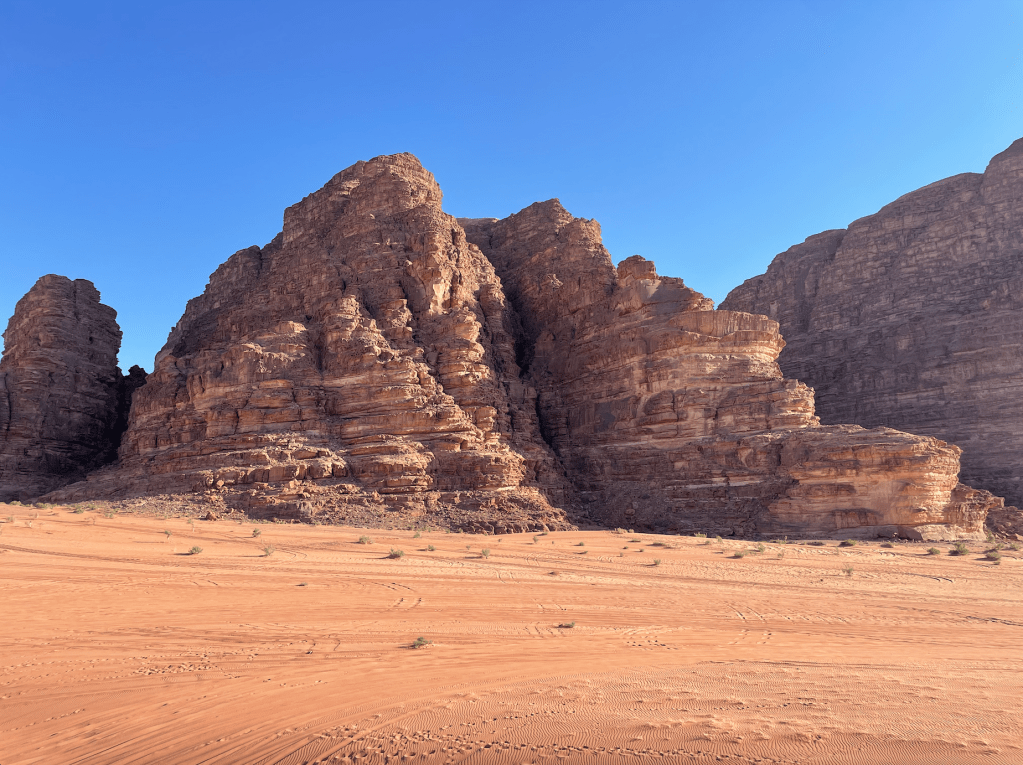
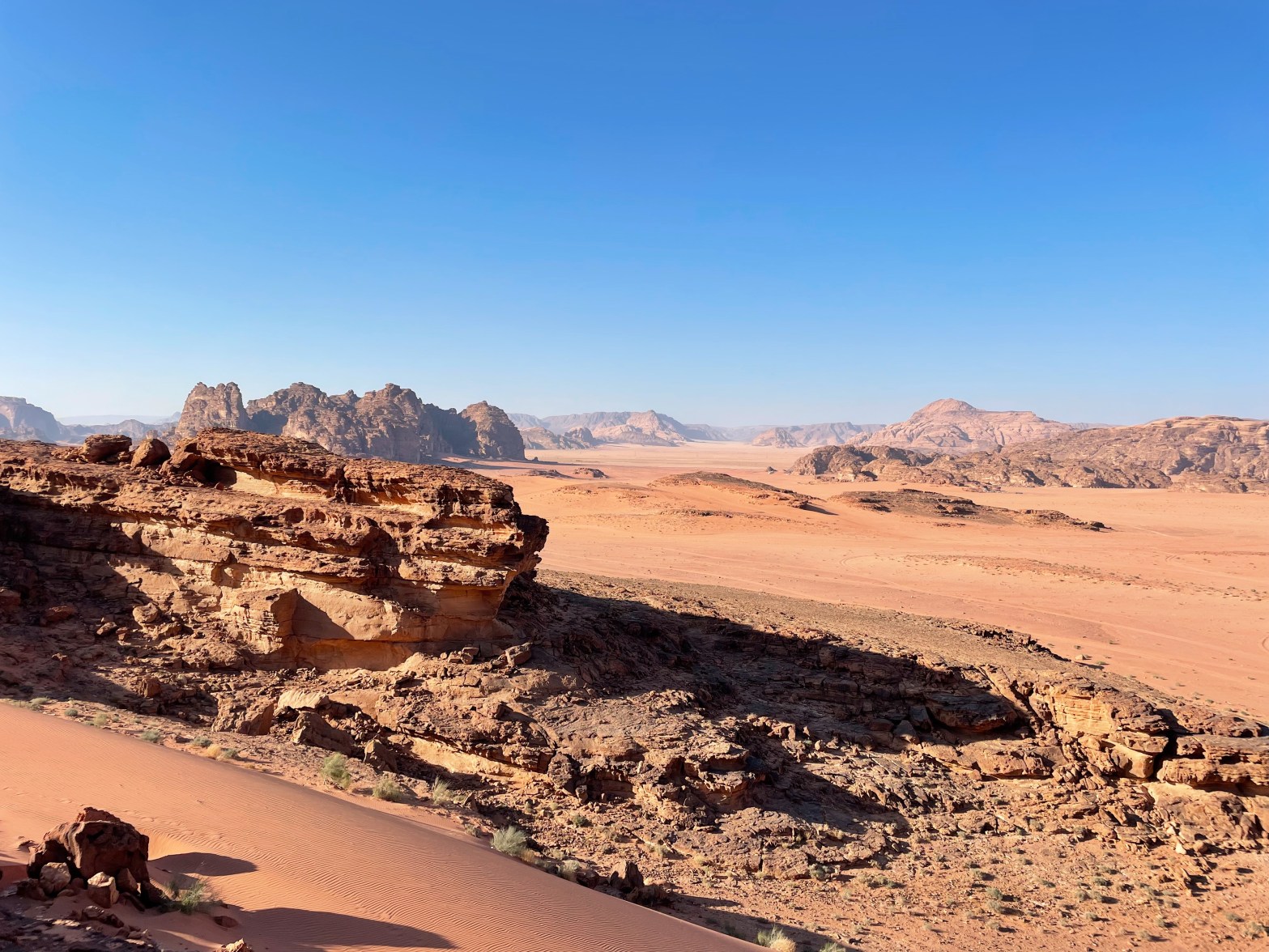
In the afternoon we headed to the desert, better known as Wadi Rum! Jada, Annie, and I had all been thoroughly looking forward to experiencing a night here! Wadi Rum is a protected area and a UNESCO World Heritage site with prehistoric civilization tours, hiking, rock climbing, and camping experiences. Wadi Rum is also the filming site for many popular movies such as The Martian, Dune, Star Wars, Transformers, John Wick, and more! We arrived at the Hasan Zawaideh Camp, located in the red dune area of Wadi Rum. Our tent was MUCH nicer than we anticipated, complete with two beds, a bathroom, and even air conditioning. We were glamping for sure!

beautiful views from the jeep tour

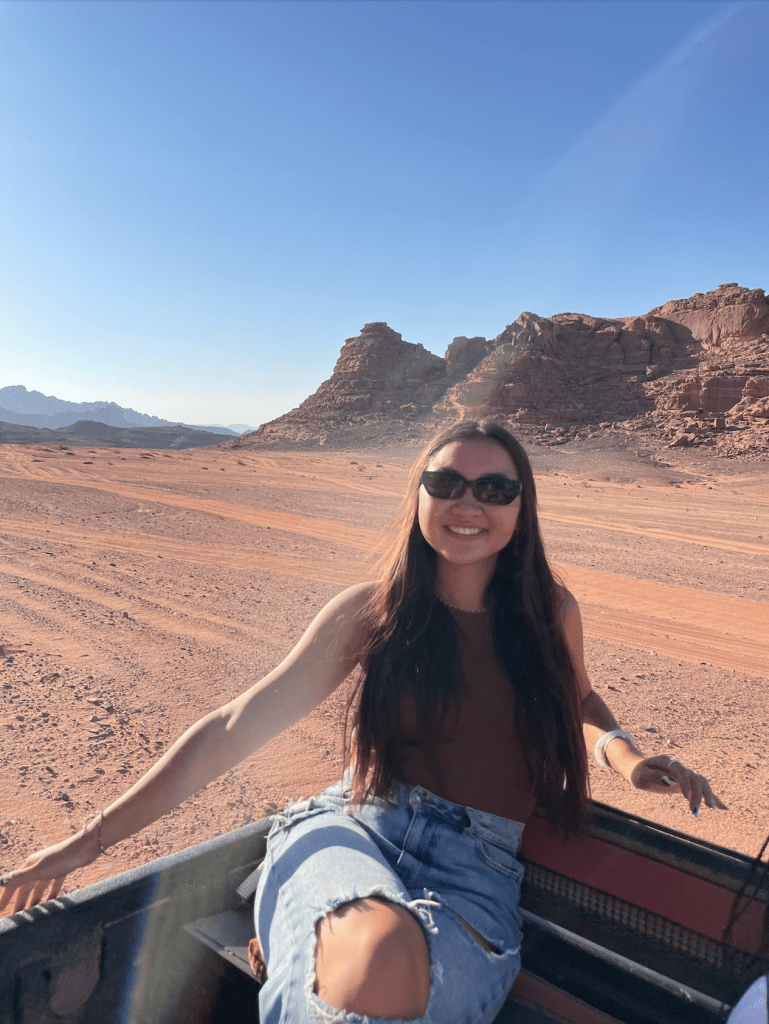
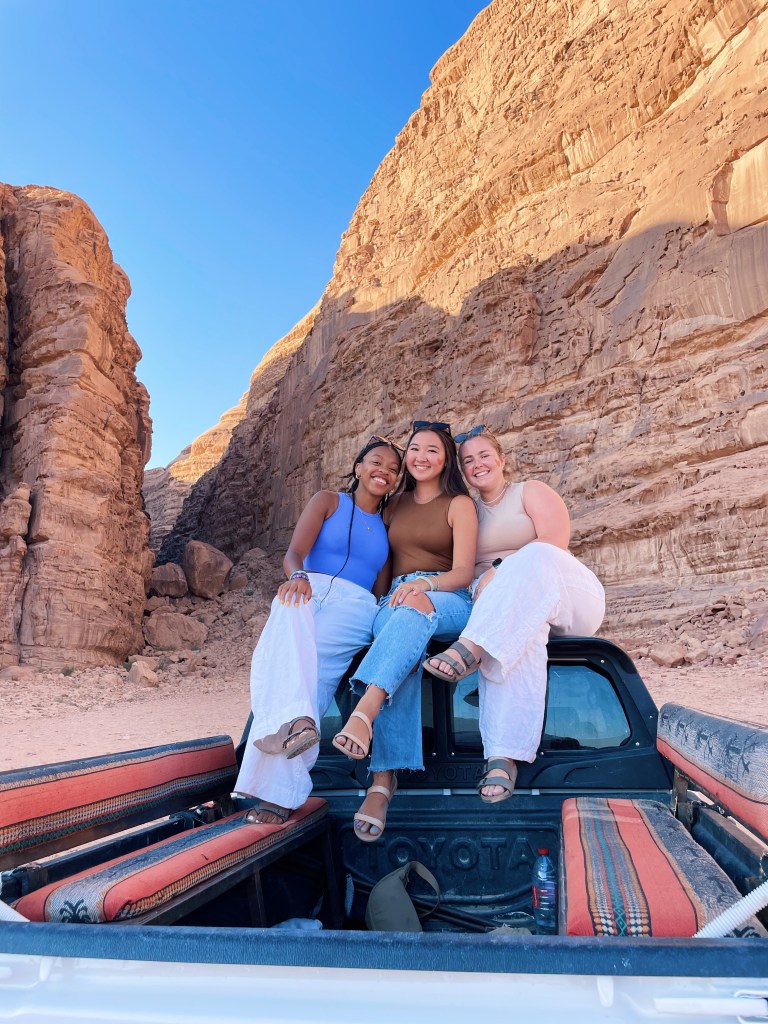
In the late afternoon, we headed out for a two hour jeep tour around the desert. We had an absolute BLAST riding on the back of pickup truck through canyons, sand dunes, and desert roads. We went so fast at certain points that it felt like we were on a rollercoaster!

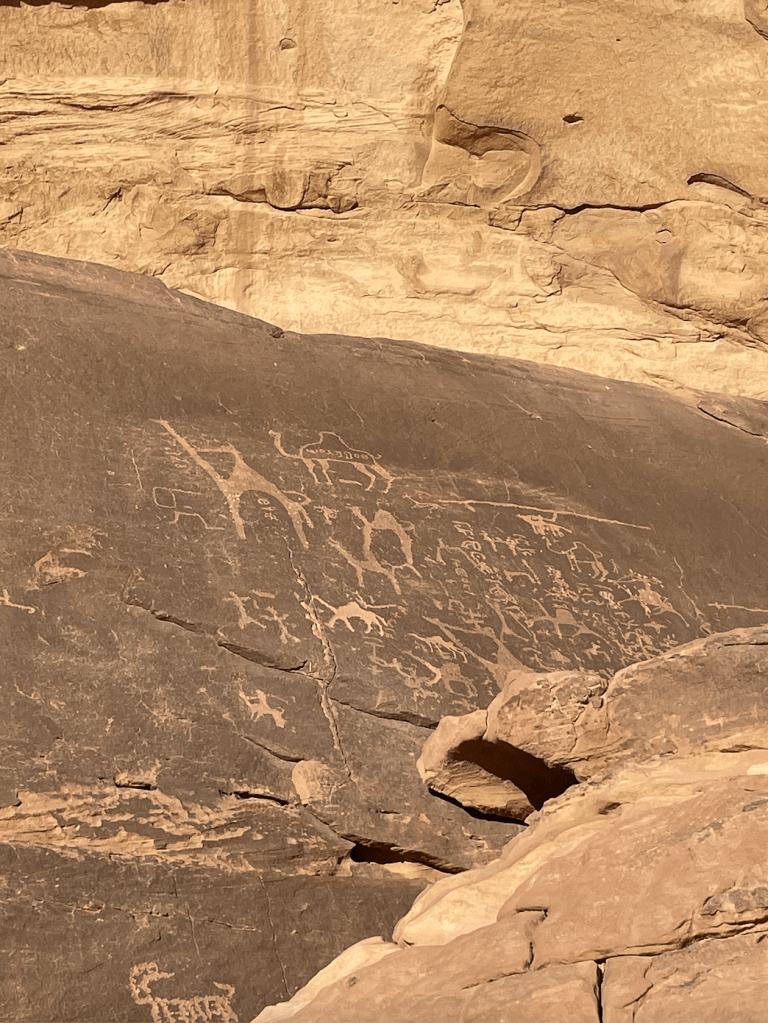
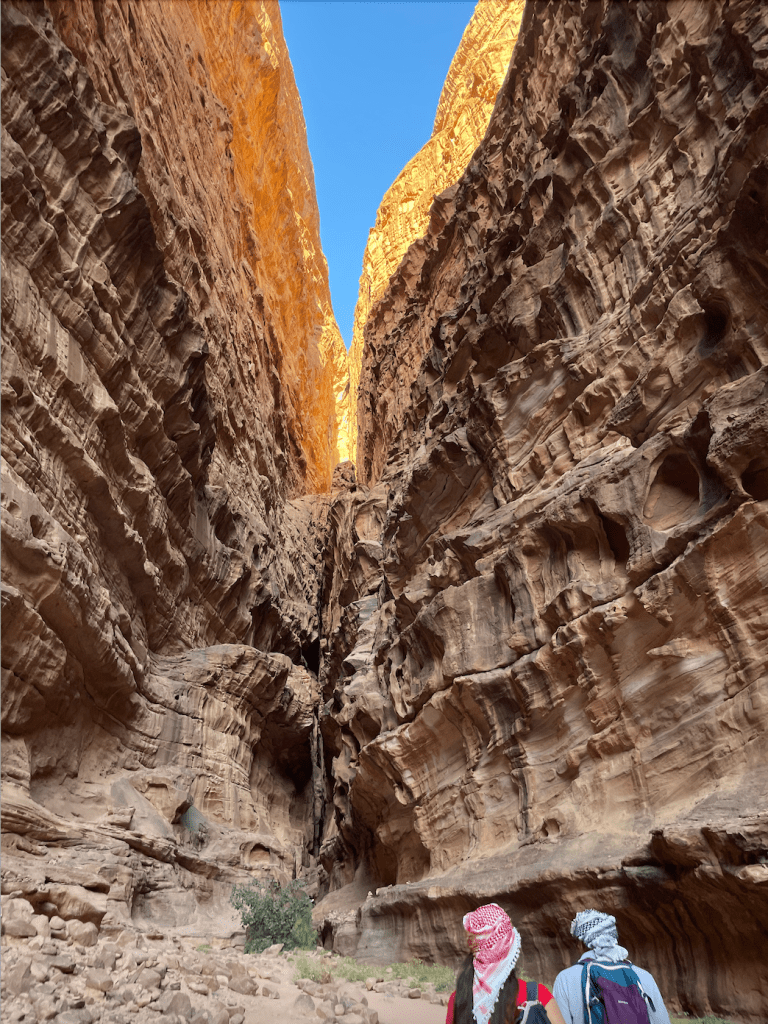
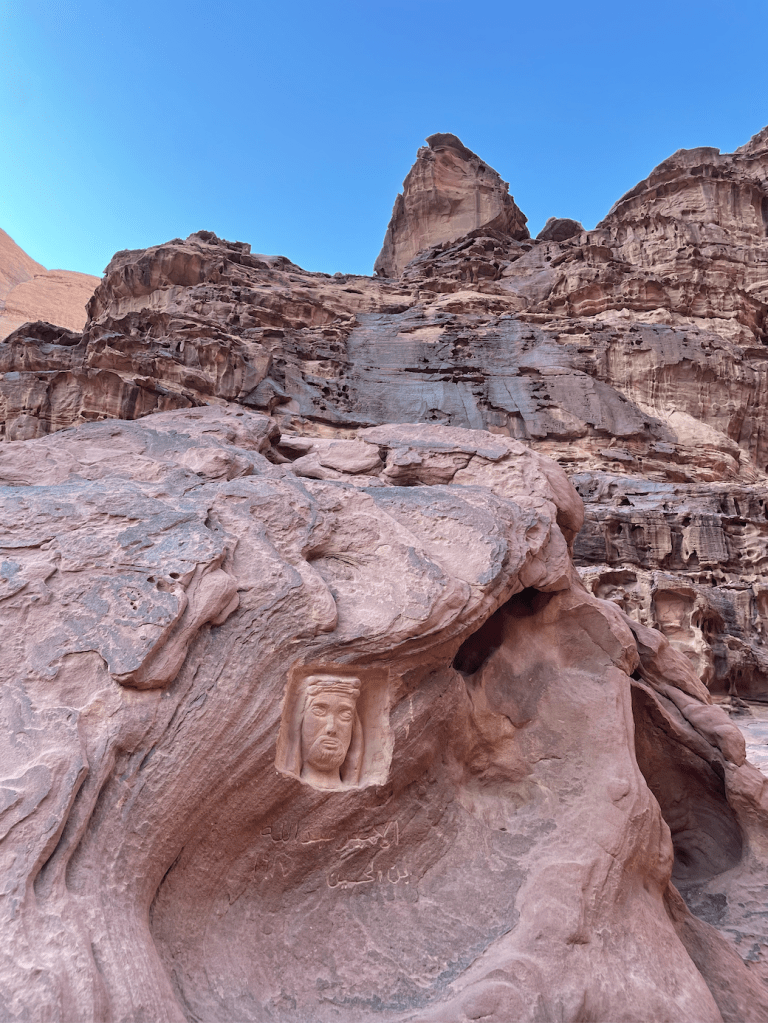
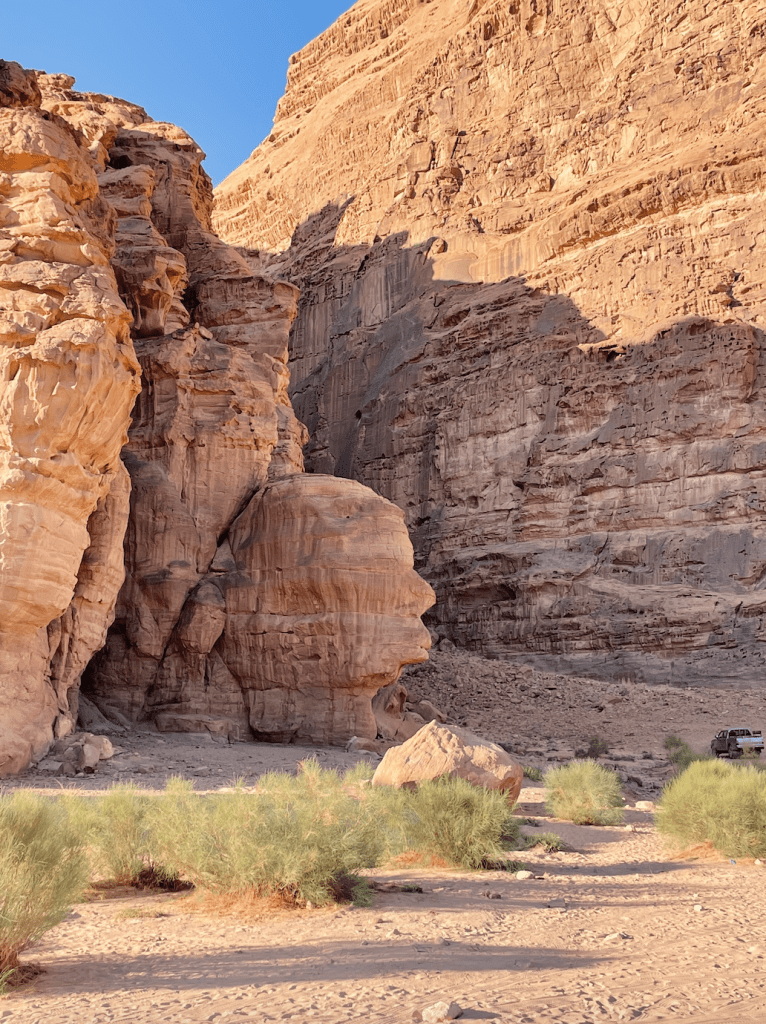
Throughout our tour we made a few different stops. First, we arrived at a huge sand dune which we ran up to see the amazing view from the top. It was so surreal to be completely surrounded by miles and miles of sand and desert environment. From there we drove to the Alameleh Inscriptions, 2000 year old carvings that depict a group of camels travelling north. Seeing such prehistoric inscriptions was absolutely mind blowing to me and a cool reminder of the Bedouin people who have lived here throughout so much time. Next, we were driven to Siq Um al Tawaqi, a narrow canyon with red sandstone cliffs and white sand dunes. Included in this area are inscriptions of Lawrence of Arabia and Prince Faisal as well as a tea house where we stopped for a drink. Our jeep driver did a great job of showing us around and pointing out all of the unique rock formations, such as one that looked remarkably like a face!

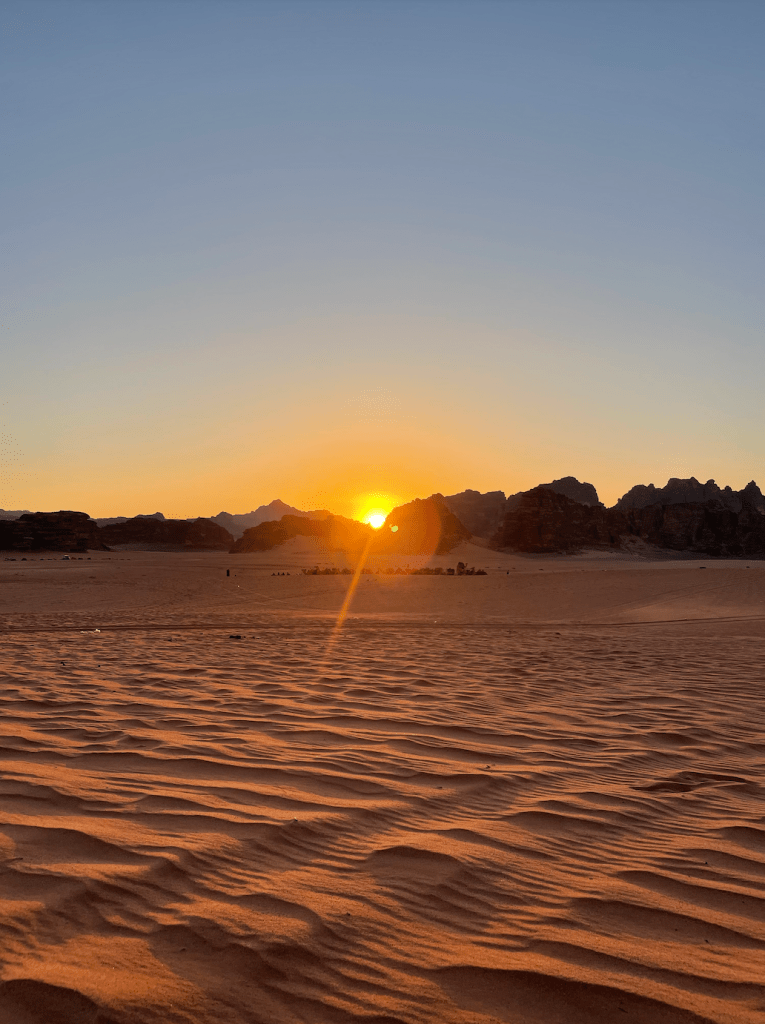
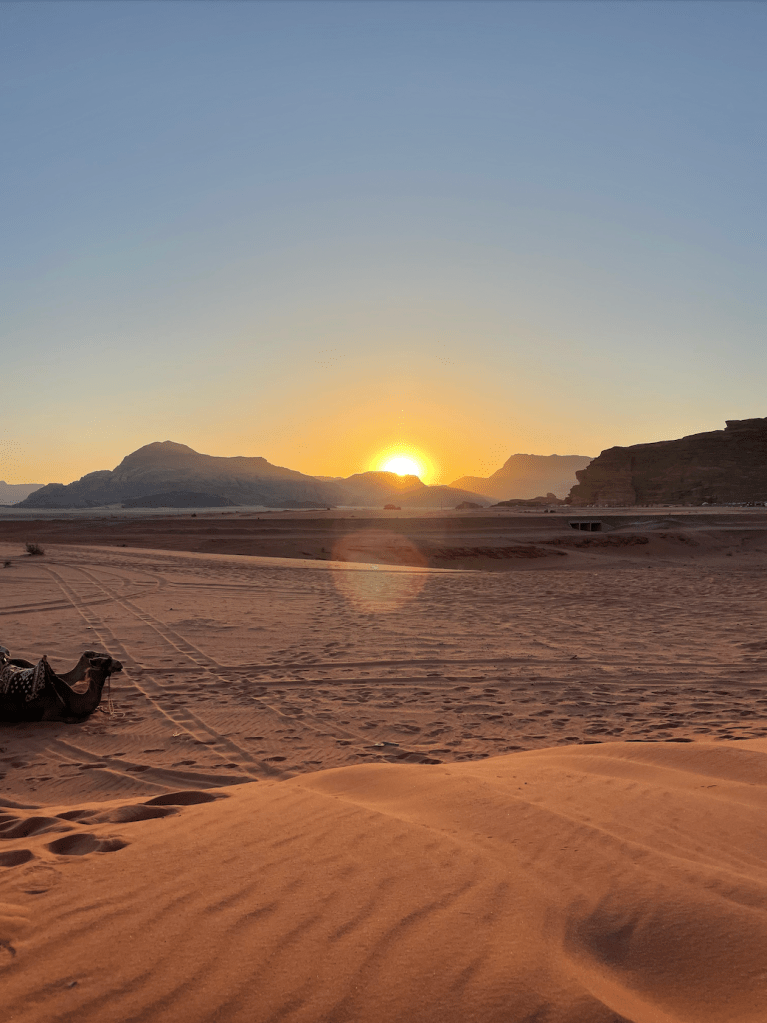
beautiful sunset over Wadi Rum

Finally, we drove to a quiet, sandy area to watch the sunset. This was such a relaxing way to end the day and reflect on the busy week we had just had. The view felt very peaceful as we watched the sun fall below the mountains, sand dunes, and groups of camels.

preparing the zarb

Once it was dark, we headed back to our camp for dinner. Our camp prepared a traditional Bedouin meal called zarb. To prepare this meal, lamb, goat, chicken, and vegetables are cooked underground in a cylindrical oven buried underneath the ground. This allows the meat and vegetables to slowly cook and for all of the rich flavors to blend. We got to watch as they pulled the meat from the ground which was such a neat experience. All of the food at the camp was delicious, with the meat in particular being my favorite.

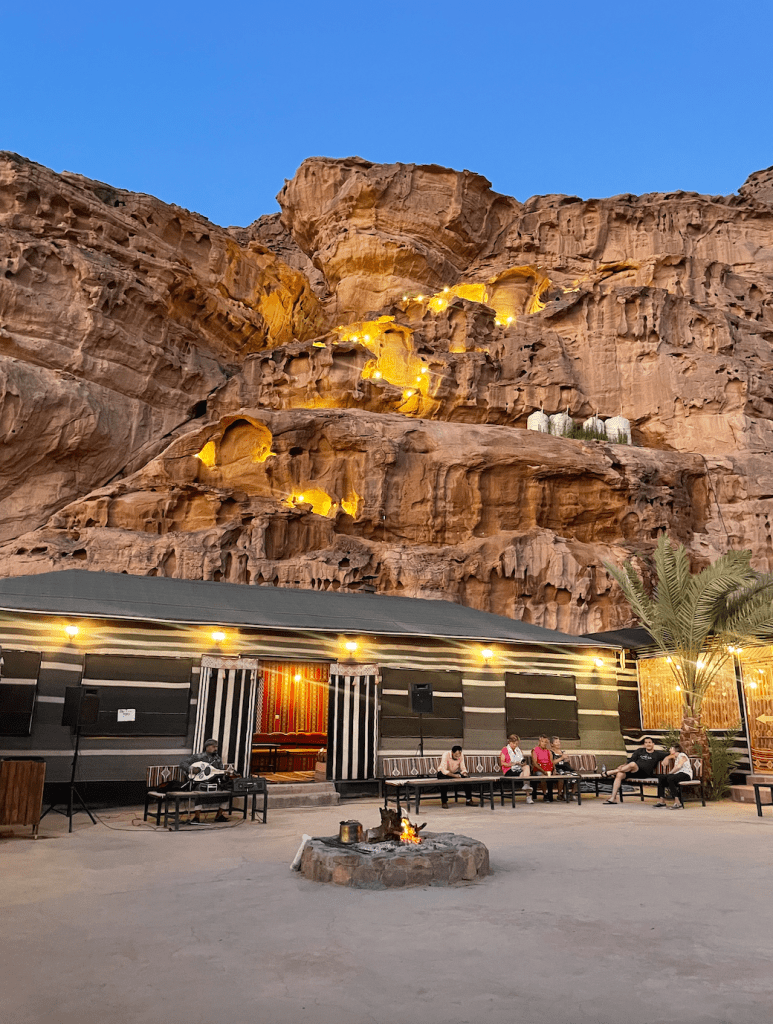
our outdoor campsite

After dinner, we sat around a fire in the main camp area and enjoyed live music and dancing. Several of the camp staff performed dabke which is traditional Arab line dance. It was such a great end to our busy day and the dabke performances were so fun and exciting to watch. Before heading to bed, we laid out in the sand and stargazed for a bit. It was amazing to see how bright they were, and it was lovely to enjoy such views without typical light pollution.

camel riding

The next morning, we woke up before the sun to enjoy a sunrise camel ride! While we were all pretty tired, we hopped on our camels and took off for a ride around the desert. It was so peaceful to be up while the desert was so quiet and empty, and it really felt like we were wandering around a whole other planet. We paused our camel ride on top of a sand dune to watch the sunrise over the mountains and enjoy the quiet golden hour.

delicious shawarma

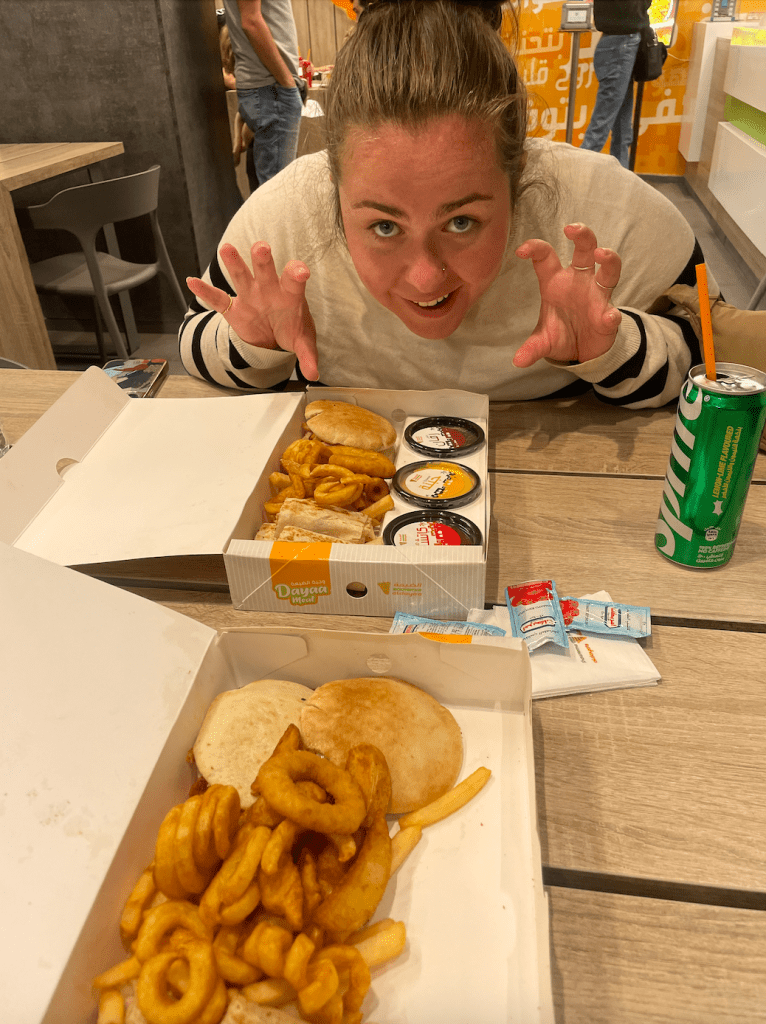
After returning to our camp and packing up, we set off to drive back to Amman. Back in Amman, we rested up after our long travel day and then headed to for dinner. We drove to Abdoun Circle, a neighborhood with numerous popular restaurants, cafes, and shops. Jada took us to Al Dayaa, a popular shawarma restaurant chain. We ordered a few boxes of their shawarma options which were all fantastic and certainly some of the best I’ve ever had.

overlooking Jerash

On our final day in Jordan, we explored Jerash, a city that flourished during the Greek, Hellenistic, Roman, and Byzantine periods until it was largely destroyed by an earthquake in 749. Today, the ruins are considered one of the best preserved Greco-Roman cities, with Jerash even being called the, “Pompeii of the Middle East”.

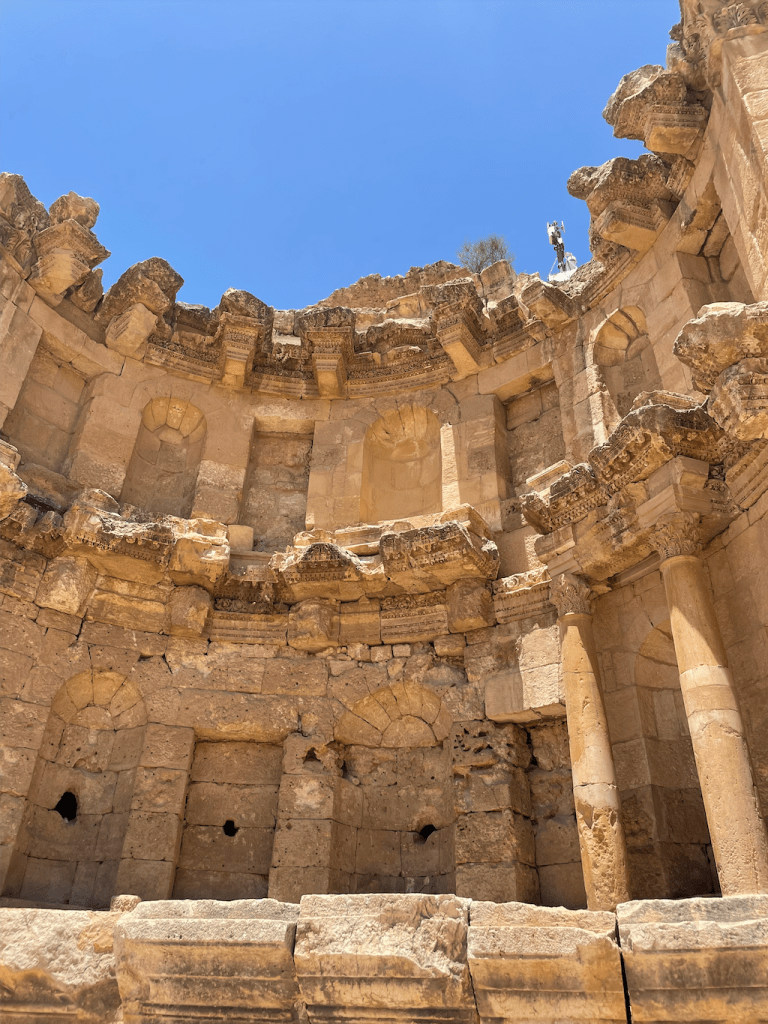
First, we walked through the hippodrome, an arena where gladiators and charioteers would perform for crowds. This space was massive, fitting over 15,000 spectators. From there we walked to the oval plaza, a spacious area surrounded by tall columns. This plaza led into Jerash’s colonnaded street, which is still paved with the original stones. This street is one of the focal points of Jerash and even contains an entire underground sewage system below the street. Amongst the other historical sites were a Byzantine cathedral, the Nymphaeum, the North Theater, South Theater, and an archaeological museum. Walking around Jerash was fascinating, as it really felt like you were walking through an ancient Roman city. We spent the rest of our afternoon shopping to get gifts for family and friends, before packing up to leave Jordan.

Overall, this trip to Jordan was a wonderful week of history, delicious food, and amazing company. It was remarkable to see the blending of culture, religion, art, and language in Jordan due to the passing of power and control throughout the years. Each landscape was infrastructurally adapted to whatever cultural group was in power, and the progression of the land to what is now modern-day Jordan is amazing. Additionally, I loved the variety of environments we were able to experience from the city, to the Dead Sea, to the desert. Jordan is truly a place of diversity and the perfect blend of adventure and exploration!

Journeying through Jordan

welcoming Jada and Annie to Morocco!

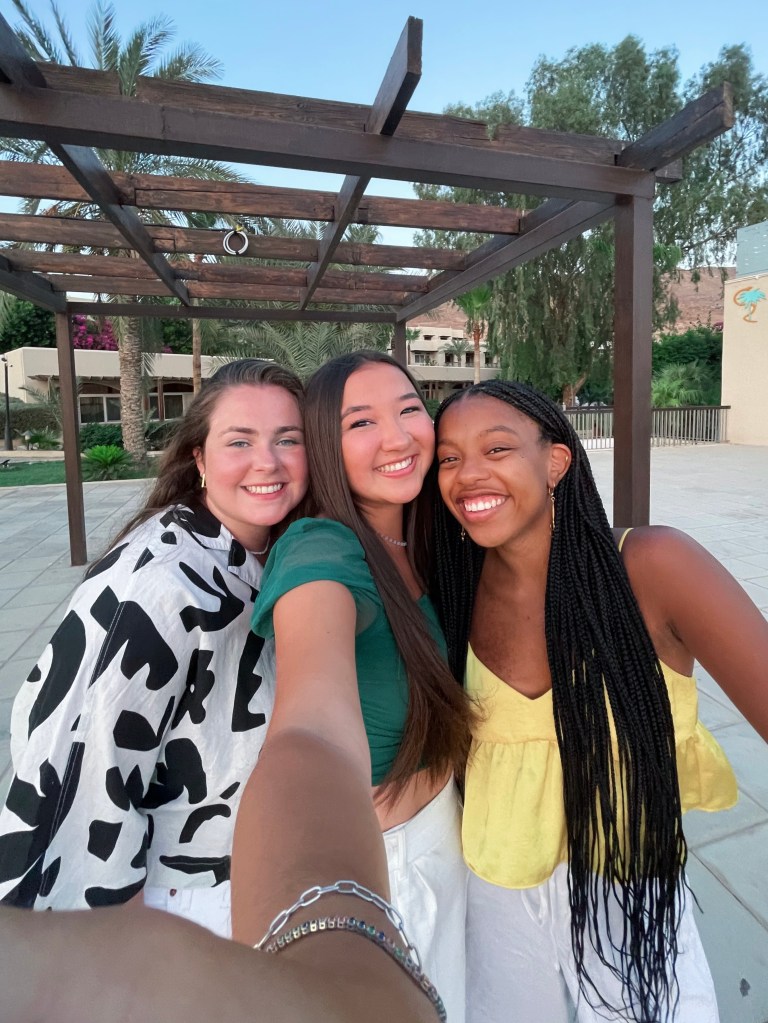
After months of texting, calling, and planning, I finally embarked on a trip to Jordan with two of my good friends Jada and Annie! They first flew into Morocco where we spent about a week exploring Marrakech, Ouzoud, Essaouira, and Casablanca. It was incredible to have close friends visit, and I had a great time showing them around all my favorite places in Morocco.

After a long day of travel from Casablanca, we landed in Amman, Jordan. We booked our trip through a tour company, which was highly convenient considering that all of our transportation, site visits, and accommodations were covered. For the first day on our itinerary, we had a free day to explore Amman on our own. Since Jada has studied abroad in Jordan twice, she was our tour guide for the day and took us around to all her favorite spots.

Rainbow Street

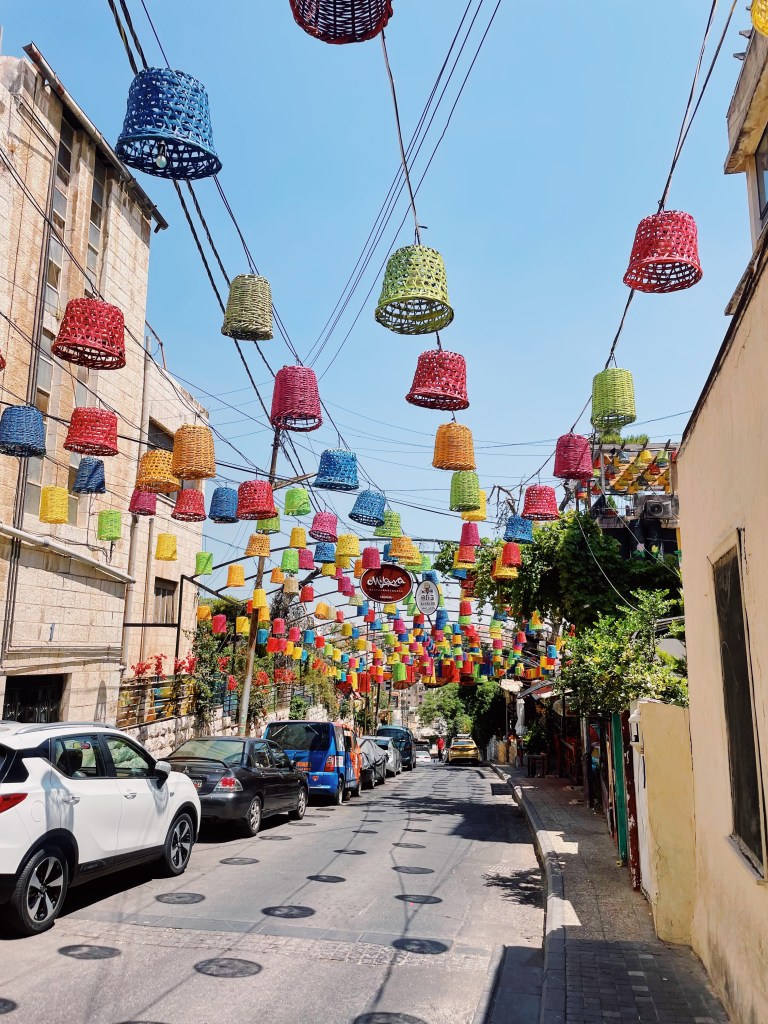
We started off on Rainbow Street, a popular street in Amman containing lots of restaurants, cafes, and shops. We did some shopping and had a great time walking around the quiet streets which felt relaxed and more residential.

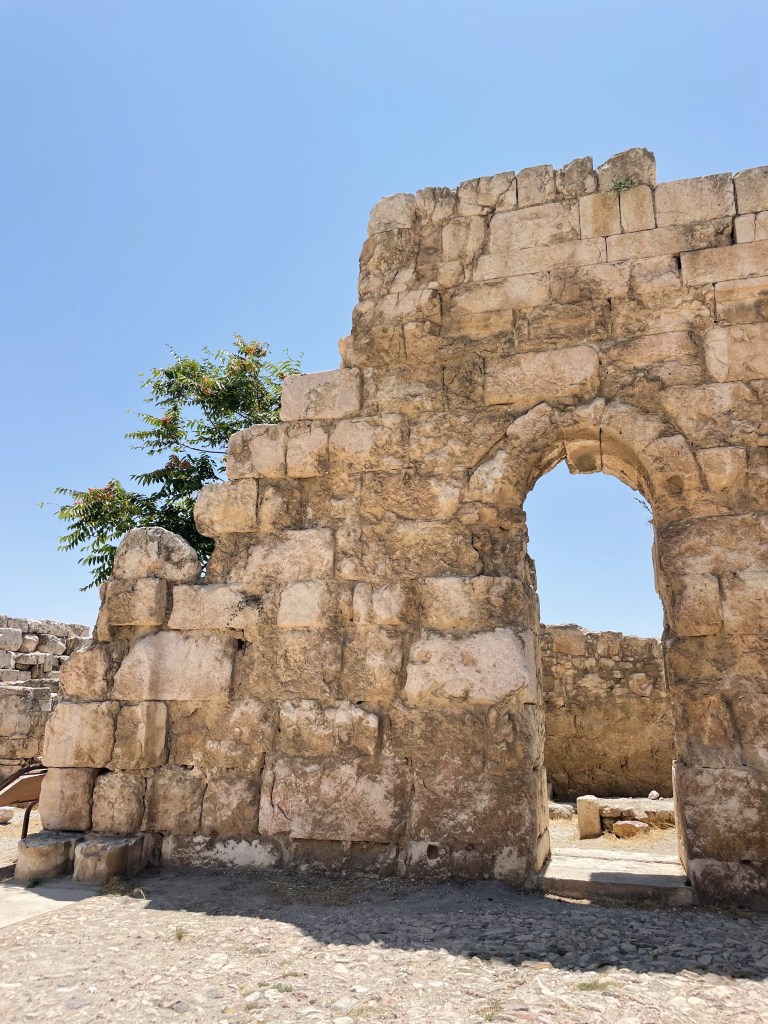
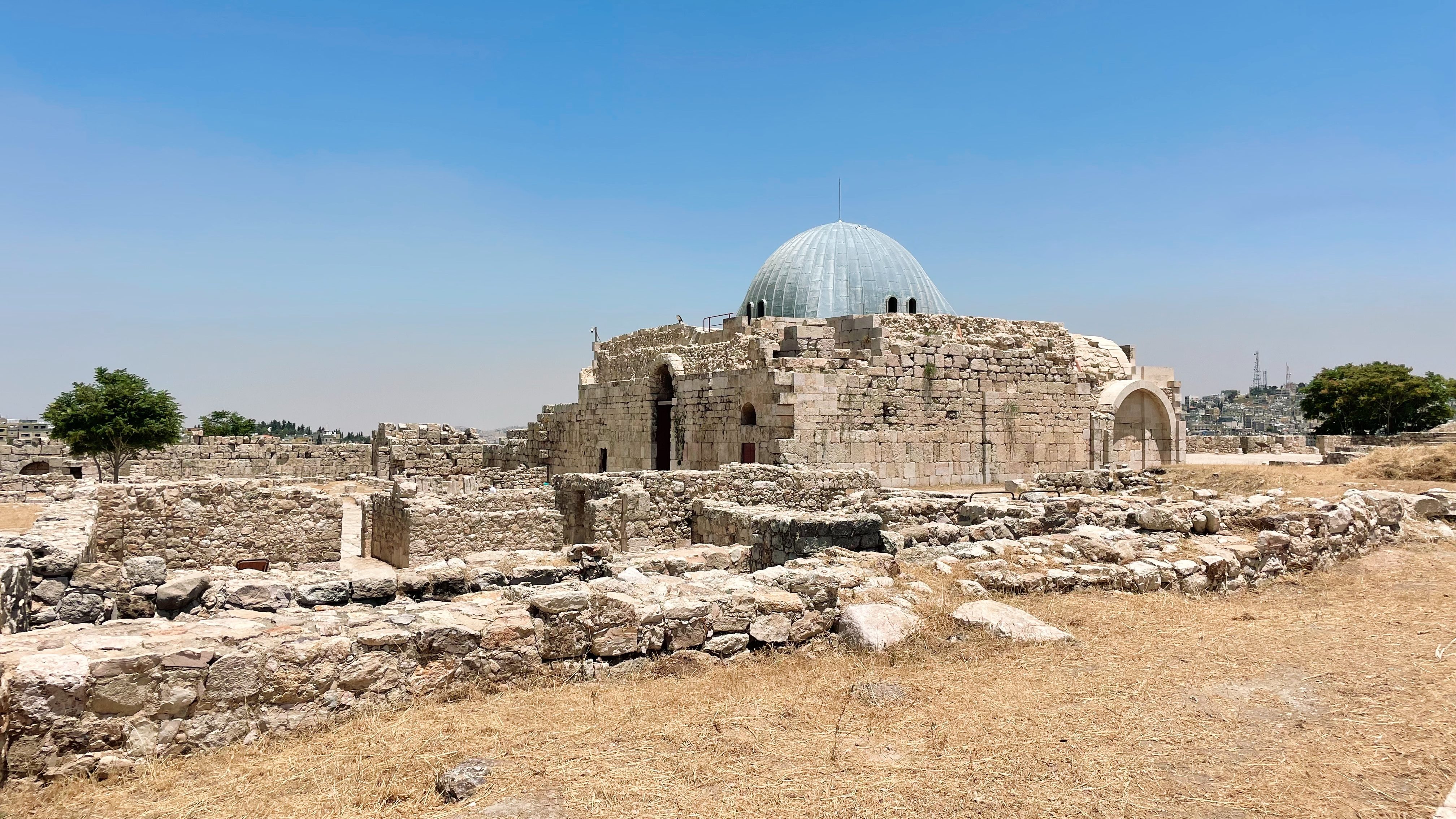
We then headed over to the Amman Citadel, which is an archaeological site on top of Jebel Al Qala’a, overlooking the city. The construction of the citadel dates back to the Bronze Age (1800 BCE) and was occupied by moving groups during the Iron Age, Roman, Byzantine, and Umayyad eras. The most famous site at the citadel is the Temple of Hercules built by the Romans. While most of it is in ruins, some of the pillars are still intact and were an incredible sight.

In addition to the temple, we walked around ruins of the Umayyad Palace and a huge entrance hall built over a previous Byzantine church. Near the palace was a small archaeological museum showcasing a variety of artifacts dating all the way back to the Paleolithic period. I loved exploring this area and learning about the extensive history of Amman. It’s super interesting to consider how many different people groups have occupied and changed the city over the years.

ruins of the entrance hall
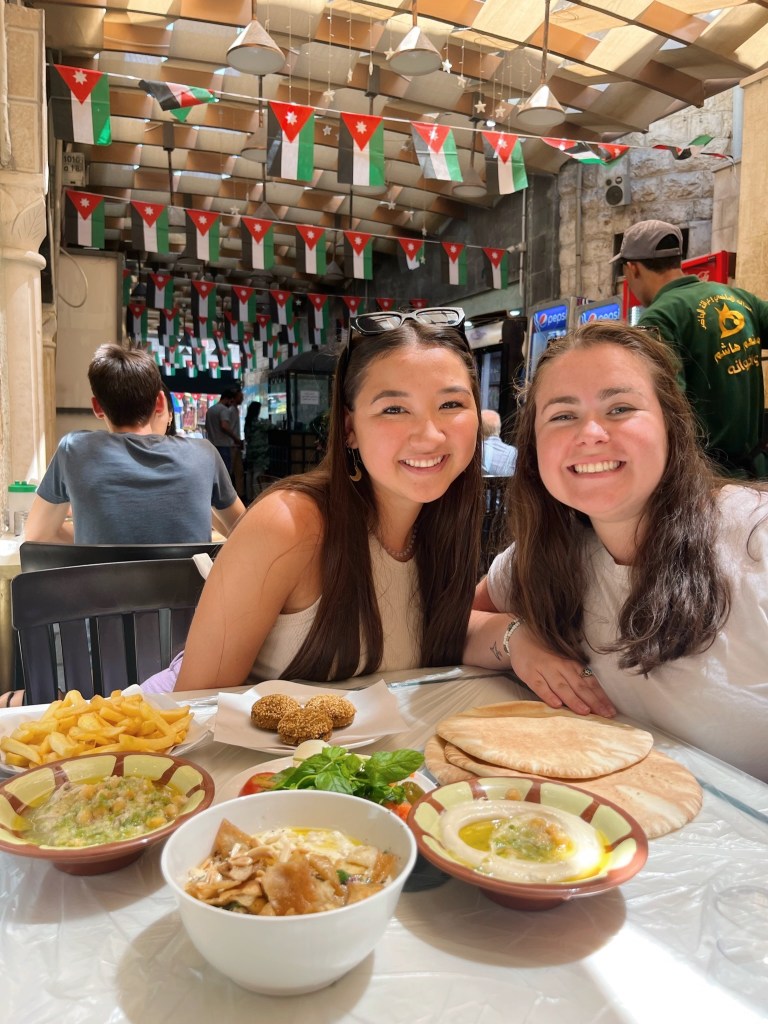
our delicious Hashem lunch

For lunch, we headed downtown to Hashem, one of the oldest and most popular restaurants in Amman! It was opened in 1951 and remains pretty much unchanged. The restaurant is sandwiched in a small alley, giving the place an open air, street food feel. We ordered a bunch of small plates including the pita, hummus, fattoush, and falafel which were all delicious.

pans and pans of knafeh

For a little dessert, we grabbed some knafeh at Habibah Sweets. Jada and I had been counting down the days until we were able to have knafeh in Jordan so we were so excited to make this food stop. I’ve had knafeh in Morocco, but nothing compared to the knafeh from this famous bakery opened in 1951. We tried the cheese and cream knafeh which was so rich and super filling.

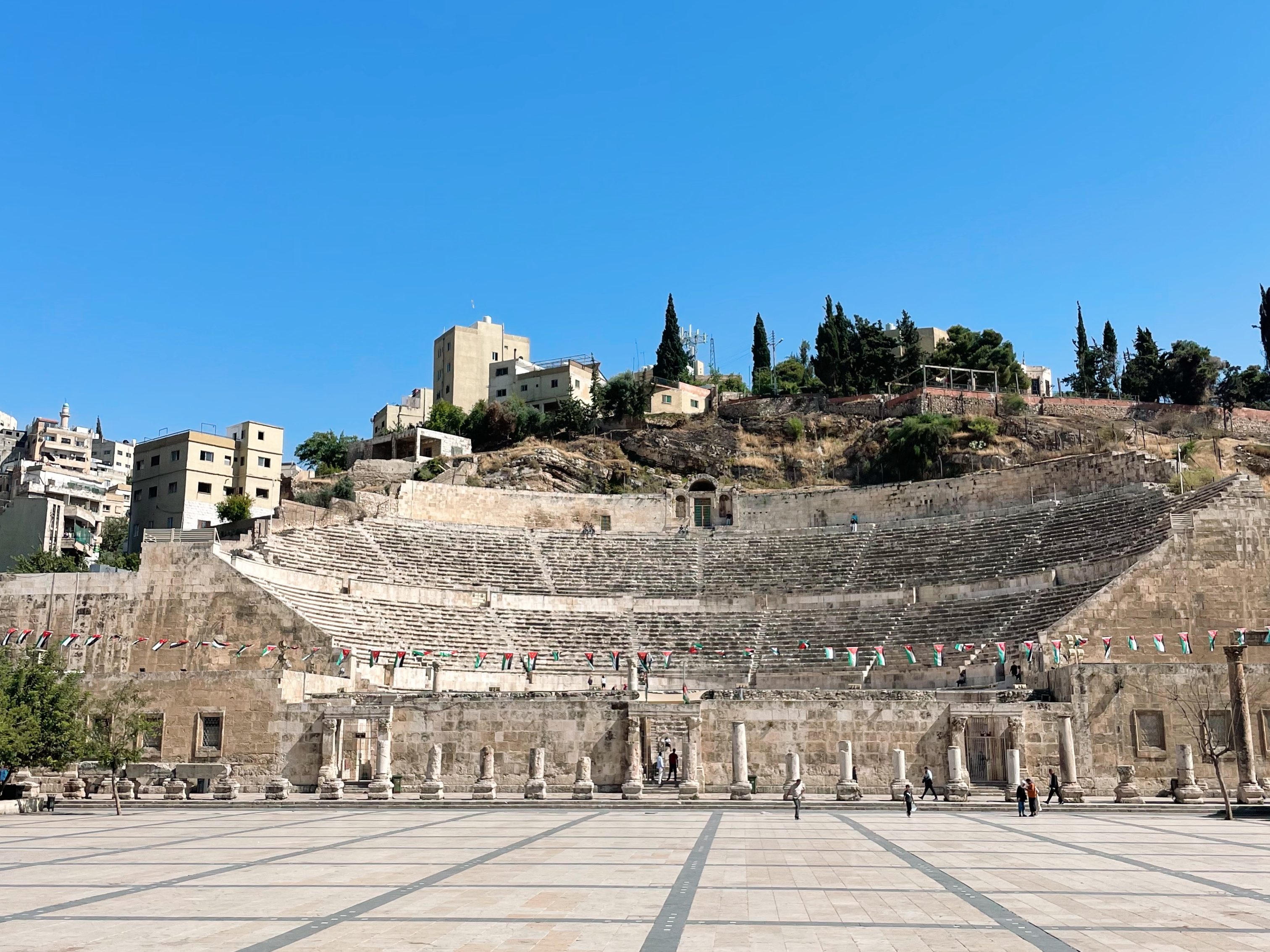
the ancient Roman theater

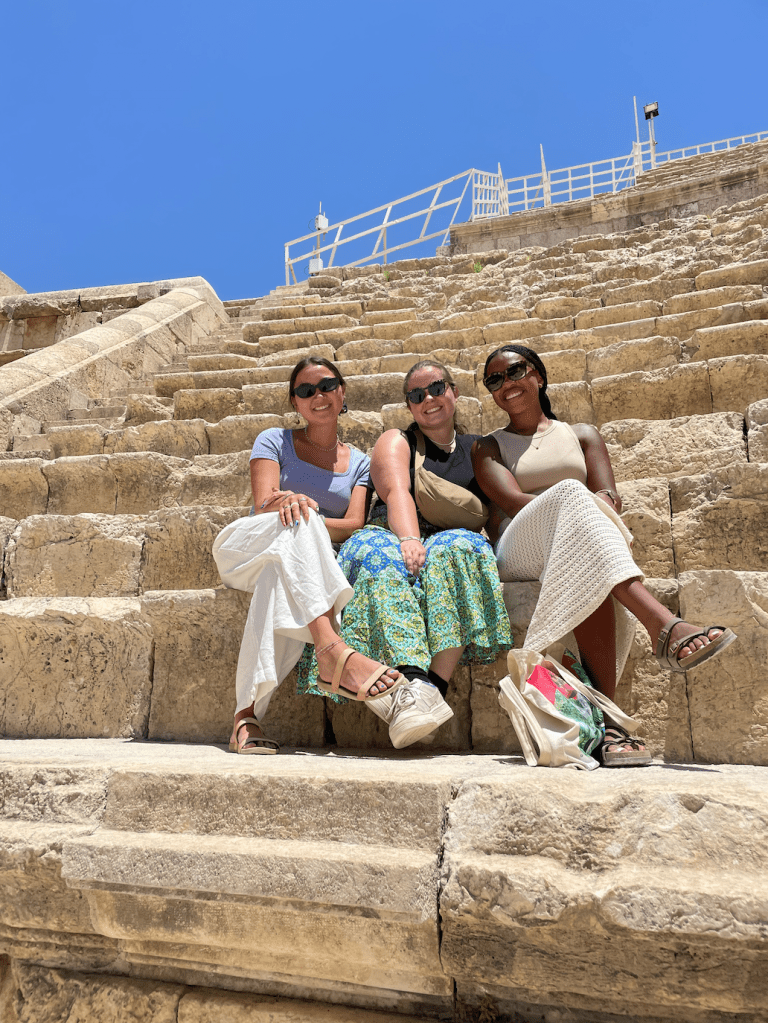
After lunch we walked around the shops in downtown Amman, which were busier and more crowded but filled with lots of neat souvenirs and trinkets. We then visited the Roman Theatre, built in the 2nd-century when the city was known as Philadelphia. The amphitheater was massive, built into the hillside and seating 6000 people. It was a little too hot for me to climb all the way to the top, but we sat on the amphitheater steps and walked around the nearby museum.

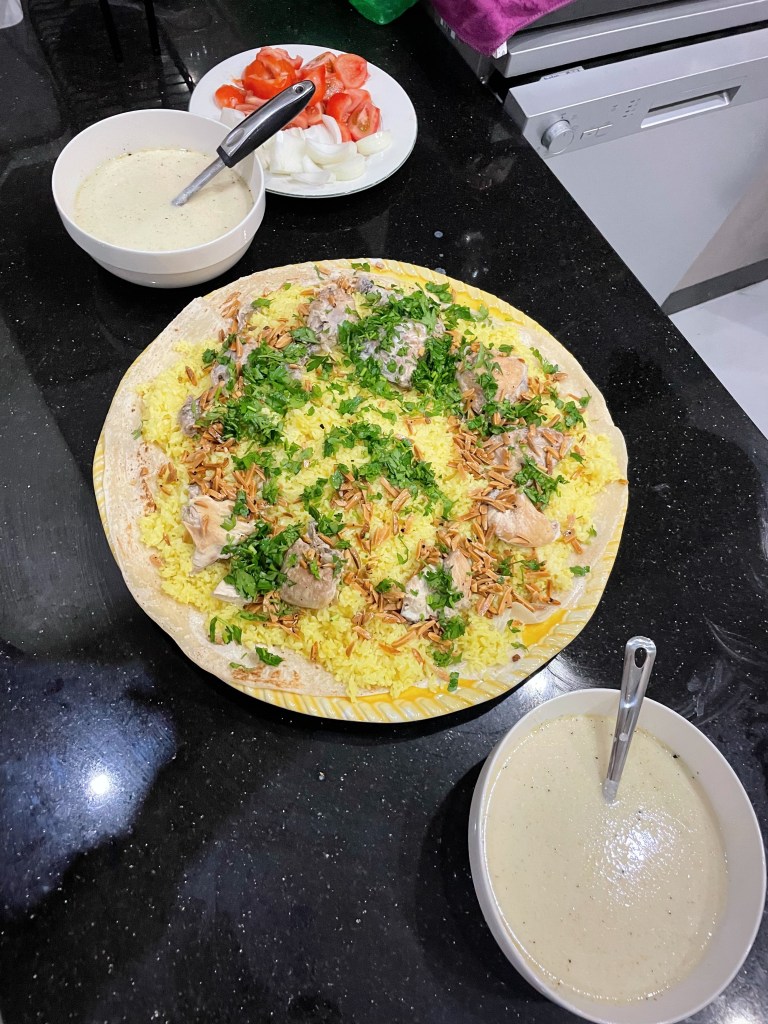
homemade maklouba

In the evening, we had the amazing opportunity to visit Jada’s host family, who she stayed with while she was in Jordan in 2017. It was so sweet to meet a few of the family members and they were thrilled to have Jada back after so many years. Her host mother made us homemade chicken maklouba, a rice dish that is flipped upside down and filled with meat, herbs, nuts, and a labneh sauce. This was by far one of the most delicious meals we ate on the entire trip and we completely stuffed ourselves full. It was a very meaningful reunion for Jada and her host family, and they were incredibly kind and welcoming to Annie and me, making us feel right at home.

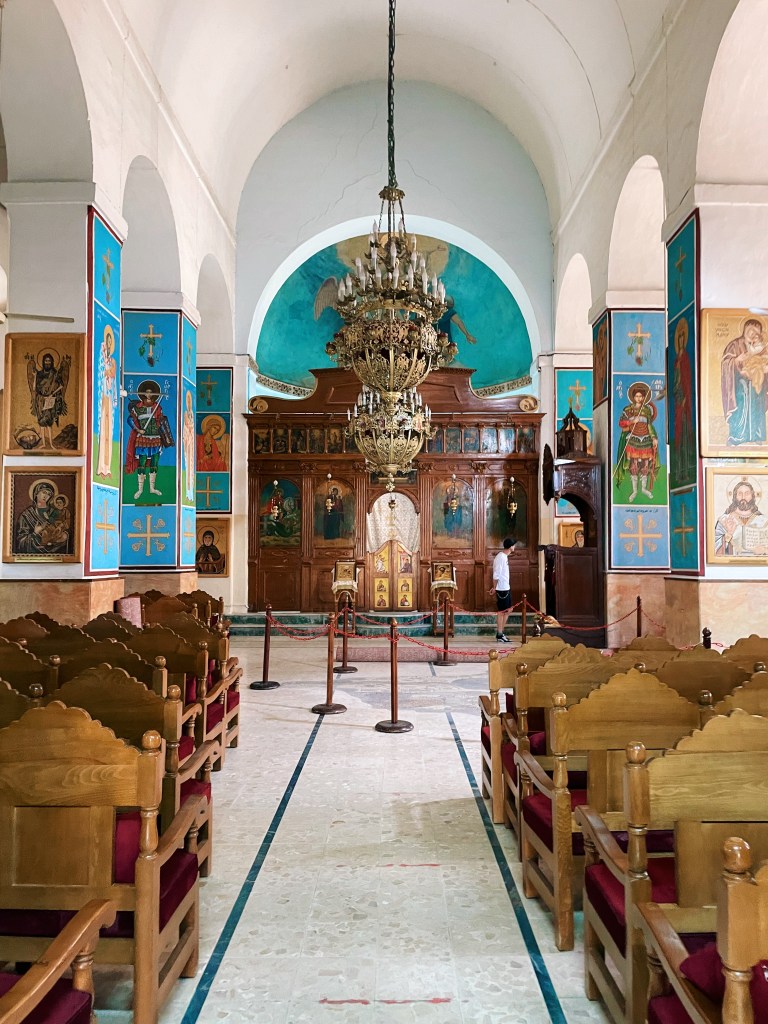
beautiful interior of the Greek Orthodox church

The following day we headed out early in the morning to hit the road towards the Dead Sea. I was super excited for this day, as we had several historical stops on the way. We drove towards the city of Madaba and stopped at St. George Greek Orthodox church.

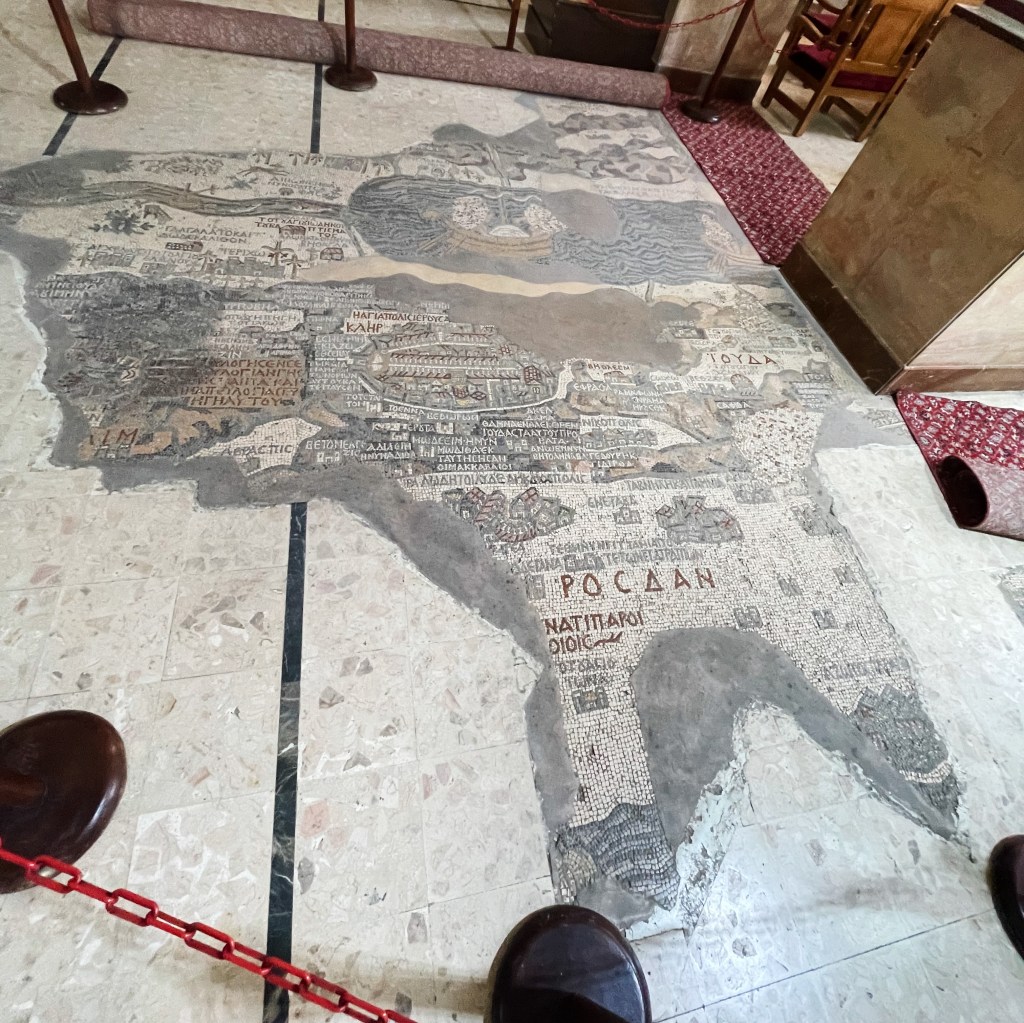
Palestinian map mosaic

The church is famous for the mosaic remnants that have survived since AD 560 and display the oldest map of Palestine in existence. The map depicts the region from Egypt to Palestine and is estimated to have contained over two million pieces in its original form. It was amazing to see such an old piece of history and I loved looking at all the intricate mosaics and paintings in the church.

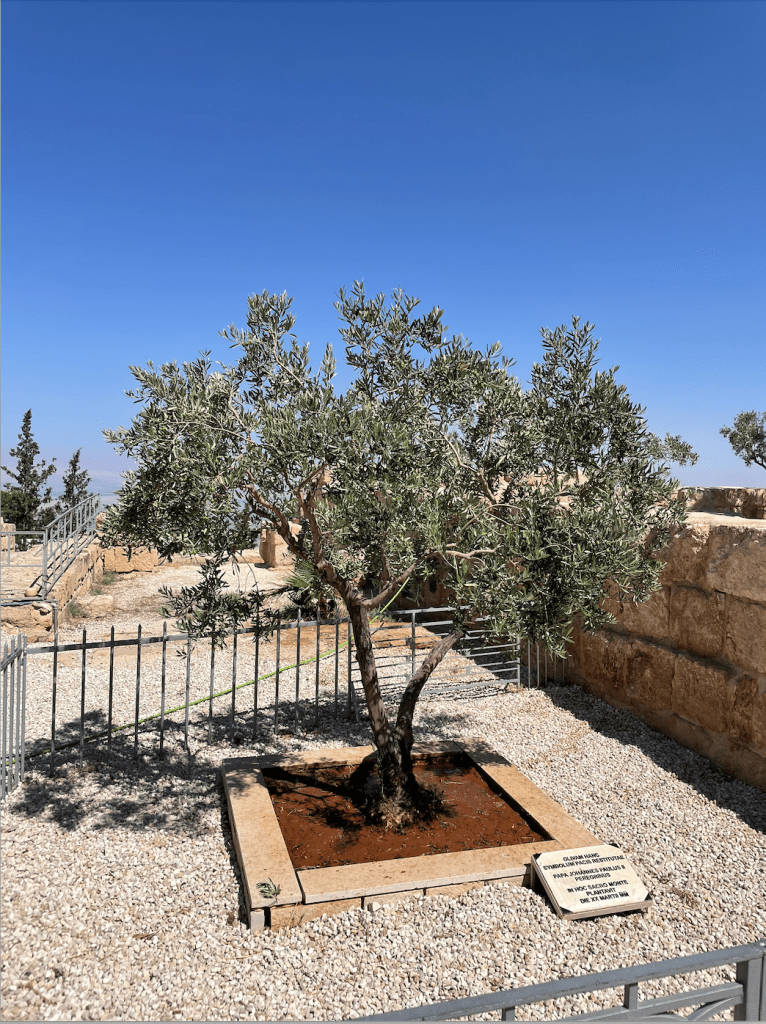
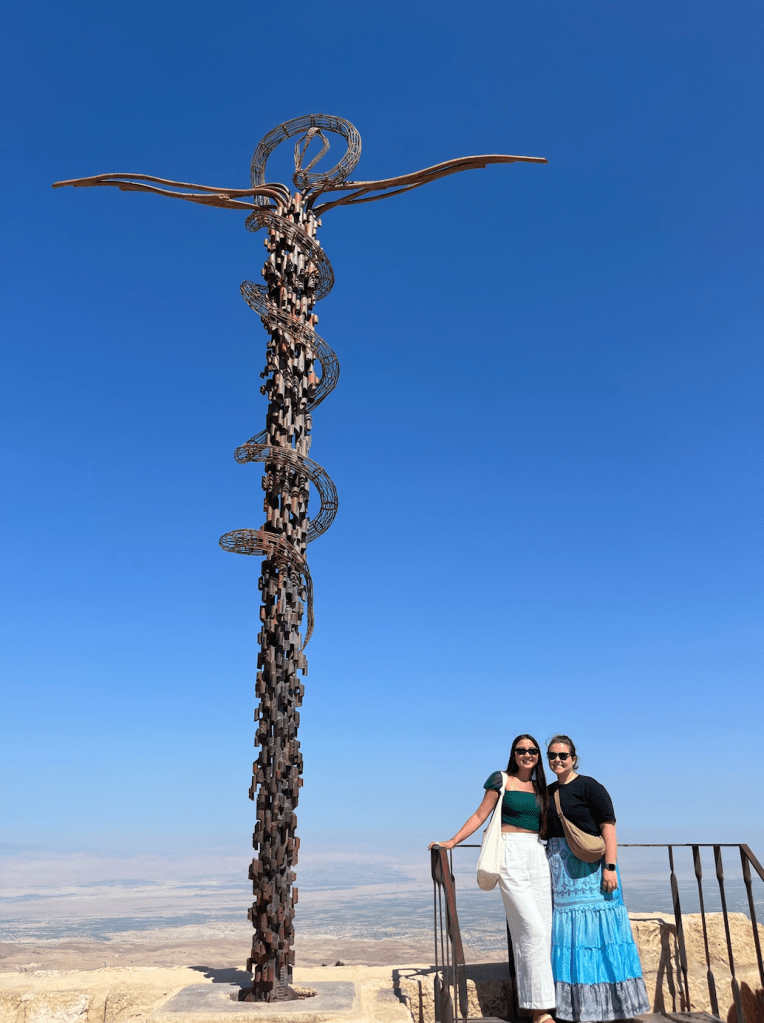
Next, we drove to Mount Nebo, a religiously significant mountain believed to be where Moses looked upon the Promised Land before his death. Walking around the mountain there were several memorial pieces for Moses and Christian history, including a small monastery built by Egyptian monks, now filled with Byzantine mosaics. There was an olive peace tree planted by Pope John Paul II and a beautiful serpentine cross sculpture symbolizing serpent taken by Moses in the desert and the crucifixion.

My favorite part of this site was looking out over the viewpoint on the same landscape Moses would have seen. We got lucky that it was such a clear day, and we were able to view the Dead Sea, Bethlehem, Jericho, and Jerusalem from the mountaintop.

the incredible Holy Land overlook
the baptism site of Jesus

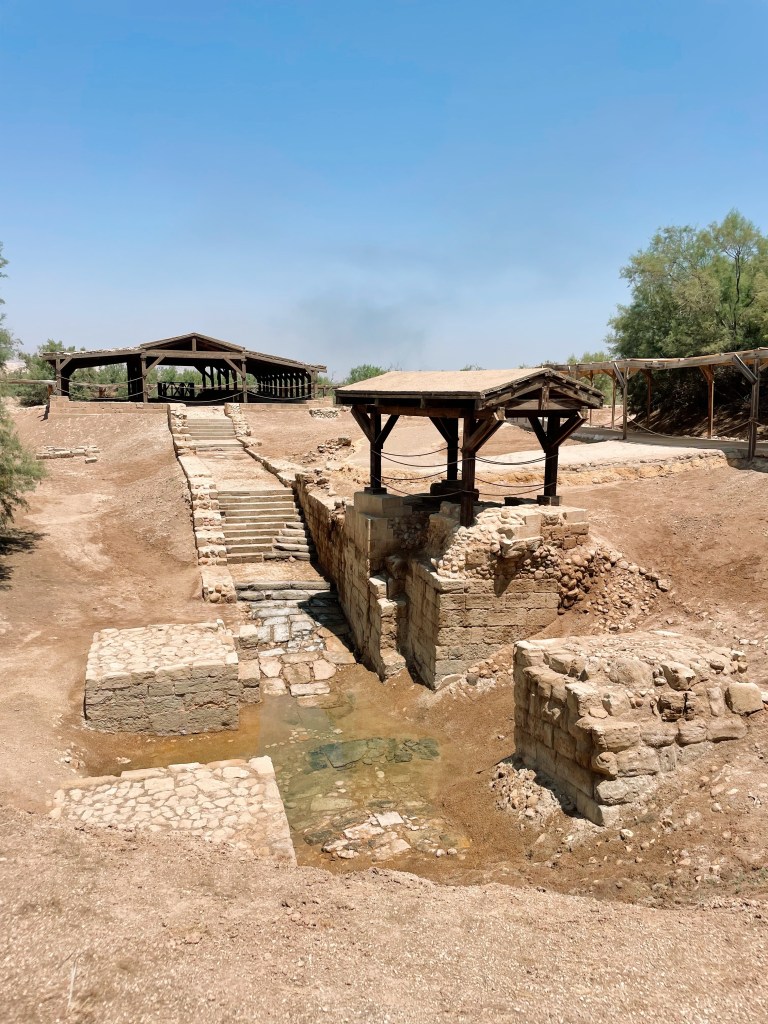
From there we drove to Al-Maghtas, which is an archaeological site on the eastern bank of the River Jordan. Located here are several churches, chapels, a monastery, caves, and the site where Jesus was baptized by John the Baptist in the River Jordan. We had a guide walk us to the baptism site, which had been identified by several biblical and historical accounts throughout the years. While the river is quite dried up in this location after thousands of years, it was surreal to be at such a religiously significant place! We walked to another area where the river where we could stand just about ten meters from Israel and even wave to people on the other side.

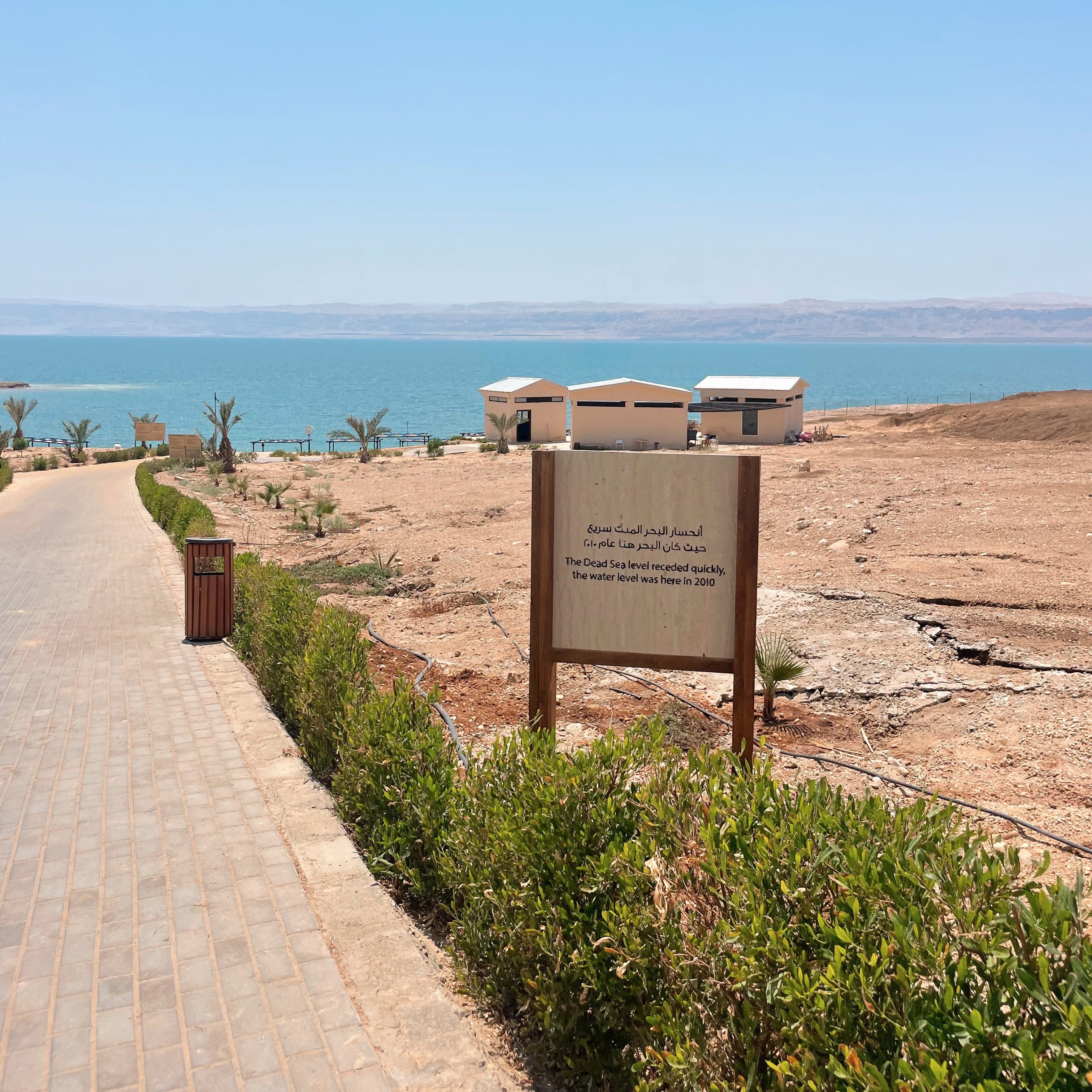
the sign reads, “The Dead Sea level receded quickly, the water level was here in 2010”

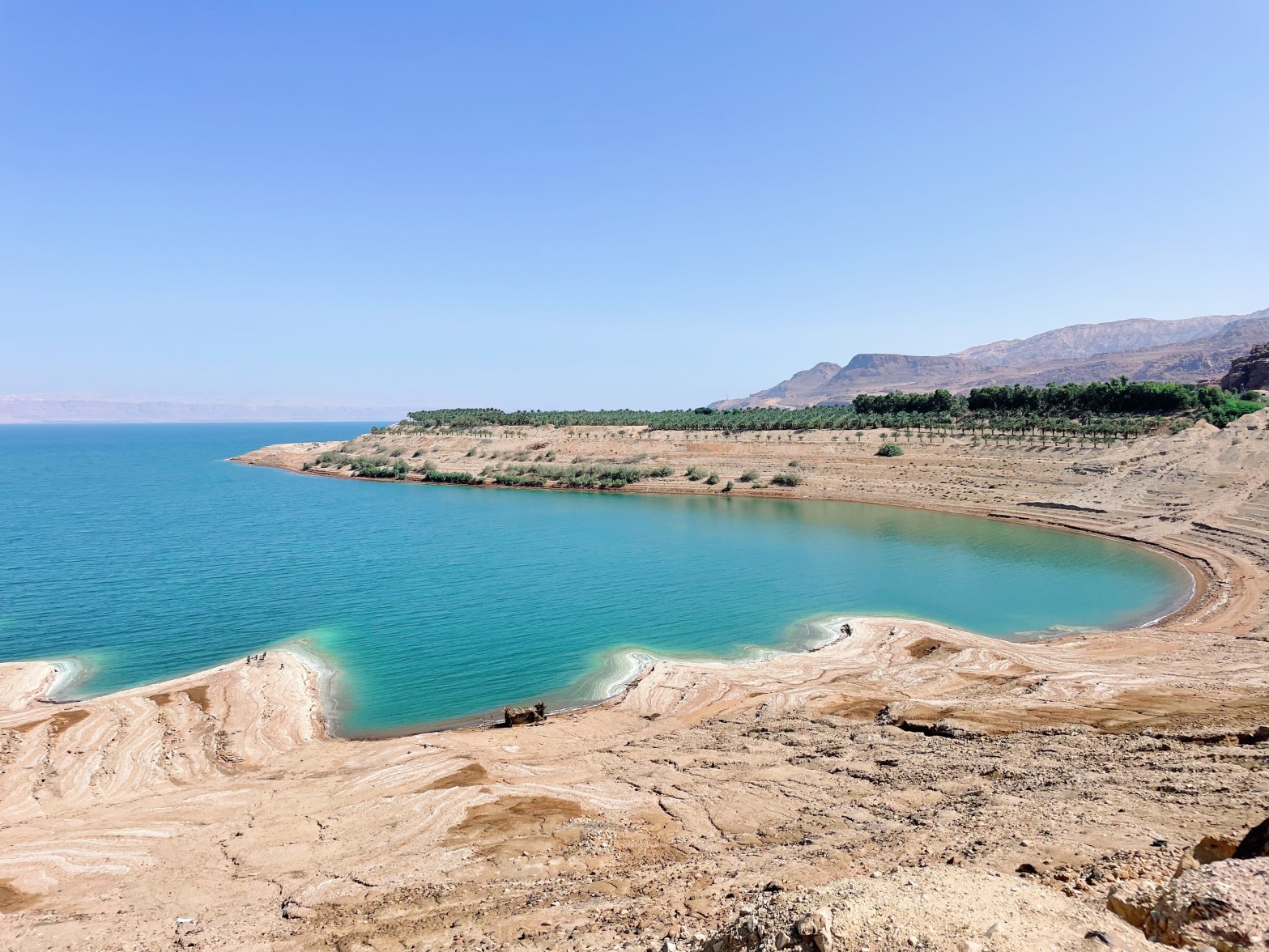
After our tour, we headed towards the Dead Sea and checked into our new hotel. Immediately we headed down to the water, which was just a short walk from our hotel. The Dead Sea is a landlocked lake between Jordan and Israel and is named for its high salt concentration which is inhospitable to any aquatic life. This area is the lowest elevation on the surface of Earth being 400 meters below sea level! As we walked down the path, there were signs indicating how much of the water has receded over the years. The water level drops about four feet every year as Israeli, Jordanian, and Syrian factories have been diverting freshwater sources that feed the Dead Sea and extracting Dead Sea water for decades. This made me even more grateful that we were able to visit such a unique place while it is still around.

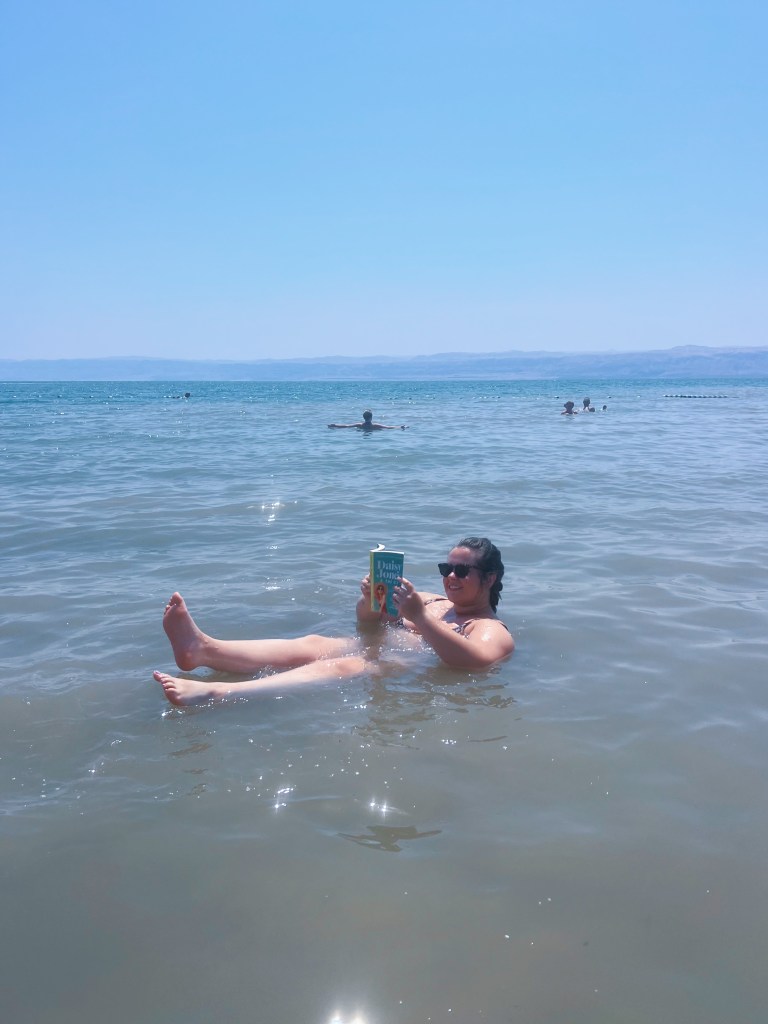
We lathered ourselves with mud and then swam around in the water, being extremely not to get the salty water in our eyes. It was such a cool phenomenon to experience as we were able to float so easily on the water and it felt almost impossible to sink down at all. I loved relaxing and floating around, and my skin felt much smoother after our Dead Sea mud scrub. Overall, the Dead Sea was one of the highlights of the whole trip as it’s always been an item on my bucket list!

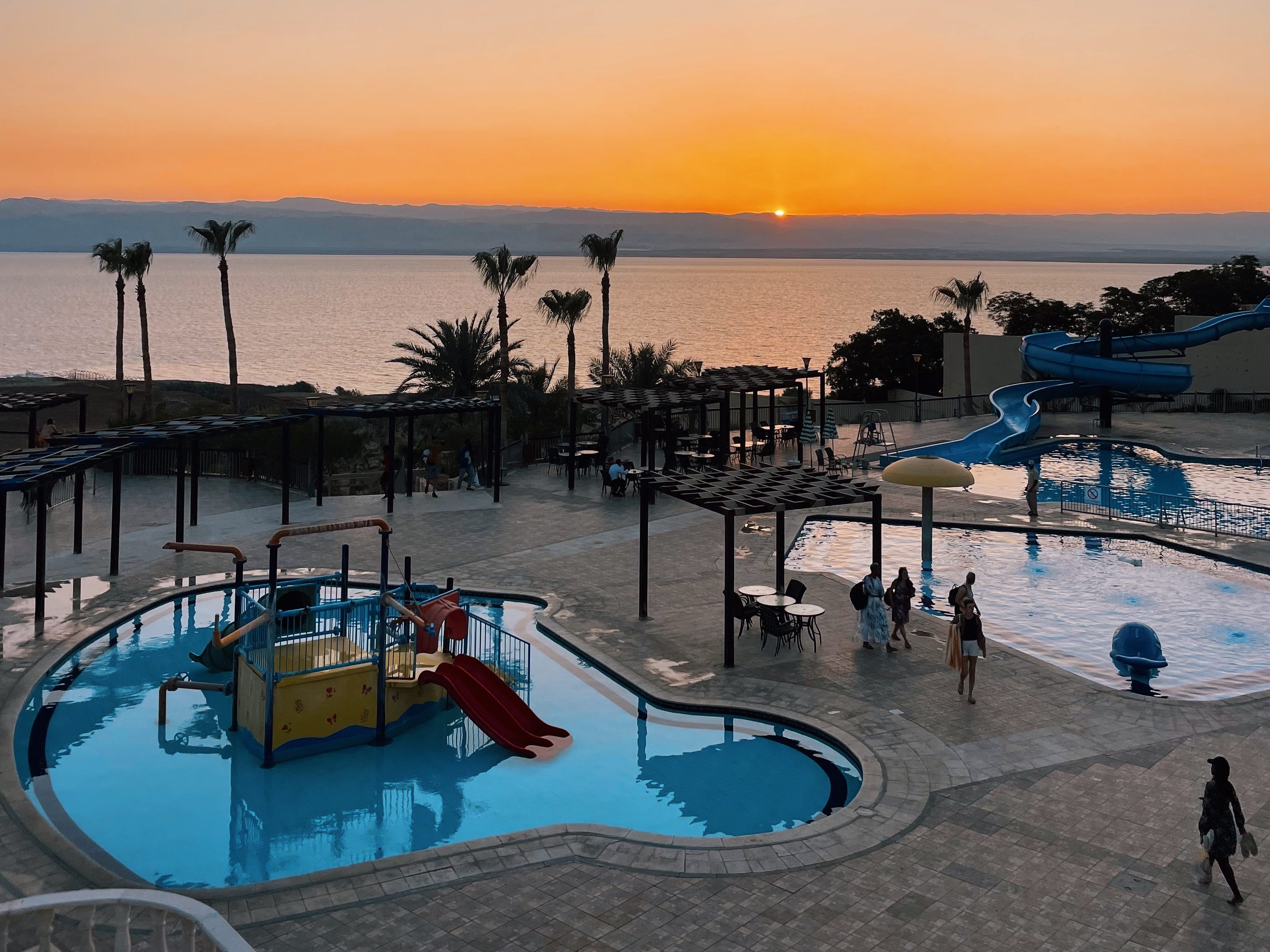
sunset over the Dead Sea

For the rest of the evening, we hung out at the hotel, had a poolside lunch, swam, and even went down the waterslide a few times. I absolutely loved the hotel which had a beautiful view of the water. It was great to relax after a busy few travel and sightseeing days. We caught the sunset over the water and enjoyed a nice dinner complete with a belly dancing show!

The first leg of our Jordan trip was incredible, and I loved exploring Amman and the Dead Sea. It was super interesting to observe the similarities and differences between my experience in Morocco to the environment and culture in Jordan. Everything including the food, people, history, and culture was delightful and it was even more enjoyable to experience it all with good friends. Stay tuned for part two of our Jordan trip in Petra and Wadi Rum!   

The Vibrant Culinary Experience of Morocco

Being about four months into my time in Morocco, I’ve been able to indulge so many different types of cuisine. Travelling around the country, attending different events, and even just exploring around my neighborhood has allowed me to sample so many new types of foods, dishes, and spices. I love trying new foods and I’ve grown to realize it’s not only one of the best ways to experience a new culture but an excellent way to immerse yourself in the community and passion that revolves around food!

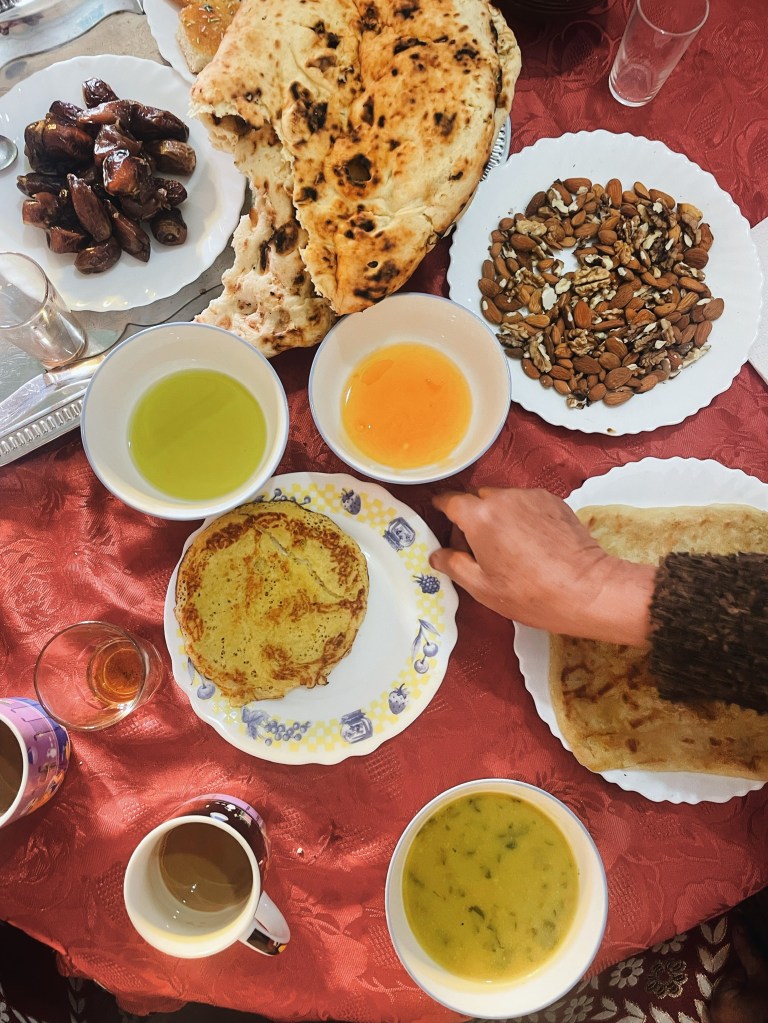
breakfast in Ighil n’Oumgoun

I love the diversity within Moroccan cuisine. While having traditional Amazigh, Arab, and Middle Eastern roots, there are additional French, Spanish, and Mediterranean influences that create such a unique fusion of culture. Luckily, I was able to learn about Moroccan food in its most authentic, traditional form through my time in the commune of Ighil N’Oumgoun, a rural village in the High Atlas Mountains. Here, there wasn’t a restaurant, café, or even grocery store in sight; everything is grown, harvested, and consumed in its most original form. I truly got to eat like a local and share in some of the BEST homemade meals I’ve ever had.

lots of bread!

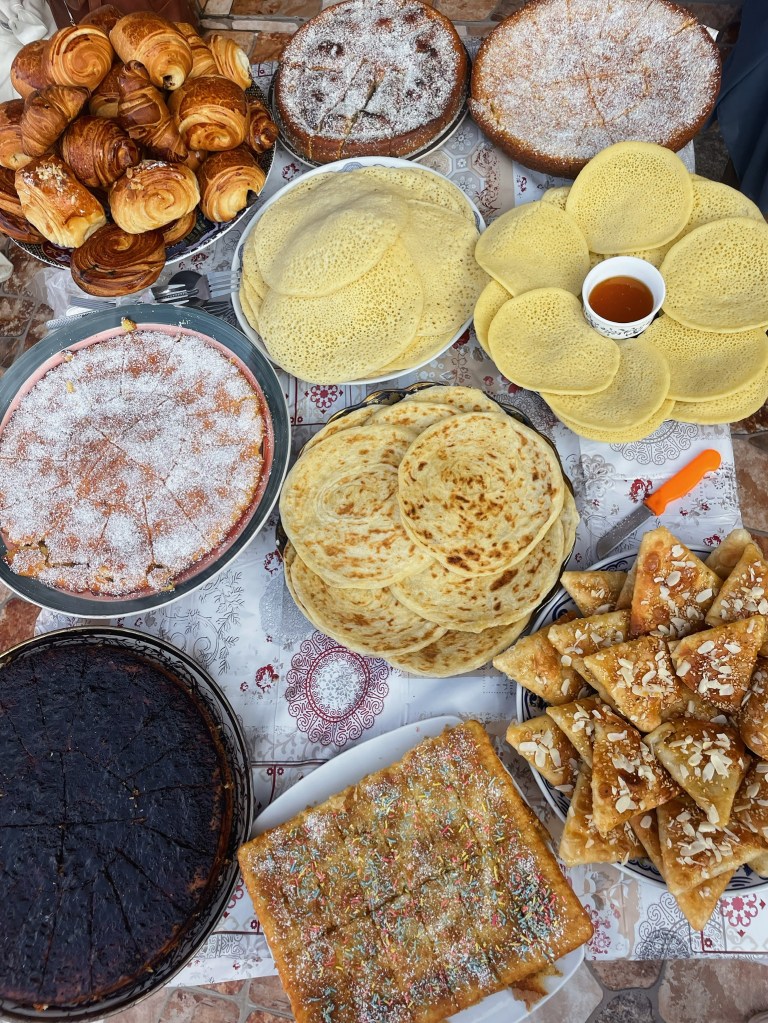
Traditional Moroccan breakfasts consist of lots of bread- which was something I definitely had to get used to as someone who typically eats a lighter breakfast. While in Ighil N’Oumgoun, we would enjoy platters of khobz (a round flatbread), beghrir (a spongy pancake), batbout (similar to pita bread), and m’semmen (a fried, flaky flatbread). Olive oil, butter, jam, and cheese are typically spread on the bread, and there were additional cakes, dates, almonds, and harira (a dried lentil, chickpea, fava bean soup) on the side.

Our lunches and dinners consisted of a variety of tagines, one of the most popular dishes in Morocco. While it varies, it’s a mixture of meat (beef, lamb, or chicken) and veggies cooked inside a clay tagine pot. You can get it at pretty much any restaurant, cafe, or street shop in Morocco, but the tagine I had in Ighil N’Oumgoun was by FAR the best I’ve ever had. Tagine is eaten as a communal dish, with everyone dipping their hands into the steaming pot and taking their portion- there’s no need for any silverware!

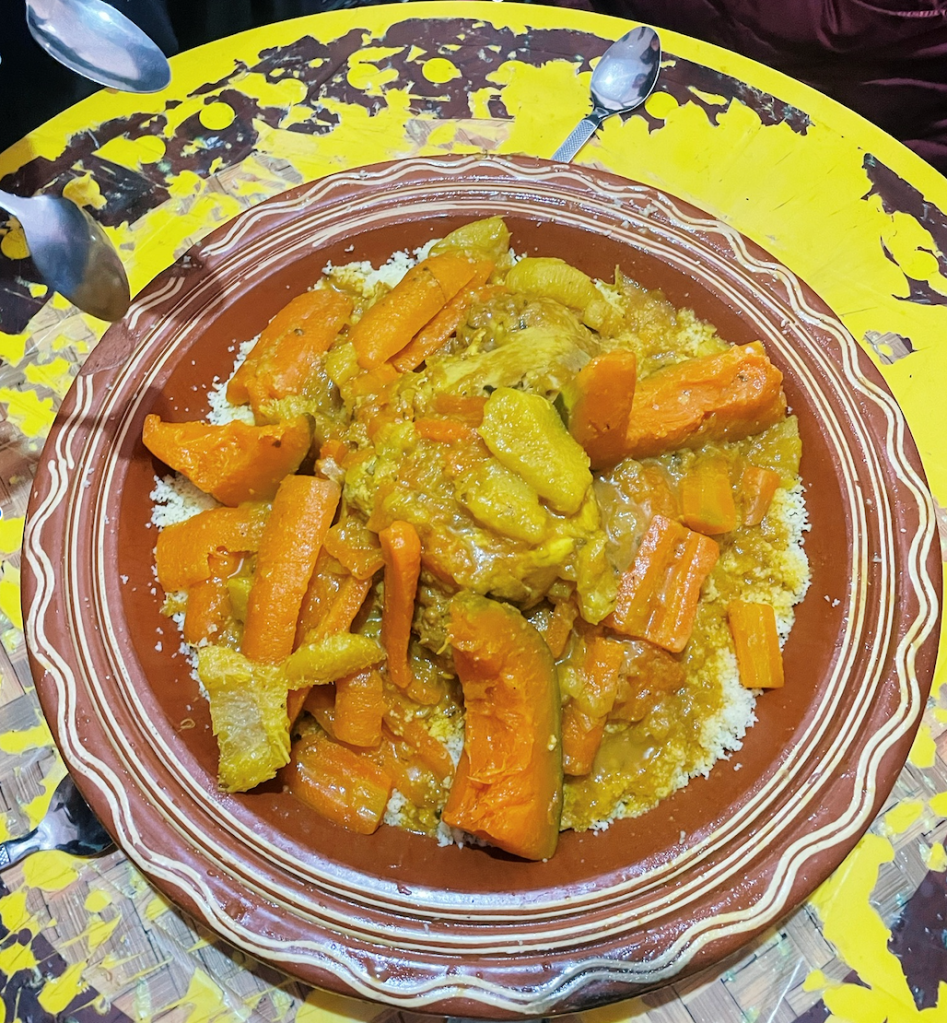
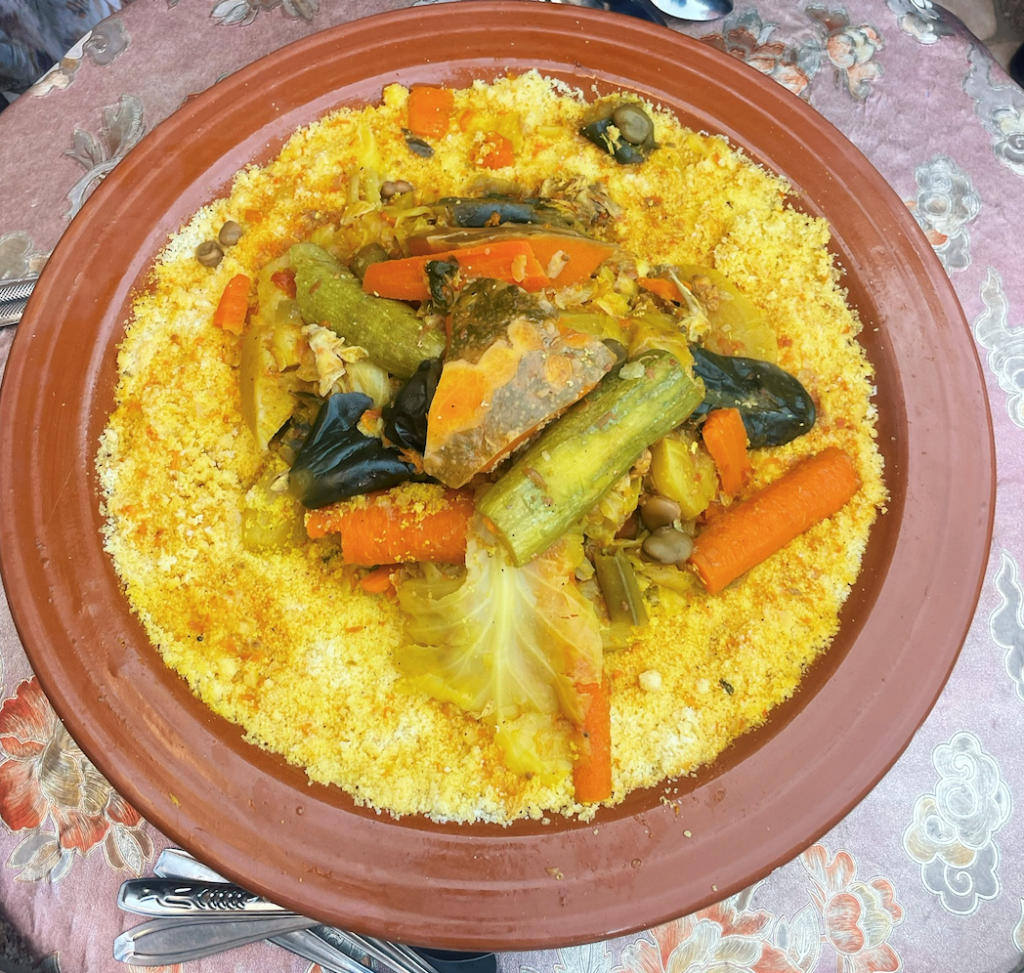
Moroccan food cannot be discussed without mention of their national dish: couscous! As an already avid couscous lover, I was so excited to try Moroccan couscous- which not surprisingly is a million times better than the Whole Foods boxed version I’m used to. Most places only serve couscous on Fridays, a tradition started in the 7th century when the Maghreb would eat couscous after their midday Friday prayers. The couscous dishes I had in the rural regions of Ighil N’Oumgoun and Ourika were so delicious and beat out any restaurant couscous I’ve had by FAR.

a dessert feast

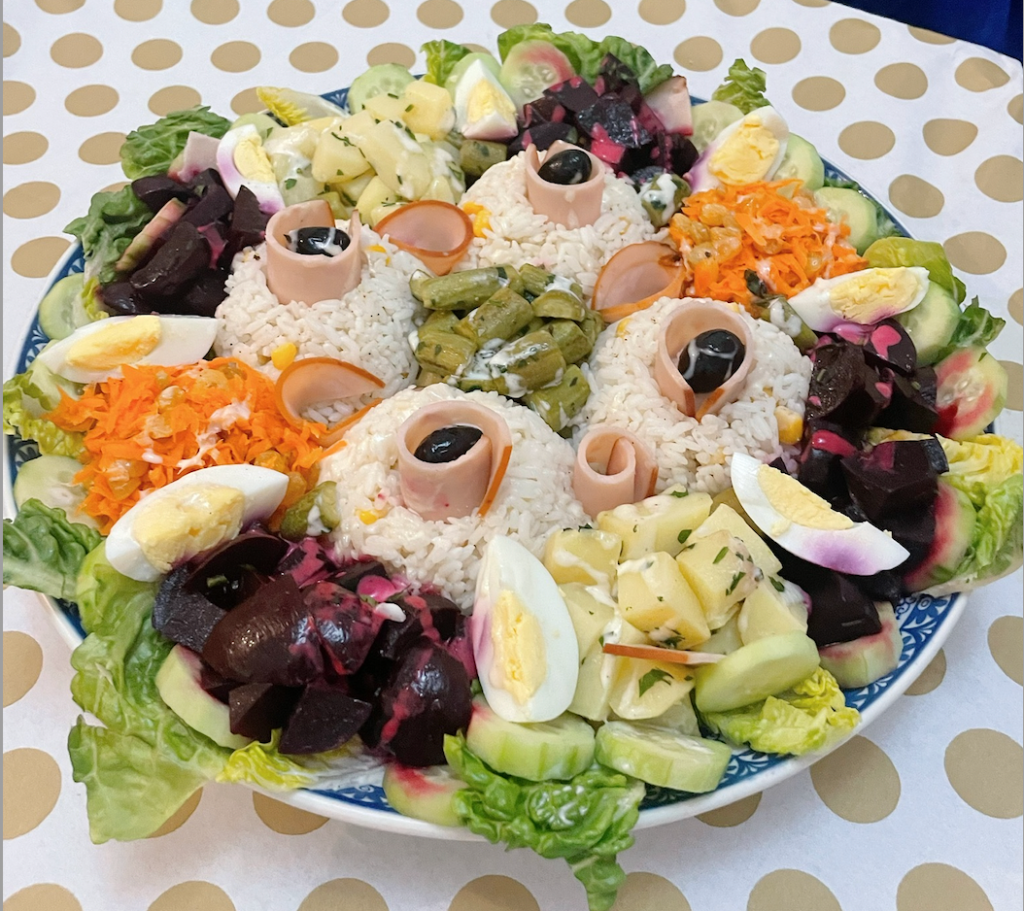
I’ve also been lucky to attend several special celebrations during my time in Morocco, which are often centered around the enjoyment of many special, homemade dishes. I was the guest at a wedding for two of my coworkers, which was such an incredible cultural celebration to witness. Although I didn’t realize we wouldn’t eat dinner until almost midnight, the food was worth the wait! We started with a traditional Moroccan cold salad and then enjoyed the main dish of an olive oil and seafood pastilla. Pastilla is a sweet and savory North African dish similar to a thin, crispy pie filled with meat- or in this case, shrimp and fish.

lots of pastries to choose from!

I’m a huge fan of Moroccan desserts and pastries which have unique, sweet flavors. Popular desserts include, kaab el ghzal (a crescent shaped cookie filled with almond paste), chebakia (deep-fried dough rolled in honey, orange blossom water, and sesame), ghoriba (sesame shortbread cookies), briouat (a sweet puff pastry), and mhancha (an almond, cinnamon, orange wrapped dough). Other well-known desserts such as crêpes, cakes, and croissants are also popular.

my shakshuka!

During the month of April, Morocco observed Ramadan. As a non-Muslim who has never really experienced what Ramadan looks and feels like within an Islamic state, it was certainly adjustment. With the mornings and afternoons consumed by a slower-paced lifestyle, prayers, and fasting, the evenings were for Iftar, or the breaking of the fast- meaning lots of delicious food! I partook in a few Iftars with my coworkers, where everyone brought dishes in a pot-luck style meal. Pushing myself to cook something new, I got really into making shakshuka, a North African and Middle Eastern dish of poached eggs in tomato sauce. It’s super easy and quick to make and will definitely be a meal I continue to make in the future!
fresh clams

 The coastal city of Essaouira has easily become one of my favorite places, and after several trips I’ve been able to try lots of amazing seafood dishes here. While the restaurants are amazing, my favorite place to stop for a quick bite is Sqala du Port, the fishing port.

fresh oysters

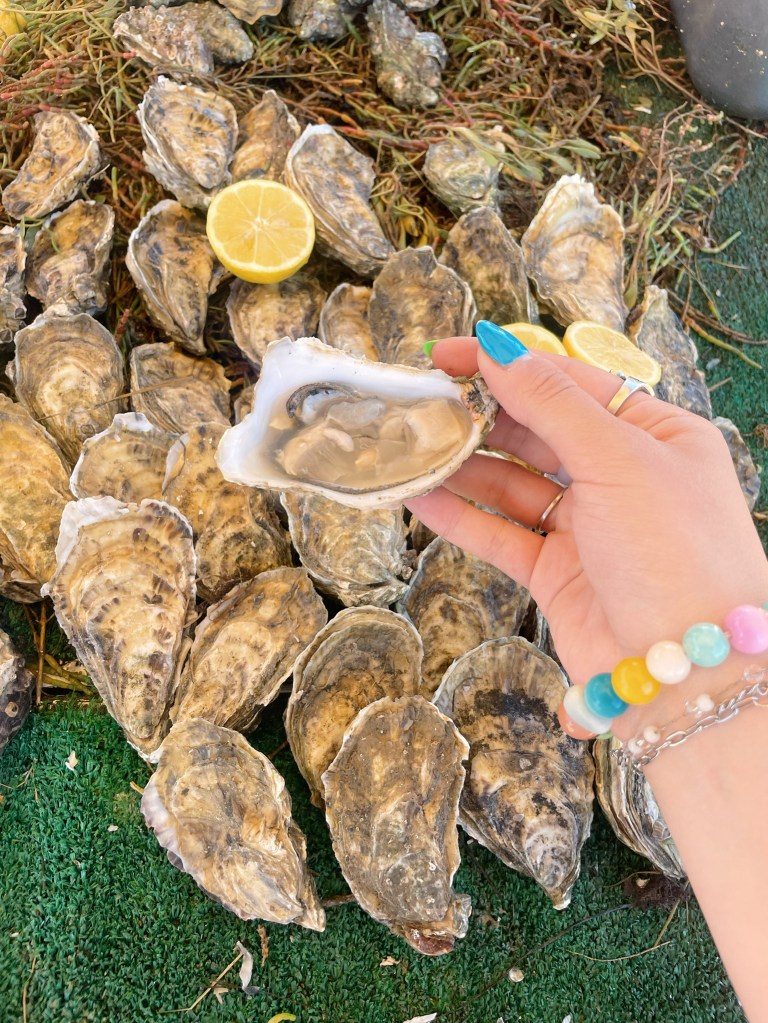
Amongst the swarming seagulls and the endless booths of fish, crabs, and eels are few stands that sell raw oyster, clams, and mussels. For only seven dirham you can have the freshest oyster with a dash of horseradish and lemon drizzled on top. And they are DELICIOUS. I look forward to getting some every time I visit!

cocktails on the Kabana rooftop

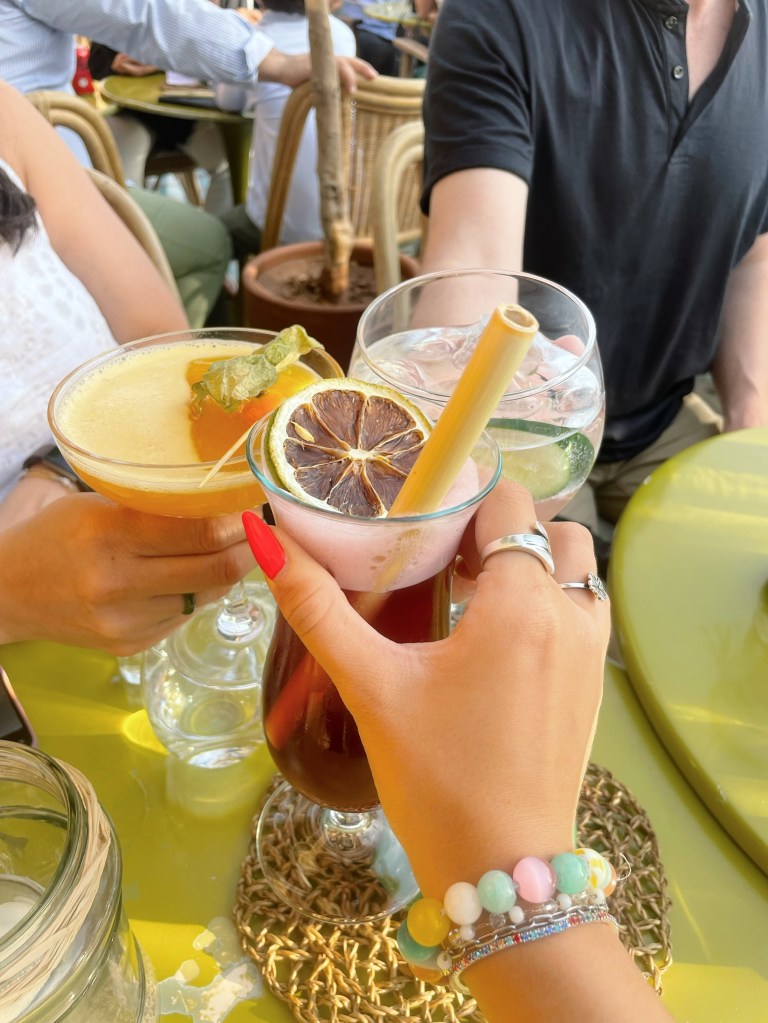
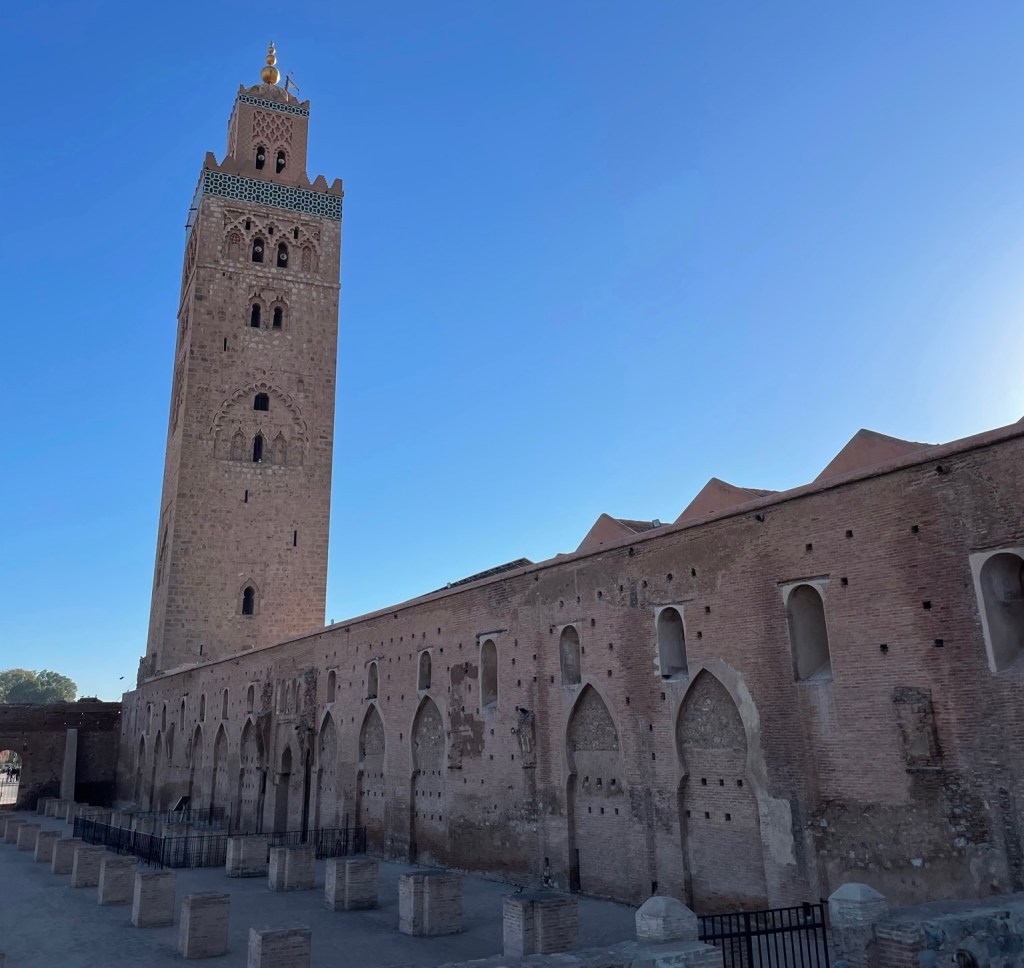
Marrakech is an amazing city for food. In addition to Moroccan dishes, you can pretty much find every time of cuisine here including French, Spanish, Italian, Mediterranean, Sub-Saharan African, Japanese, Chinese, and Thai. One of my favorite restaurants I’ve discovered is Kabana, a beautiful rooftop bar overlooking Koutoubia mosque, often hosting live music or DJs. While their creative cocktails are a highlight, their wide selection of food has always amazed me. Some of my favorite dishes have been the parmesan and truffle fries, garlic prawns, sirloin burger, fried calamari black rice aioli, and the lamb shank with truffle gnocchi. Not only is the atmosphere of this restaurant a blast, but the food and beautiful sunset views make for a great experience.

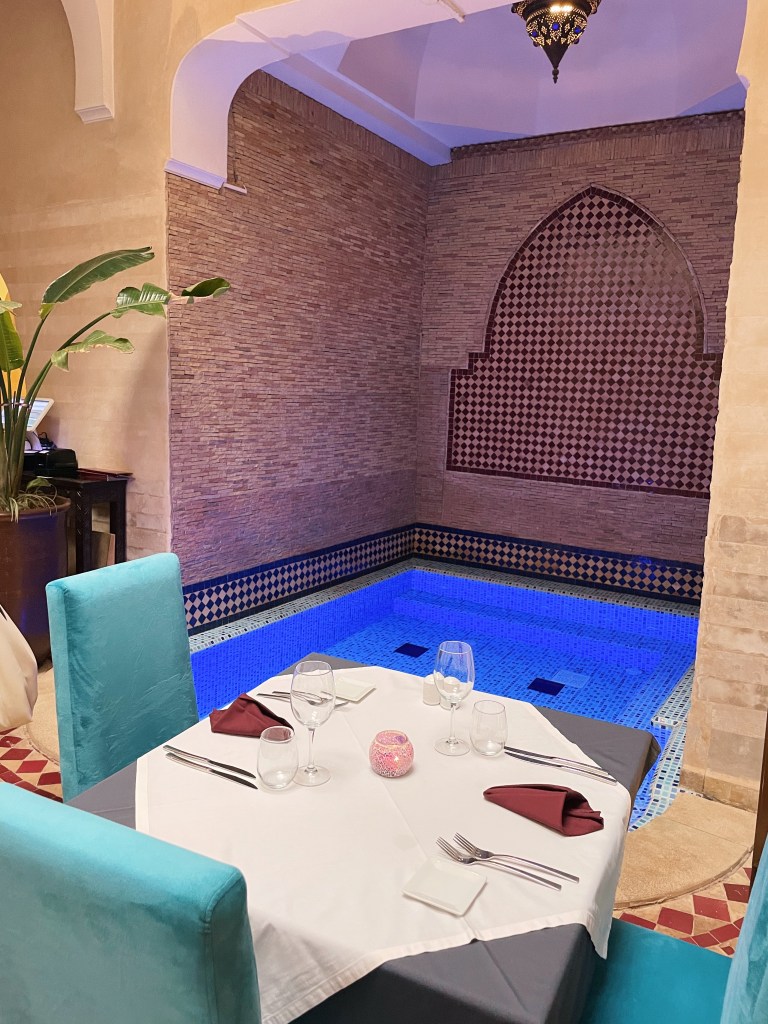
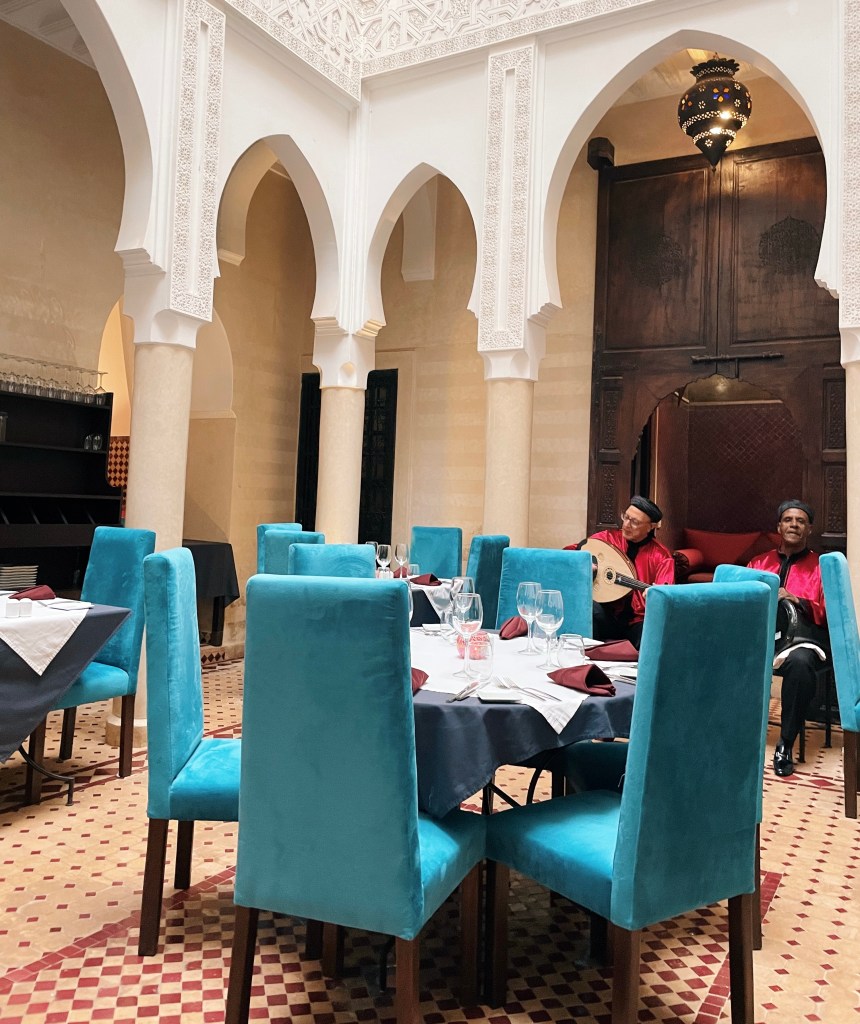
poolside riad dining

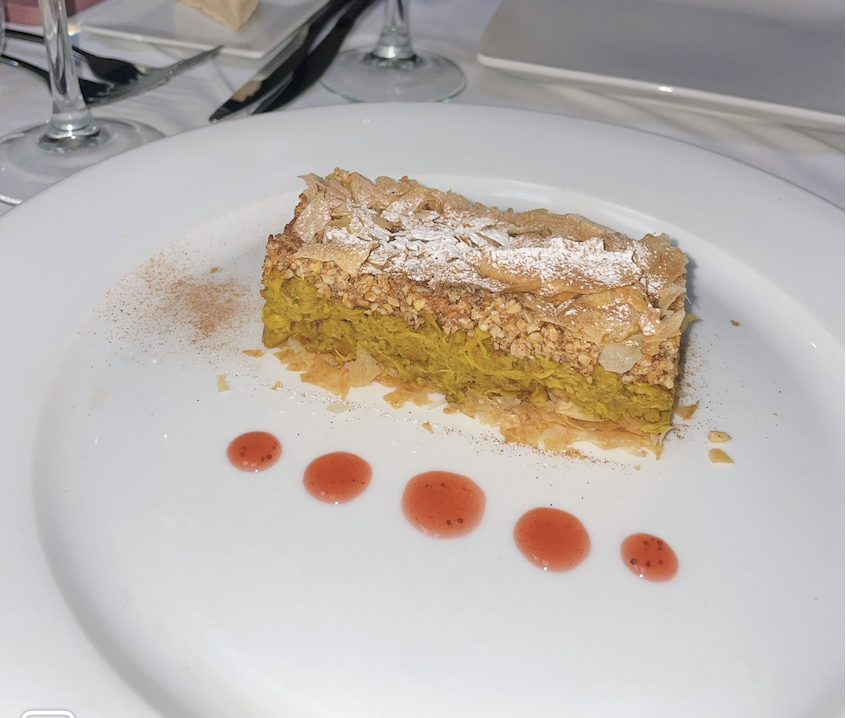
My parents recently visited Marrakech, and I hunted for well-rated restaurant to really show them the amazing food of Morocco. I landed on Riad Casa Lalla, a riad and restaurant in the middle of the medina. Although this place is actually rated the 4th best restaurant in all of Africa, it was almost impossible to find without a guide who took us through winding back alleys to the unsuspecting main door of the riad. With such a prized title, I was interested to see how good the food actually was- and we were not disappointed in the slightest. I can hands-down say this was the best meal I’ve ever had in Morocco! They had two menu sections: international food on one side and an elevated spin on traditional Moroccan dishes on the other. We started off with their traditional chicken pastilla, which was the perfect mix of sweet and savory. From that very first bite, I knew we were in for a treat!

a beautiful riad with live music

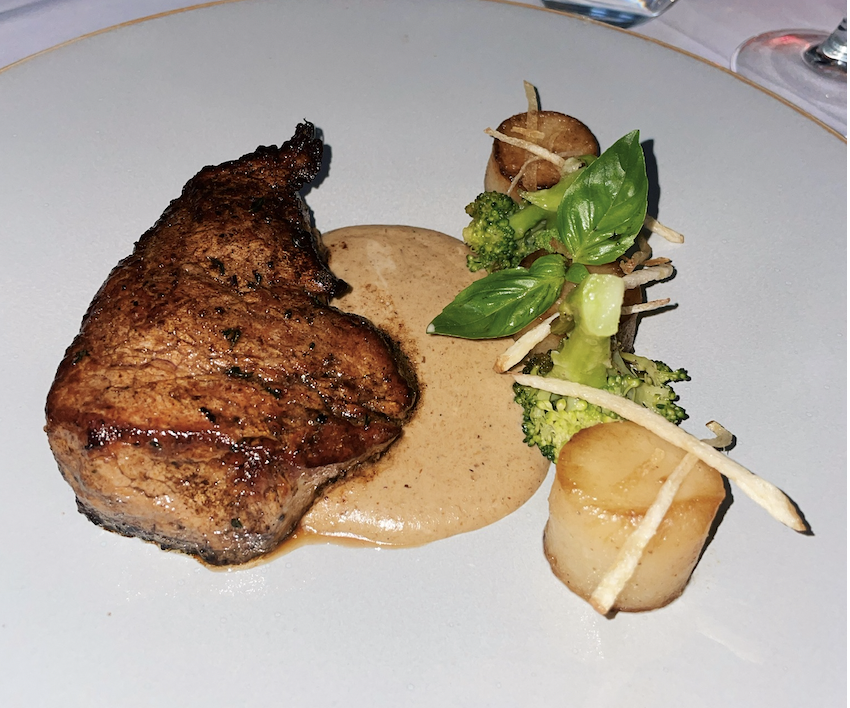
My dad ordered the chicken couscous, which was topped with sweet tfaya sauce and fancy garnishes. While you would never typically see couscous plated this way, it was absolutely delicious with the meat and couscous melting in your mouth. My mom ordered the slow-cooked lamb with dried fruits, which looked phenomenal. I ordered the medallion of beef which was served with a porcini mushroom sauce. The meat was cooked perfectly, and I could’ve drunk an entire bowl of the mushroom sauce. We finished things off with a selection of Moroccan pastries and washed everything down with mint tea of course. The meal was accompanied by live traditional Moroccan music, making for a peaceful atmosphere to enjoy the most incredible meal! If you ever visit Marrakech, I cannot recommend Riad Casa Lalla enough!!!

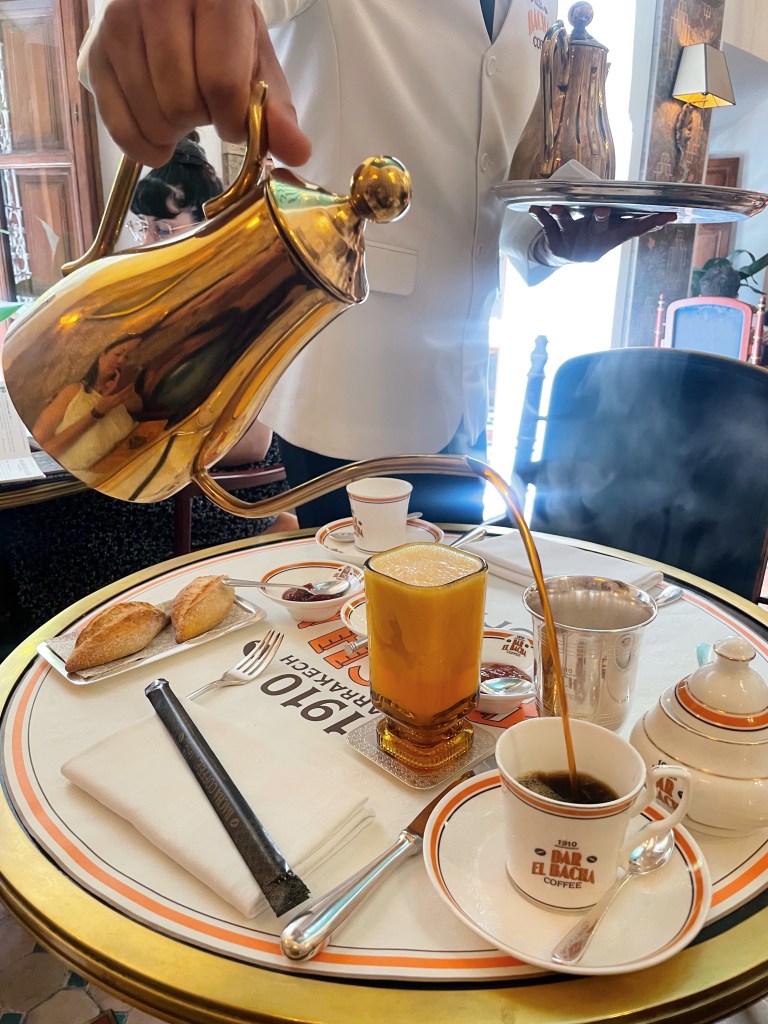
the stunning coffee house

With my parents in town, I also took them to Dar el Bacha, a historical palace turned museum. However, our primary goal wasn’t to see the museum exhibits, but to actually visit the coffee house inside. I’ve heard so much about how incredible Bacha Coffee is, from amazing reviews to the typical two hour wait for a table. With the museum opening at 10am, we were shocked to find a line formed outside the main doors 20 minutes before opening! After a bloodbath to get our tickets and put our names on the café list, we waited about 1.5 hours for a seat. While this may seem a bit crazy just to get a cup of coffee, it was 100% worth it. The café has an exquisitely decorated, colonial atmosphere and has over 200 Arabica coffees selected from over 30 regions around the world. The coffee menu had over six pages of single origin coffees, subtle blends of coffee, coffee with delicate flavors, and naturally decaffeinated coffees, all sourced directly from organic growing, harvesting, and processing techniques. Every single cup is roasted separately by hand, using traditional preparation methods so the beans don’t lose an ounce of flavor.

beautiful coffee pour

It was so fun to just browse the menu and gawk at the hundreds of different coffee options. While most coffees cost about $4, there were a few unique options. One blend from Brazil was a whopping $127 per cup! When we asked our waiter why it was so expensive, he explained that it’s a rare blend from the mountains where they only produce 8kg of it per year. Another blend (kopi luwak) is from Indonesia, and made from coffee cherries eaten and defecated by the Asian palm civet. The rich flavor comes from the fermented cherries as they passes through the civet’s intestines. Unique!

an amazing selection of desserts

Overwhelmed by the endless options, each of us took a recommendation from our waiter based on our personal coffee preferences. I had the Café Happy Glanduja, an Arabic blend with Italian hazelnut accents. My dad had the Café Surabaya Gold, a bold Asian, Africa, Arabian blend of Corsican coffee. My mom had the Café Siena Breakfast, an Italian blend with light notes of cocoa and milk chocolate. They truly have something for everyone! This was some of the best coffee I’ve ever had, served with homemade whipped cream and grated vanilla bean flakes.

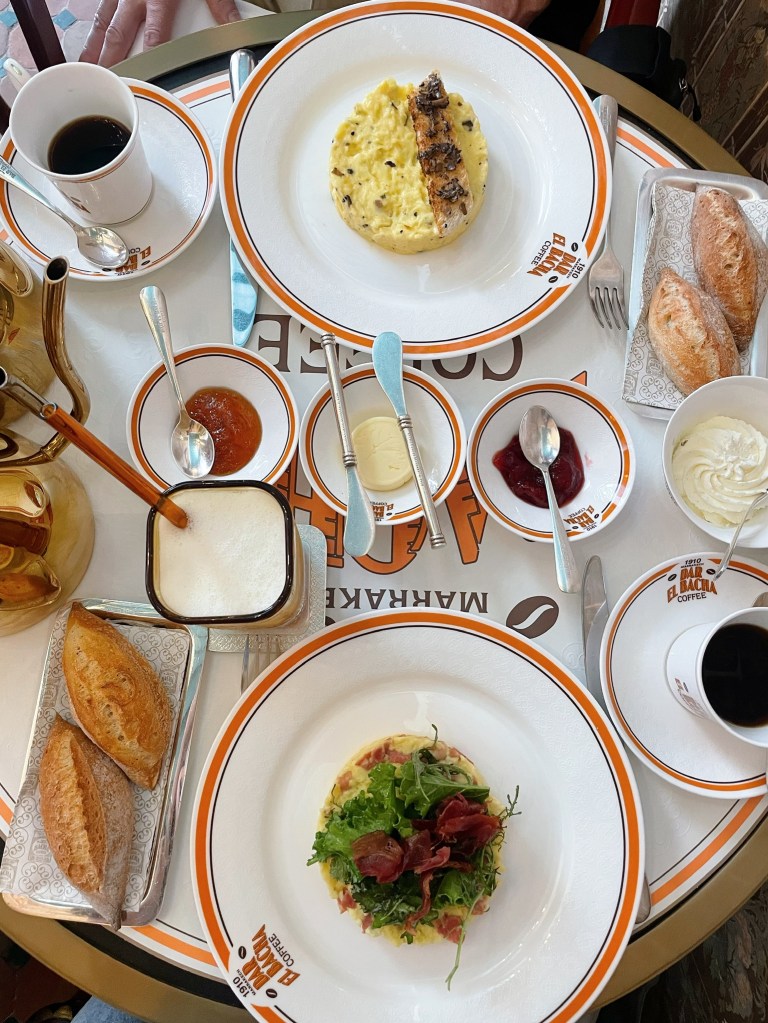
our egg breakfast

We also shared a few of their breakfast items including the black truffle eggs, an almond croissant, chocolate pistachio croissant, a few more assorted pastry items, fresh juices, and a fruit platter. As an avid coffee-lover, I had the time of LIFE here and enjoyed every single moment. Not only was the coffee and food delicious, but the eclectic atmosphere and great service made for such a fun dining experience that was entirely worth the crazy hype and certainly lives up to the hype in my opinion. It was truly a coffee-lover’s paradise!

Being in Morocco has exposed my food pallet to so many new dishes, cooking styles, and flavors- from traditional meals in the mountains to luxury coffee experiences. As someone who is definitely traveling on a budget, it’s a relief that the majority of food in Morocco is actually very affordable and reasonably priced for the quantity and quality you receive. But treating myself to a fun dining experience every once in a while is one of my favorite things, especially when guests visit. A big thank you to my parents who are kind enough to enjoy (and fund 😀) some of these food experiences with me. I attribute my love for good food to them, and I’m so grateful they were able to visit and we could share in some special meals and delicious foods we will always remember.

Break in Barcelona

Due to Morocco visa policies, it was necessary for me to leave the country at some point this month. I decided to plan a trip to Barcelona because of the cheap flight and close proximity to Morocco. I spent a few days in Barcelona about five years back in high school, so I was really excited to return and experience the city again. And I was able to time it perfectly and spend a quick couple of days with a good friend from home.

Sidenote: a HUGE shoutout to the lovely Victoria for sending me all of her restaurant, bar, and travel recommendations from her semester abroad in Barcelona! My trip would not have been complete without all of her advice and the amazing places she shared with me.

the pizzadillo

I landed in Barcelona on Thursday evening and checked into my hostel. I headed out to get dinner at Orac Gastrobar, a Spanish bar in Eixample. They are known for their pizzadillo, a calzone-like sandwich made with fermented pizza dough. I ordered one filled with tomato, Italian spicy pepperoni, mozzarella, and chili oil. It was absolutely delicious and the perfect comfort meal for my first night in Barcelona!

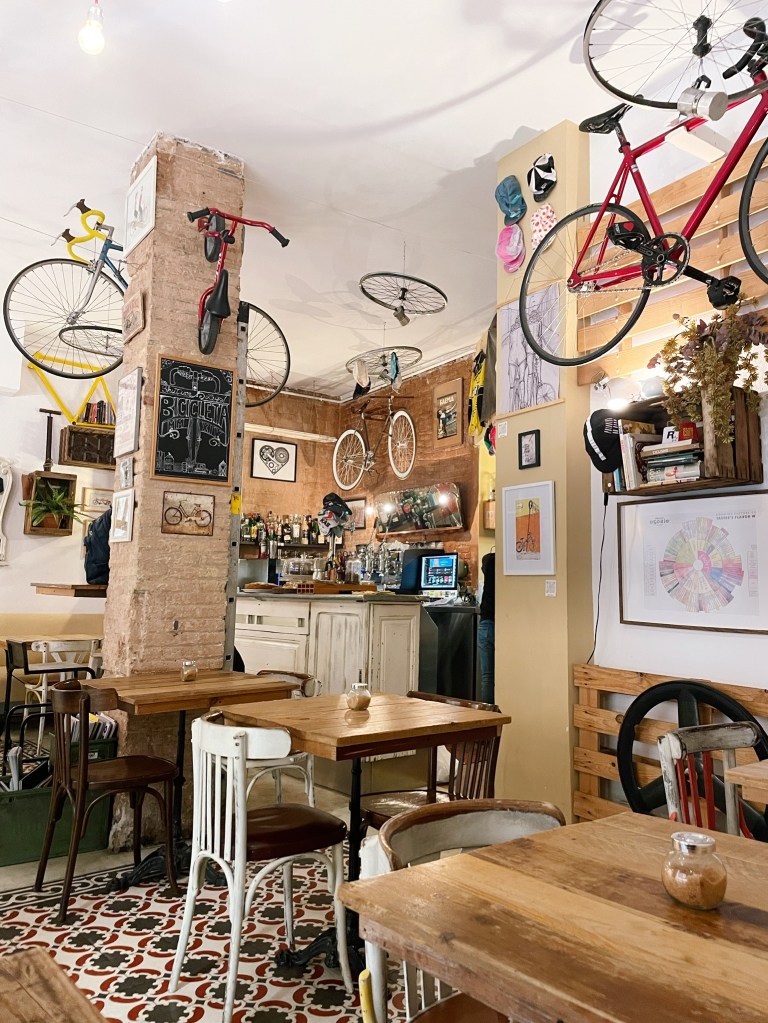
breakfast at Bicioci Bike Cafe

For day one, I headed out early at 7am and took the metro up to Park Güell. I had read on many websites that they offer free entry before 8am, but sadly all the entrances were still restricted for visitors. I was bummed since I was really looking forward to walking through Antoni Gaudi’s famous park again, but I was still glad to be up early for the day. Instead, I decided to wander through the Gràcia neighborhood, a 17th century district at the bottom of the Collserola mountain range. This area was so quiet and residential, especially in the morning, which was a nice contrast from the overly crowded, touristy streets of La Rambla and the Gothic Quarter. I stopped for breakfast at Bicioci Bike Café, a bohemian café with specialty coffee, sandwiches, juices, and pastries.

incredible pastries at Chök

From there, I walked to Plaça de la Virreina, a small square filled with shops and a church built in 1884. I grabbed a coffee at Chök, a vegan, handmade chocolate shop I stumbled upon. I had a praline latte which I think might have been one of the BEST lattes I’ve ever had in my life – it was so delicious. I spent the rest of the morning sitting in the square, which was so quiet in the morning, watching locals run their morning errands and the shops start to open.

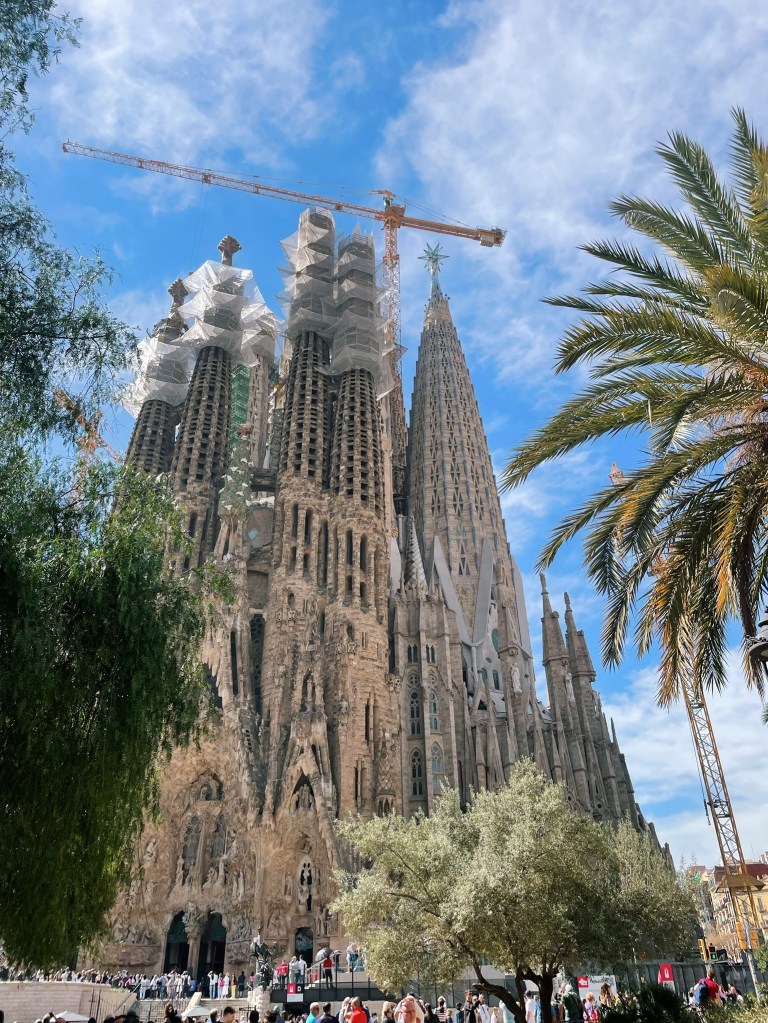
the Sagrada Familia

Next, I took a long walk down to the Sagrada Familia, a Catholic church designed by Antoni Gaudi. I didn’t have tickets to go inside, but the outside of the church is spectacular, with so many unique engravings, statues, and art forms. I sat in the park surrounding the church just admiring the architecture and watching the crowds get gradually more busy as the day went on.

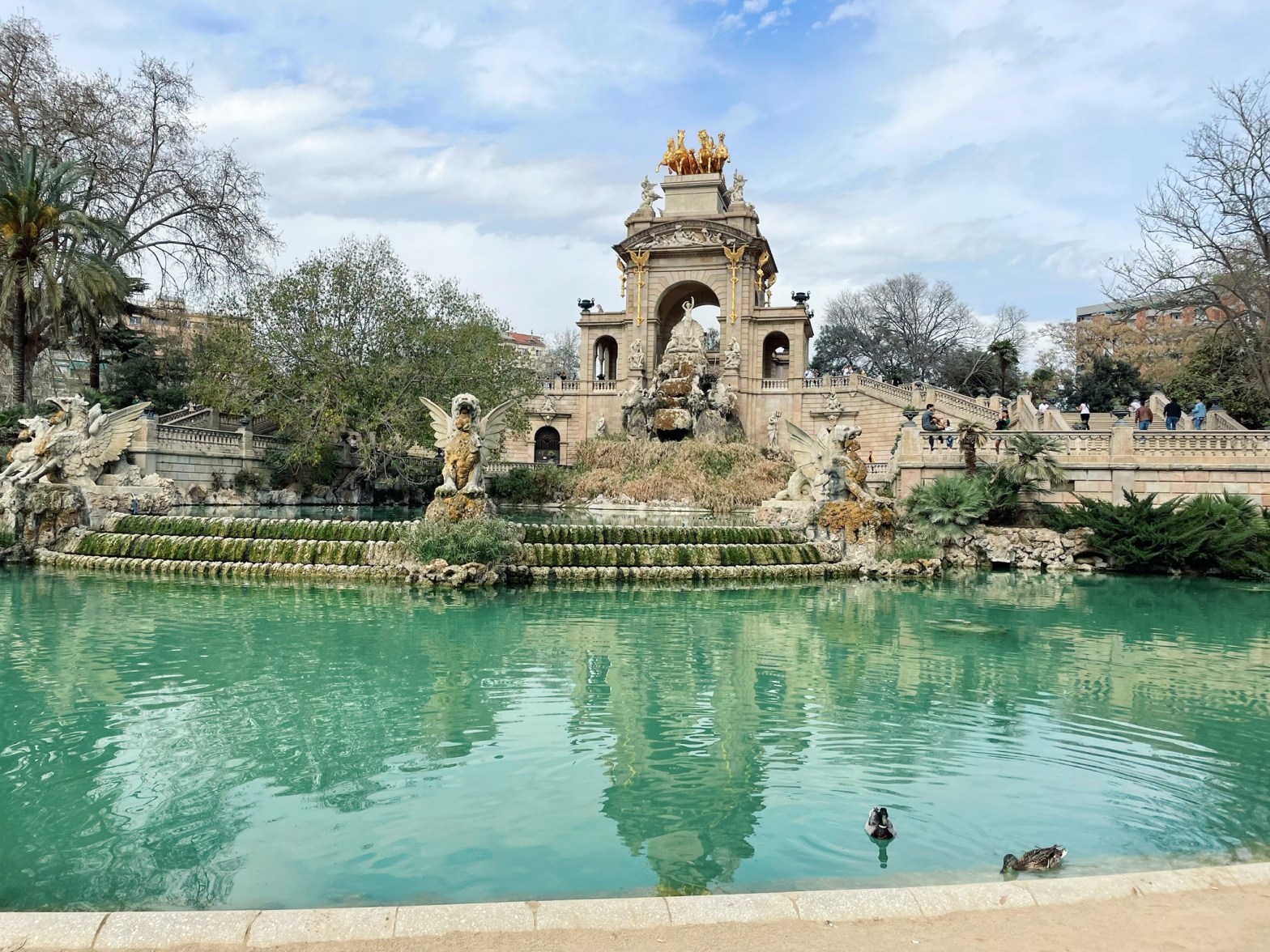
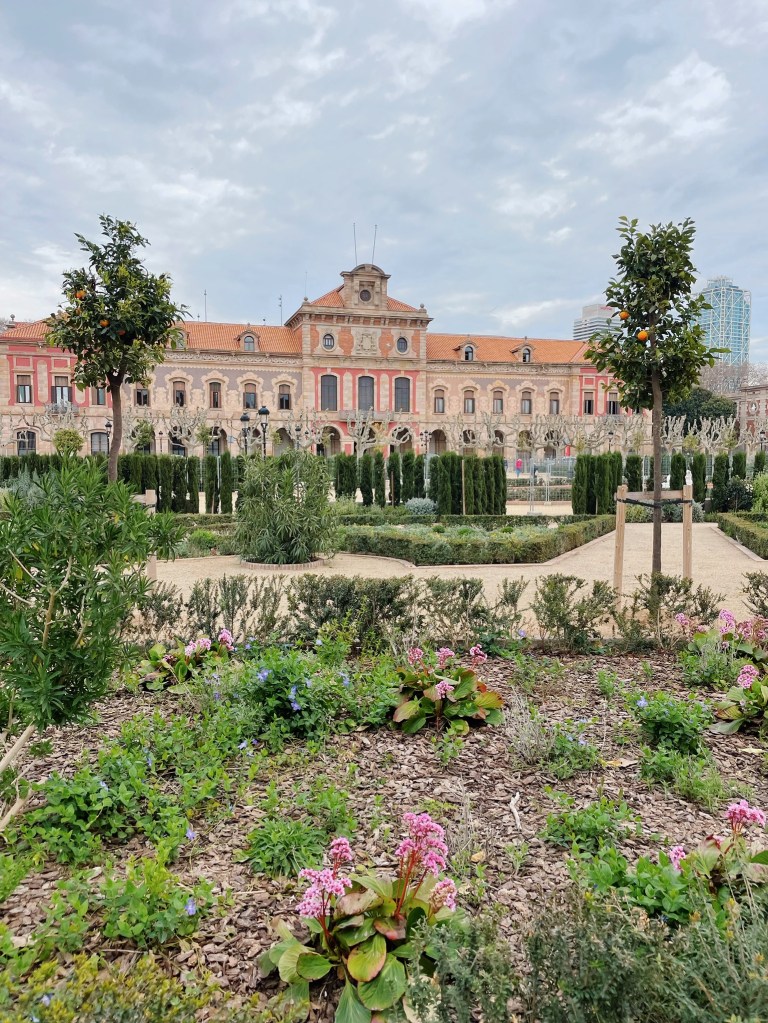
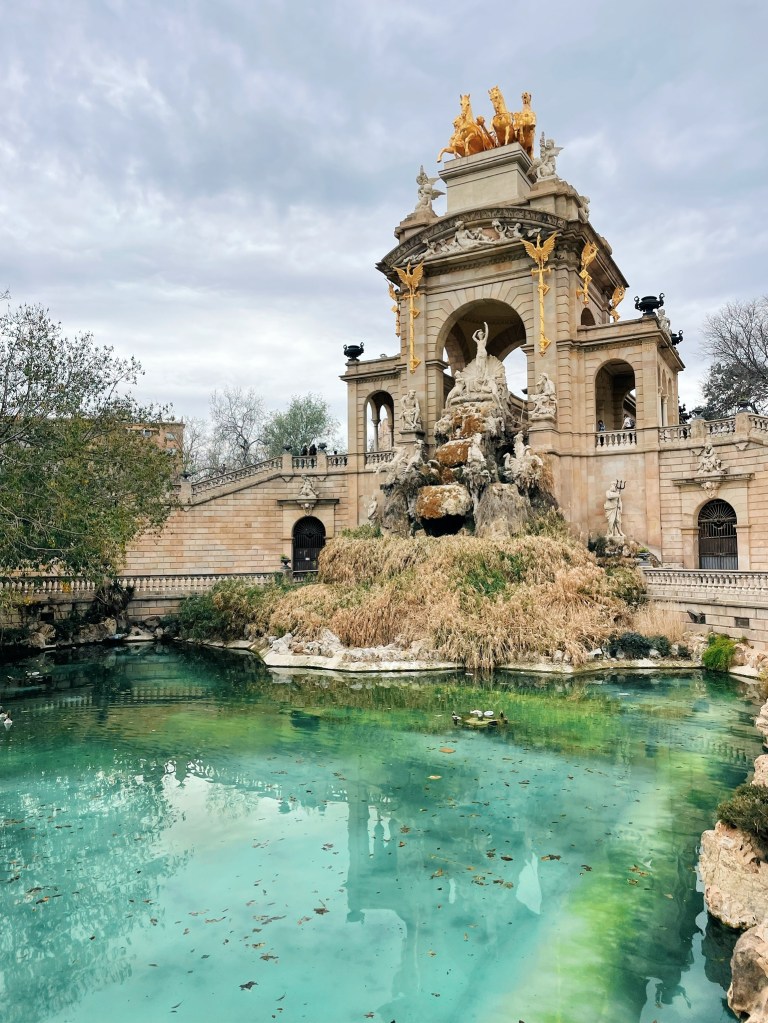
I grabbed a to-go lunch of a salad and an eggplant croquette at Paisano Bistro, a cozy Italian restaurant near the Sagrada Familia. I took my food for a little picnic at Ciutadella Park, a beautiful greenspace containing the Barcelona zoo, the Palau del Parlament de Catalunya, a small lake, museums, and a stunning fountain designed by Josep Fontserè and Antoni Gaudi. The Cascada or fountain was such a beautiful display, and was modeled to resemble the Trevi Fountain in Rome. I found a quiet grassy spot under a tree to enjoy my lunch, and spent an hour or two just enjoying the sights, reading, and listening to music. I wandered around the park a bit more, which was a nice escape from the craziness of the surrounding city.

delicious tapas!

For dinner, I went to La Bodegueta, a tapas bar recommended to me by Victoria. This place was so small and cozy and had a much more authentic feel to it. I had a glass of wine to start, and ordered the calamari, patatas bravas, and a croquette for tapas. Everything was delicious and the staff was so nice and accommodating even on a busy Friday night.

the best churros

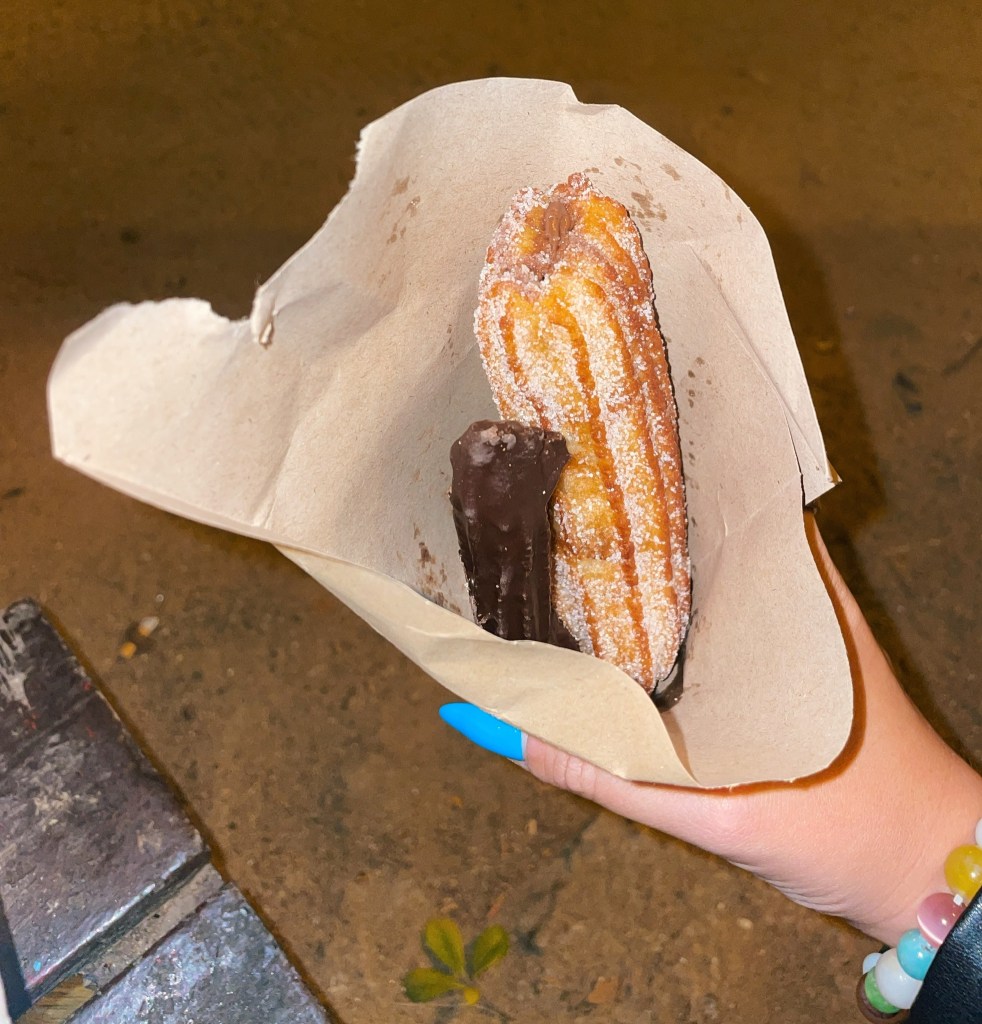
To end off the evening I needed something sweet, so I researched the best places to find churros and headed to Churreria San Román. I ordered a simple chocolate filled churro which ended up being ginormous but so incredibly delicious. Even just holding the churro in my hand, I was shocked at how heavy and filling it was. Getting back to my hostel, I checked my step count and realized I had walked over 28,000 steps that day! I was exhausted but so content with my first day in the city.

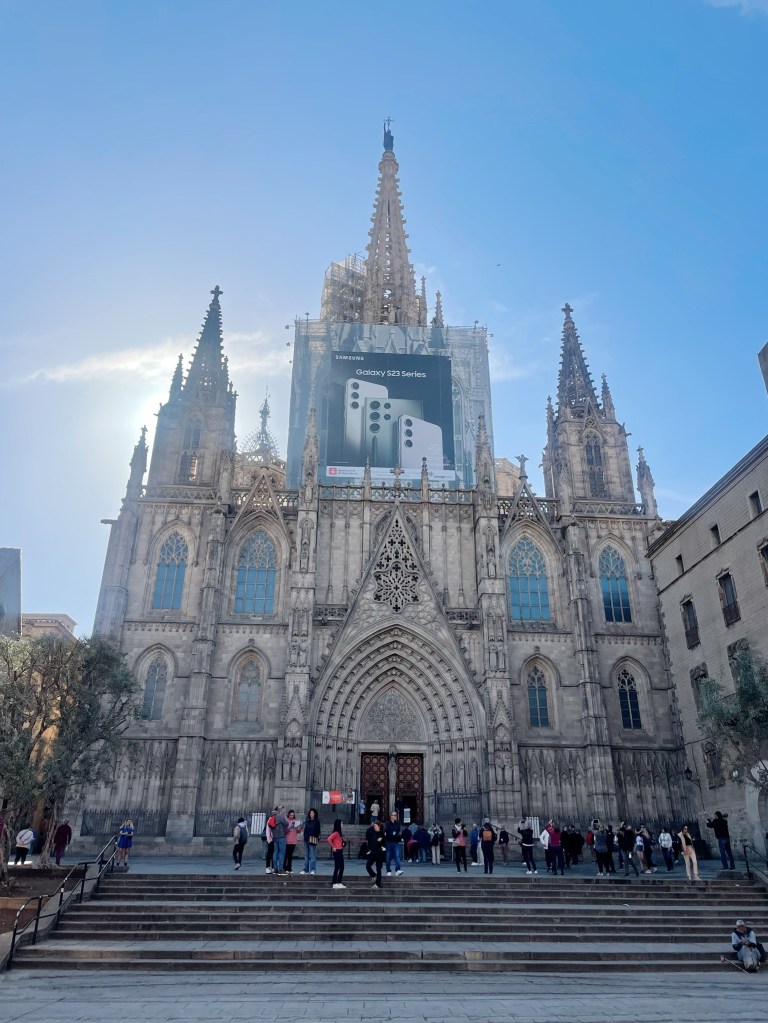
the Samsung Cathedral

I woke up on Saturday and headed out early once again to try and beat some crowds and enjoy the Gothic Quarter. I grabbed a quick meal at breakfast café and then walked to the Barcelona Cathedral, another beautiful church. While the outside of the cathedral is incredible to look at and so intricately constructed, the huge Samsung Galaxy S23 Series advertisement on the front felt pretty out of place. While a bit of an eyesore, apparently Samsung is financing the restorations of the cathedral, so they clearly took advantage of the opportunity for some adverting as well.

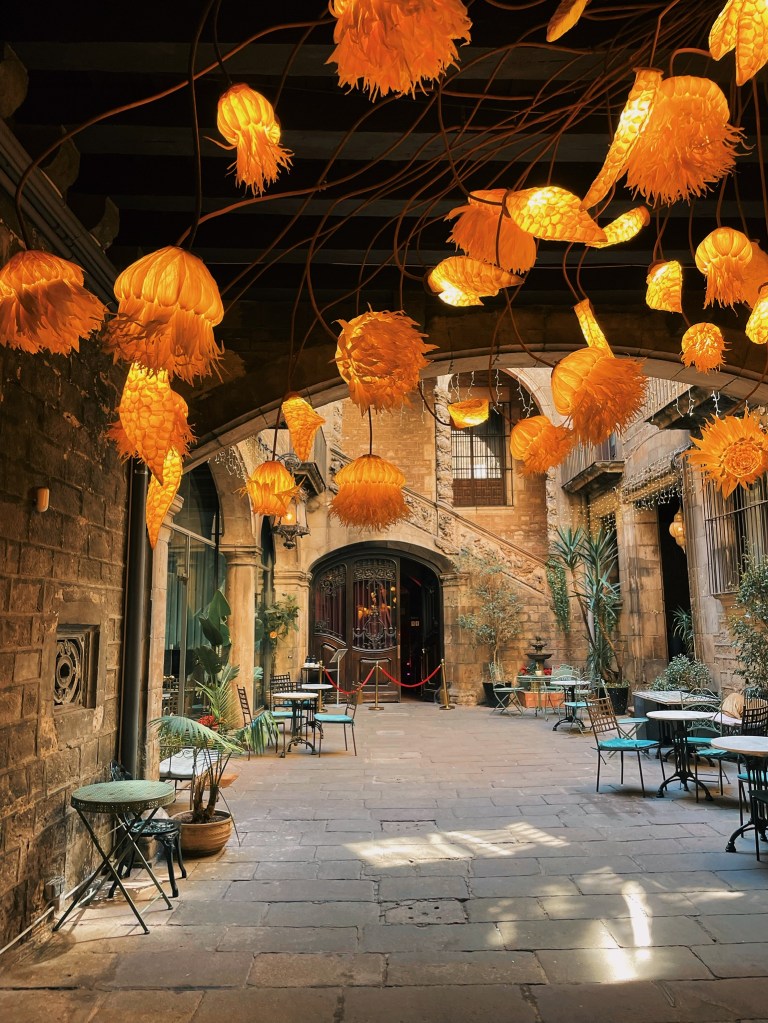
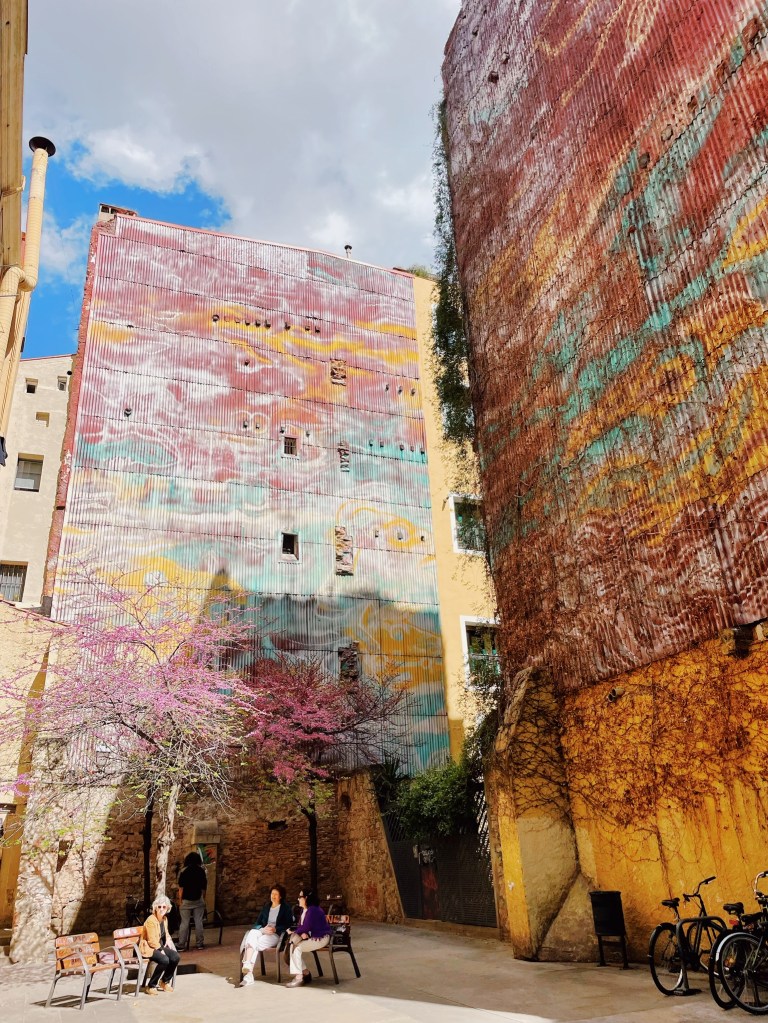
While in the Gothic Quarter area, I did some plaza hopping, sitting in each square for a while just to enjoy the quietness and sights. I started at Plaça del Pi which contains the Santa María del Pi church, built in the 1300s. Next, I walked to Plaça Reial, one of the most popular squares with tons of restaurants, cafes, and lampposts designed by Gaudi. I absolutely loved this area as it was sunny, filled with people, and even had a small artisan market to walk through. Even better, the entire artisan market was filled with little tents of crafts, arts, and goods all celebrating sustainable art and practices! After enjoying a coffee and walking through the market, I walked to Plaça George Orwell, named after the famous 1984 author. This square was also neat as it had more of a grungy feel with quirky shops and bars. I ended my wanders by the water, sitting near Marina Port Vell to enjoy the sea and the sun.

El Bosc de les Fades

For lunch I headed over to El Bosc de les Fades a super unique restaurant bar on La Rambla. Walking inside, it looks as if you’ve entered a magical forest with trees, fountains, and colorful lighting filling the space. There was even a simulated thunderstorm in the middle of lunch, which was funny and felt a bit like rainforest cafe.

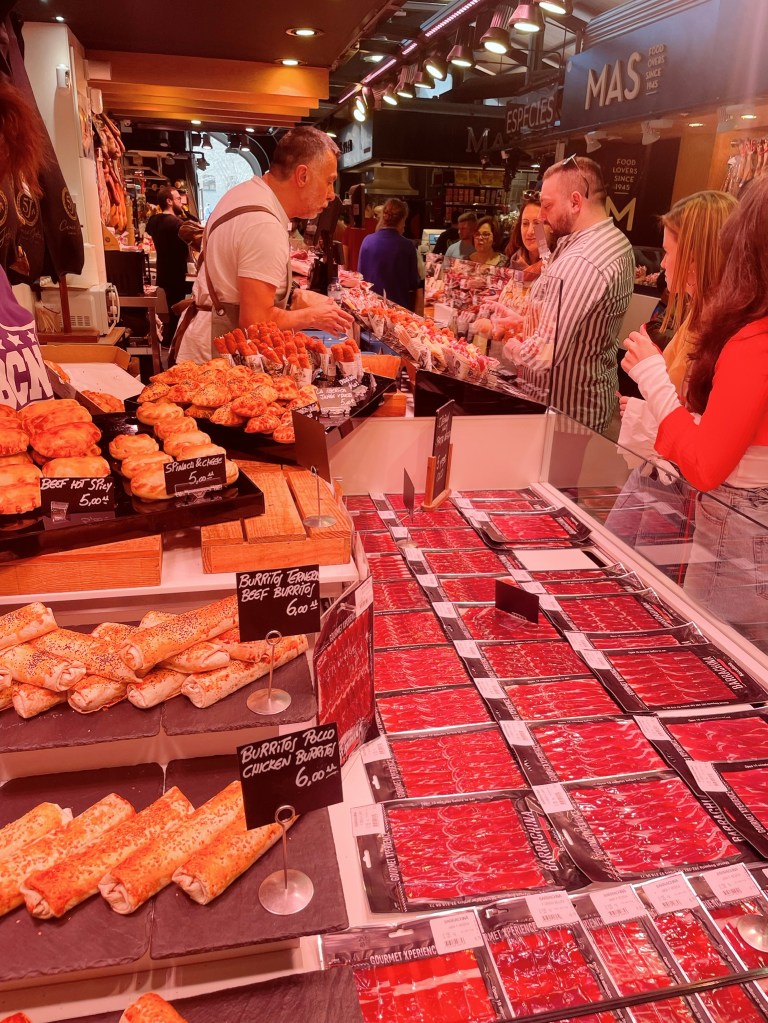
I spent the rest of the afternoon wandering around the streets near La Rambla which were filled with lots of bustling restaurants, shops, and crowds. I walked through the Mercat de Sant Josep de la Boqueria a popular public market with endless stands of fruit, meats, seafood, tapas, and baked goods. This market was absolutely packed with people, making it so hard to walk through, so I just took a brief look and wandered around the perimeter which was much calmer.

espresso martinis and Kendall

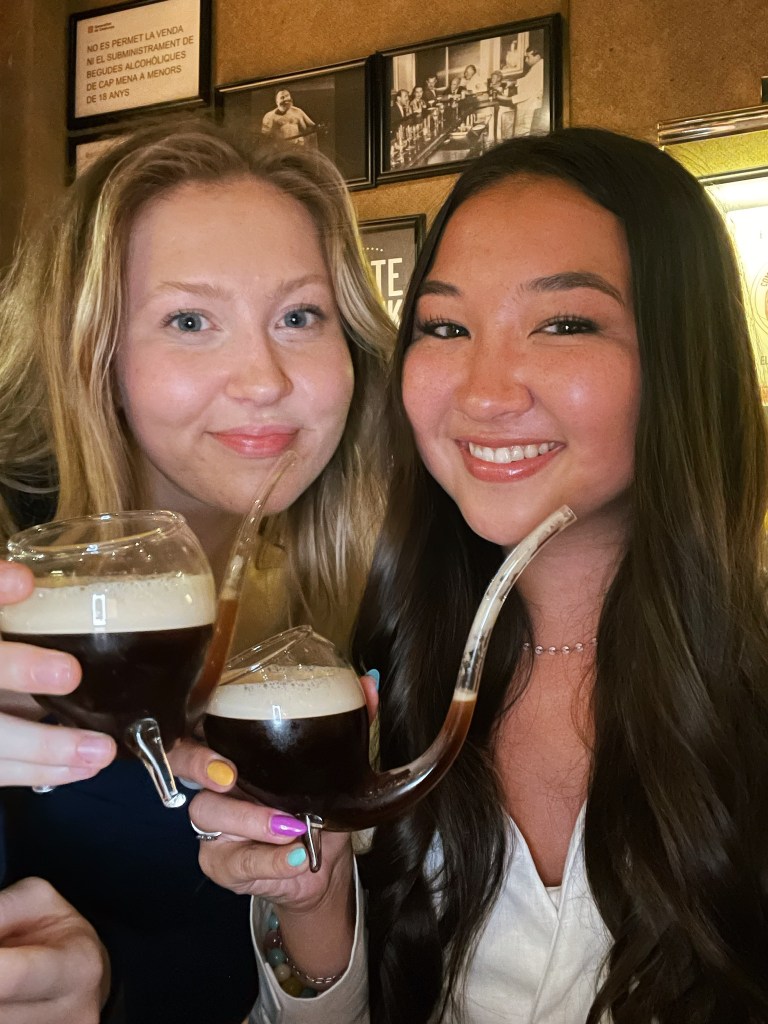
For dinner, I ate at Belladona, a tiny tapas bar with great drinks. In the evening I was finally able to meet up with Kendall and enjoy the fact that we could both be back in Barcelona together after our trip years ago in high school. We went for drinks at Hemingway Gin and Cocktail, another incredible suggestion by Victoria. This basement cocktail bar had incredible mixology-inspired drinks and we had one of the best espresso martinis I’ve maybe ever had! It was so nice to catch up on the past few months and get excited about the rest of our trip.

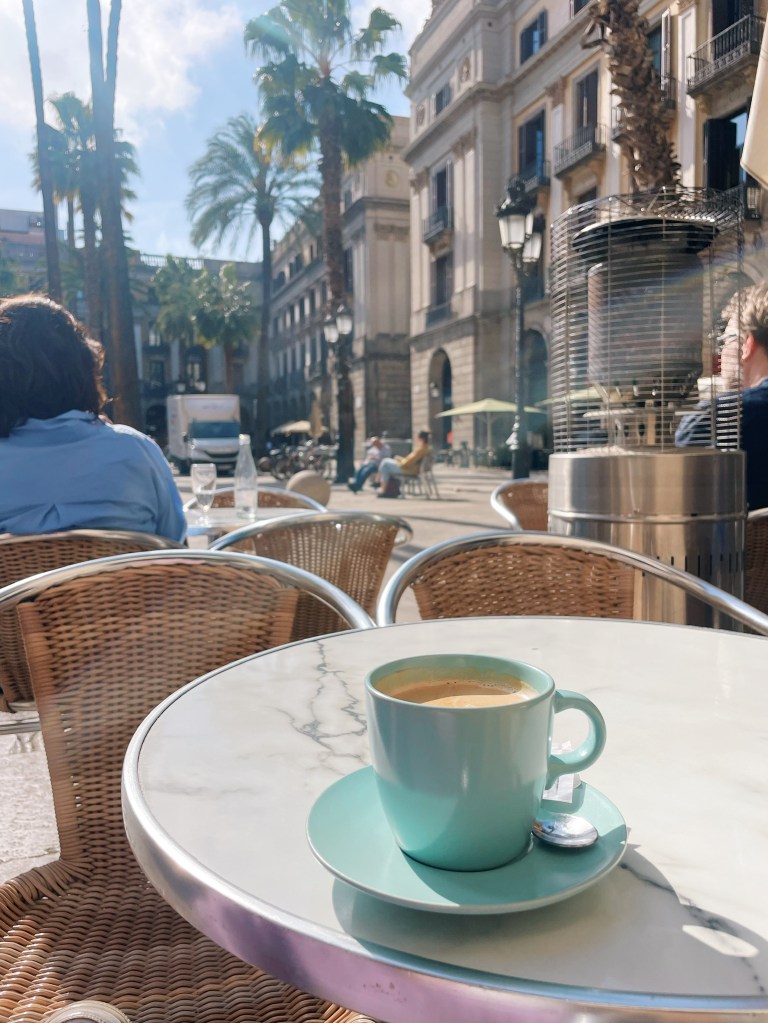
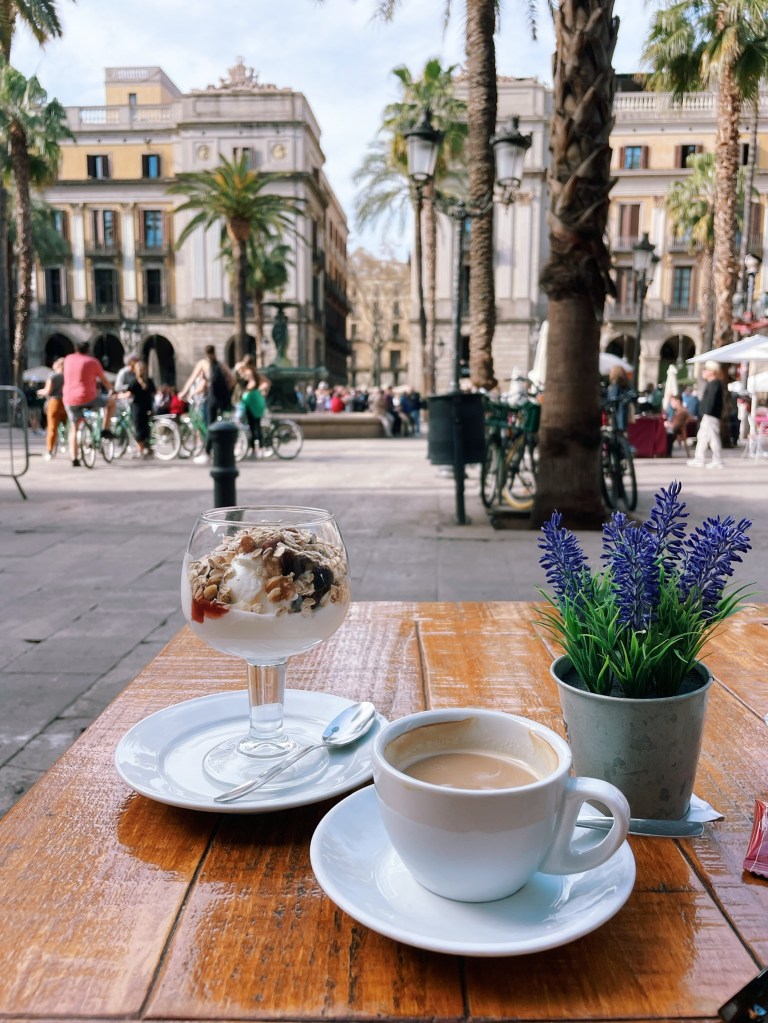
breakfast in Plaça Reial

The next morning, I headed back to Plaça Reial for coffee and breakfast, an area I’ve really enjoyed. I love being able to sit at a café facing the square and enjoy the quieter space in the early morning. I decided to fuel up with one more coffee at a small side café on La Rambla, which was a prime spot for just sitting and observing all of the busy sights and crowds of people strolling by.

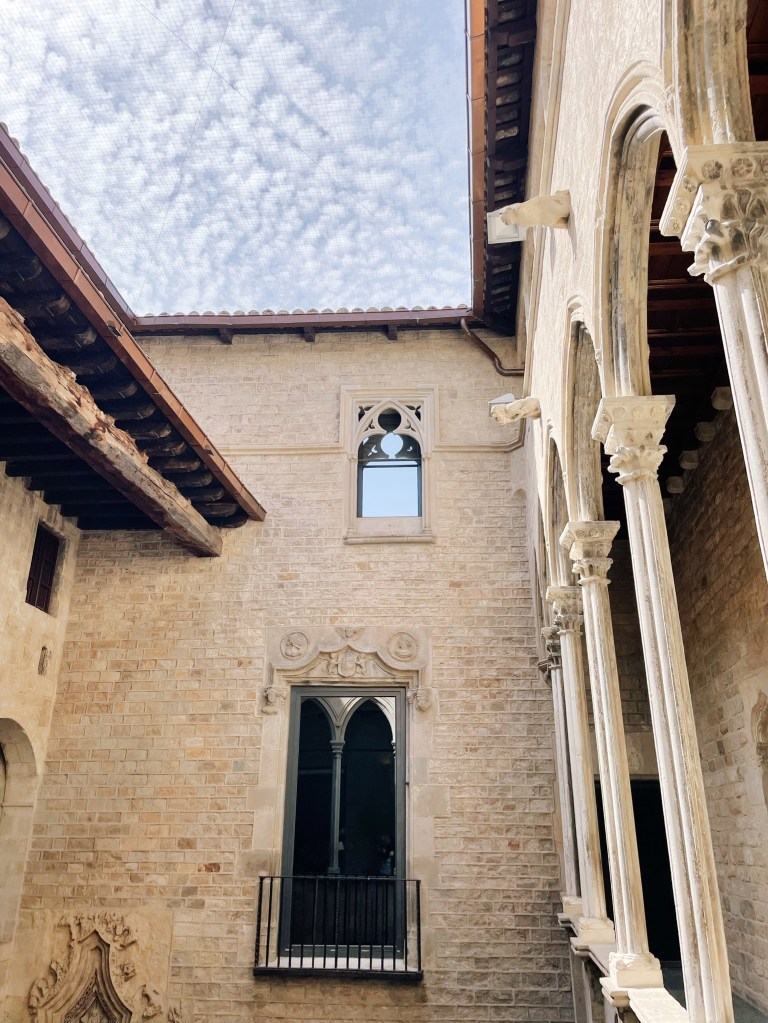
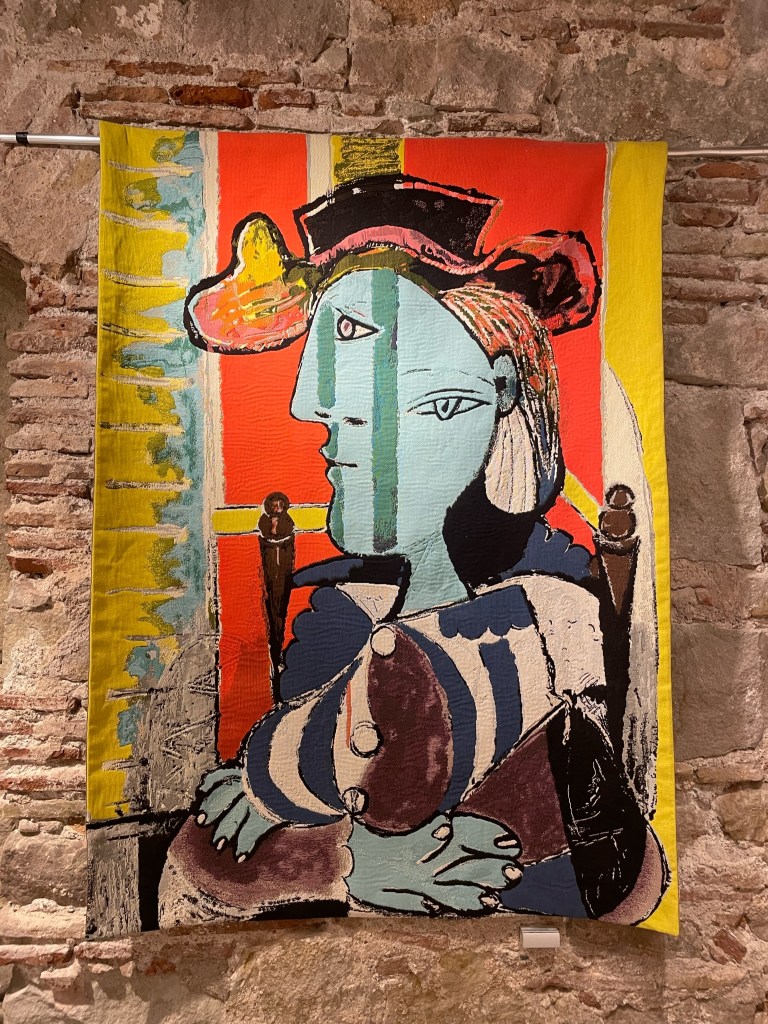
In the afternoon, I had tickets to the Picasso Museum, which holds an extensive collection of incredible pieces of Picasso. It was an amazing tour through the formative years of his life as an artist, and displayed moments in his life and his surroundings influenced his art and his style. It was so neat to see his artwork transition throughout time and how he used moments in his life to create beautiful paintings. You could spend forever just looking at all the obscurities and little details in his work.

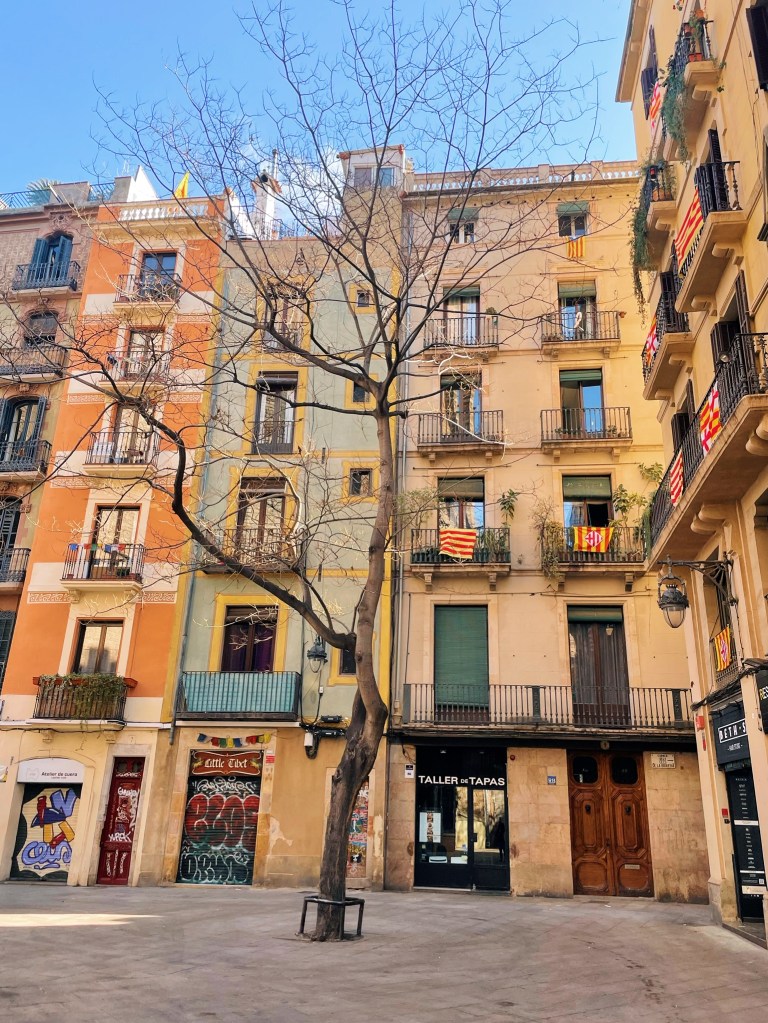
In the afternoon wandered some more around the Gothic Quarter, stopping to peek inside other small museums and interesting restaurants. I really love how spontaneous this area feels with so many winding alleyways and streets that hold little hidden gems of sights if you dig to look beyond the obvious attractions.

an incredible dinner at 7 Portes

Kendall and I met up again in the afternoon went for a pre-dinner drink in Plaça Reial at Glaciar. We enjoyed our cocktails overlooking the square and then headed to 7 Portes for a long-awaited paella dinner. 7 Portes is a traditional Catalan restaurant founded in 1836, and one of the oldest and most symbolic restaurants in the city. Picasso was even a popular diner! We enjoyed a pitcher of sangria along with the most spectacular lobster paella. This was such an amazing treat and we couldn’t stop talking about how amazing the food was. We ended our night with a walk by the water and stopped to split some churros for dessert. The perfect end to the day!

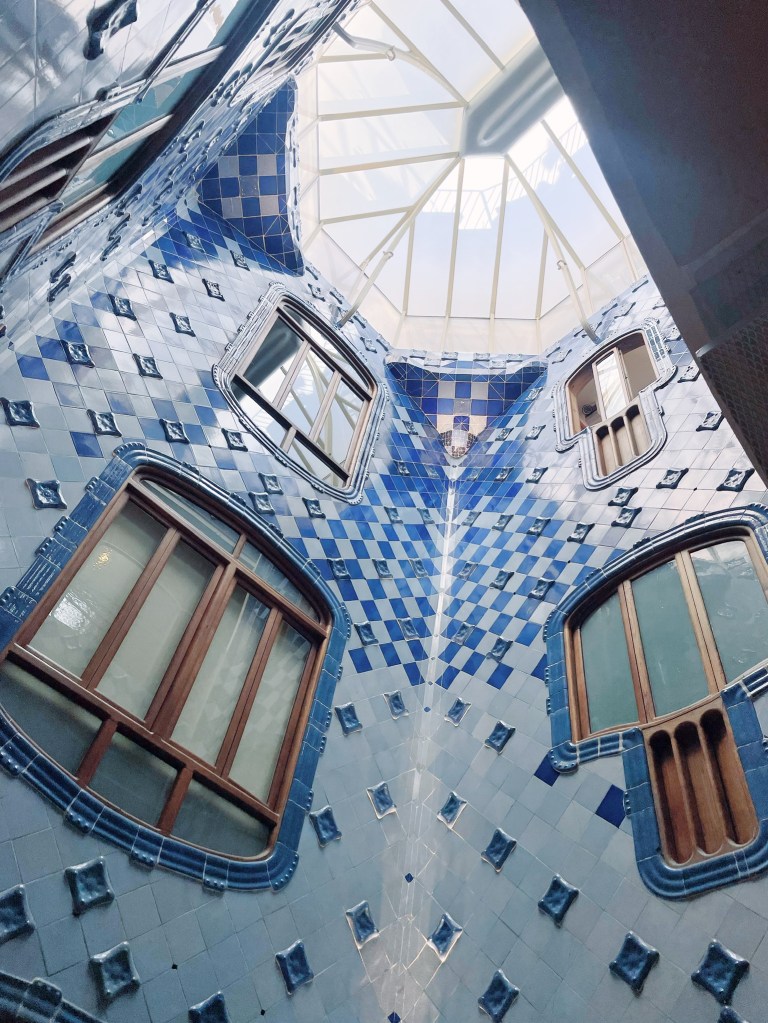
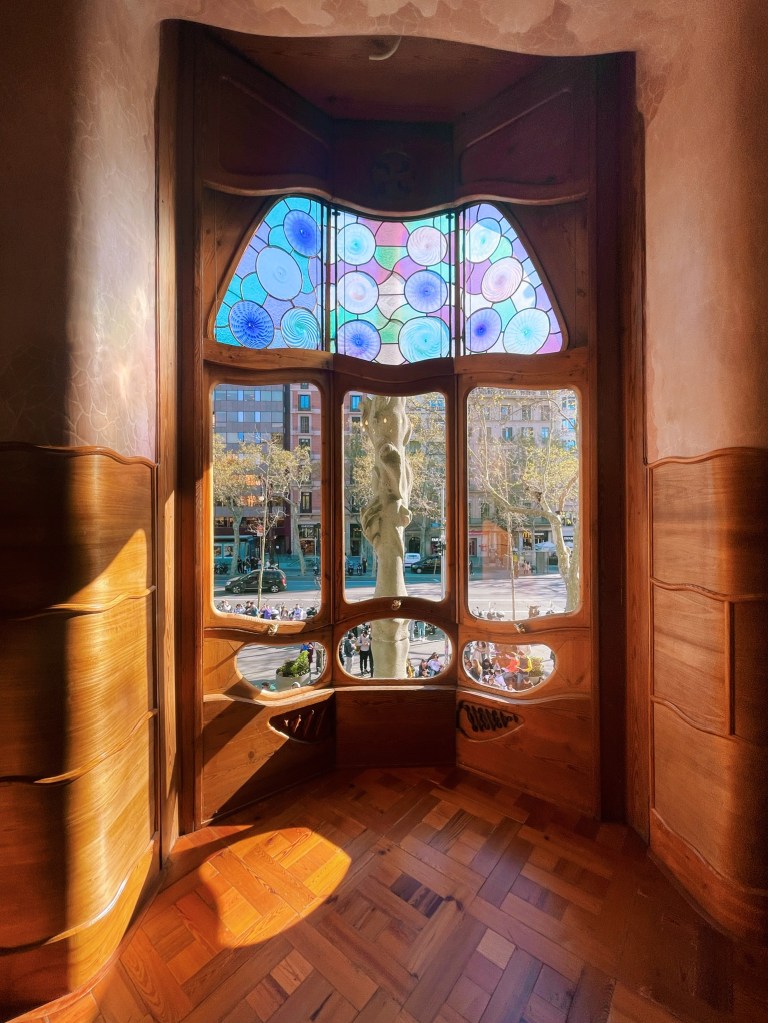
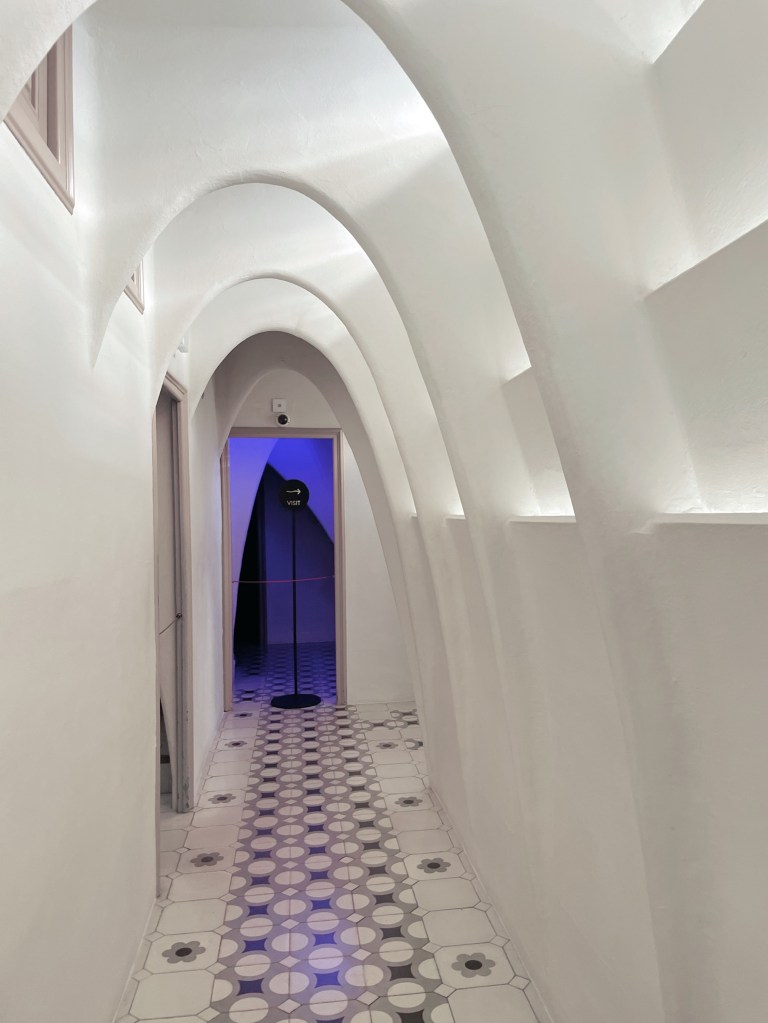
For my last day in Barcelona, Kendall and I had booked tickets to Casa Batlló, the Batlló family home designed by Gaudi. The façade of the home is colorful with curved windows and roofs, looking as if it’s almost flowing into the surrounding buildings. The inside was just as spectacular. I’ve never been in such a uniquely designed home with endless sunroofs, archways, mosaics, irregular colorful windows, and animal-inspired décor. Each room evoked such a special atmosphere, simulating everything from being under the sea to inside the belly of a monster. It was hard to capture how beautiful the house was through photos. The rooftop was an amazing spot with tiles modeled after the spine of a dragon and seating to enjoy the sun and views of the city. This museum was so amazing and definitely the highlight of my time in Barcelona. It so perfectly displays Gaudi’s creative talents and I have such an appreciation for his architectural and design work and how it’s influenced the city of Barcelona.

After the museum we had a coffee at Artisa, a café we discovered and loved while in Barcelona five years ago. We enjoyed one last lunch and round of tapas at Tapas Gaudi, before strolling a bit longer and seeing Barcelona’s Arc de Triomf.

My four days in Barcelona was such a wonderful trip! While I adore Morocco, it was fun to switch things up and be in a European city for a moment. During my time alone I really feel like I was able to reconnect with the excitement I feel in new places and rediscover the passion I feel for exploring and wandering. I view researching, planning, and crafting the perfect itinerary as such a fun challenge while travelling, and it’s the BEST feeling in the world to be able to test it out and try all the places you’ve worked to discover. I always make it a goal to maximize my experience in a new country and it certainly pays off. Barcelona is filled with such incredible architecture, art, and undeniably delicious food and I’m thankful to have been able to experience it all. And I’m more than grateful to have been able to enjoy it with familiar face from home and create even more fun memories in Barcelona. Not a bad visa trip at all!

The Blue Pearl of Morocco

I spent this past weekend in Chefchaouen, a small city up north in the the Rif mountains of Morocco. Nicknamed, “the Blue Pearl of Morocco”, Chefchaouen is known for its stunning blue-washed alleys and buildings – an atmosphere I was thoroughly excited to be completely immersed in. I traveled with four of my other coworkers making for a great weekend break from our work lives in Marrakech.

the Strait of Gibraltar in Tangier with Spain ahead

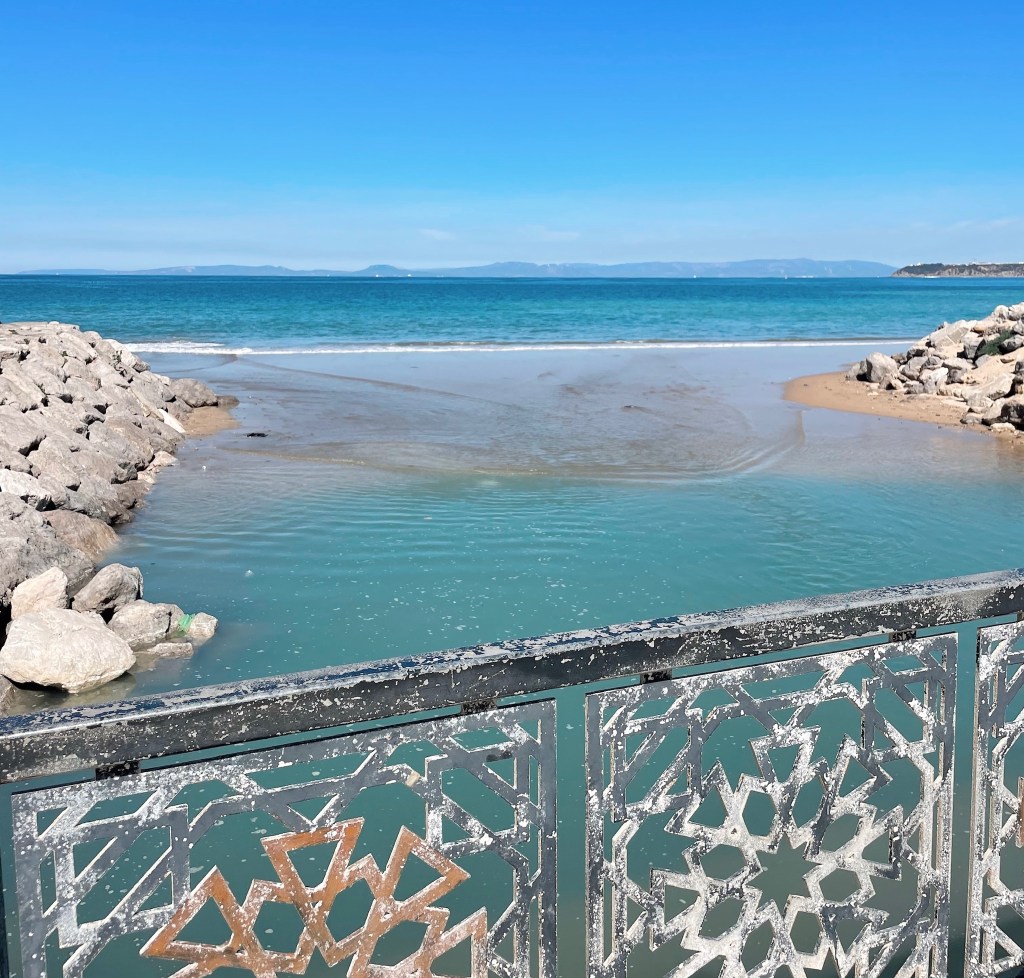
We started our travels by taking the train from Marrakech to Tangier, and then a bus from Tangier to Chefchaouen. We had a brief pit stop in Tetouan, which gave me some deja vu from my brief visit in high school! While the trip up north was long, the views made the journey worthwhile. The mountains and plains of Northern Morocco were so lush and green, a refreshing view compared to the typical red sand I’m used to in Marrakech. The ride was smooth as we passed alongside valleys, lakes, and small mountainside villages. At our brief stop in Tangier, we even had a chance to walk to the beach and dip our toes in the Strait of Gibraltar.

the view from our Airbnb

Upon arrival in Chefchaouen, we made our way to our Airbnb which was quite an unexpected trek. The streets of Chefchaouen are remarkably steep in certain areas, and a combination of the long travel day, a lack of sleep, and my heavy backpack left me pretty out of breath by the time we reached our accommodation. Alas, the journey was entirely worth it because our mountainside four-floor Airbnb had such a unique, earthen feel to it; complete with a beautiful rooftop terrace and panoramic views of the city. Arriving in the evening we spent the rest of the night enjoying a candlelit dinner overlooking the city and walking around the medina.

[Side note: I personally did not get the greatest treatment as an Asian American in Chefchaouen. Especially on our first evening, men were not afraid to aggressively yell racist harassments, especially since I stuck out a lot as a foreigner. Definitely a bit scary, and an important reminder to be extra cautious in more remote areas and to travel in a group if necessary.]

view of Plaza Uta el Hamman from breakfast

For our first full day, I woke up extra early in an attempt to see the sunrise from our rooftop. I didn’t realize that the mountains would block most of the view, but it was still nice to be up and enjoy the peace of the early morning before things got busy. When the others rose, we walked down to Plaza Uta el Hamman and enjoyed a sunny breakfast at a cafe rooftop. Since Chefchaouen is literally built into the mountainside, there are incredible views from pretty much any perspective. We spent a while at breakfast enjoying the warm sun, looking at the mountains, and people-watching in the plaza square below.

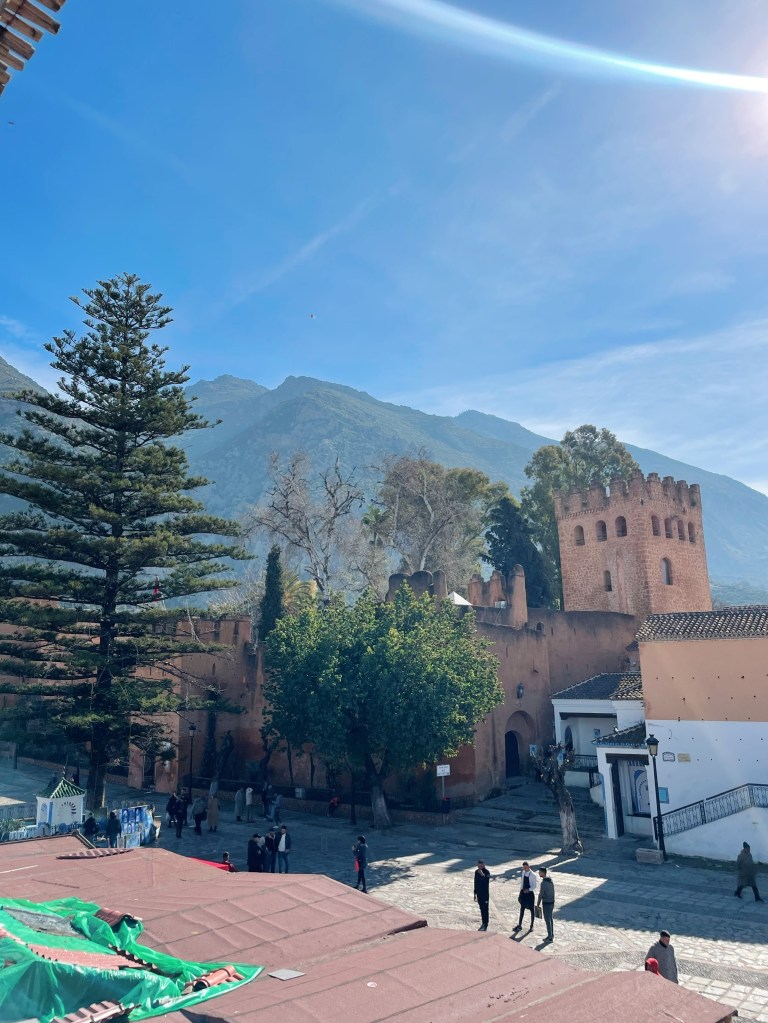
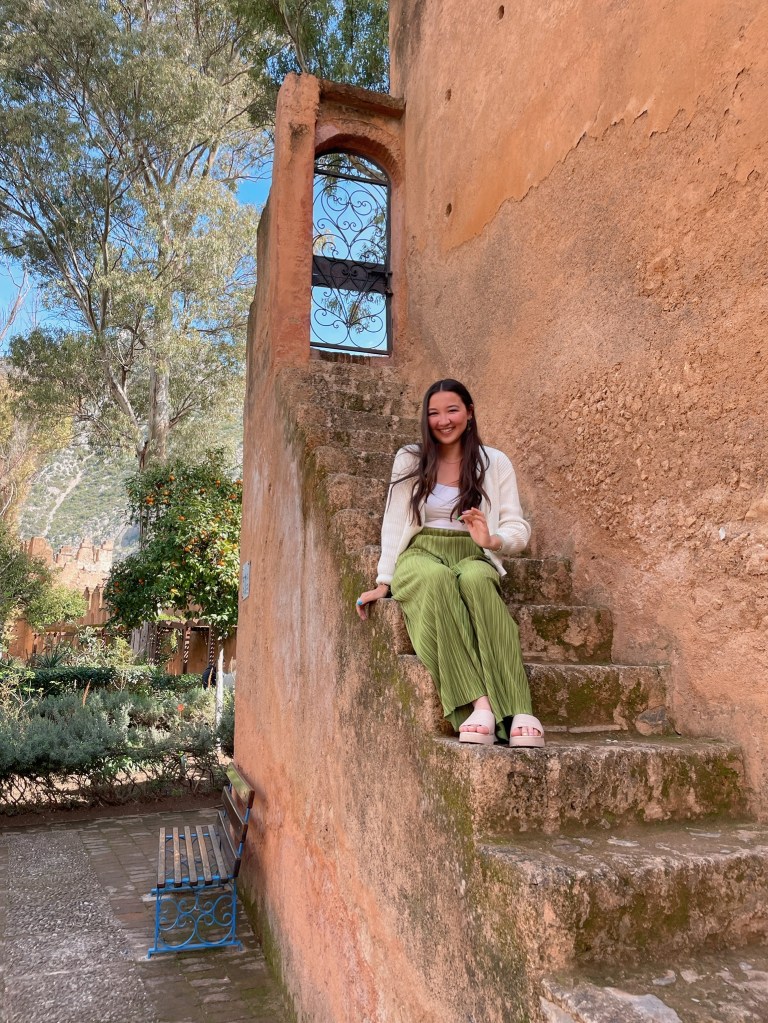
Next we headed to the Kasbah of Chefchaouen, an old fortification built in 1471 to resupply and launch counterattacks on the Portuguese. Stepping past the gate into the secluded Kasbah was a nice break from the loud, busy square. It was lovely to walk around the gardens, living quarters, prison barracks, a small museum, and the main watchtower overlooking the city. The Islamic window shapes with idyllic views of Chefchaouen made for great pictures and we spent a good amount of time finding the best photo spots.

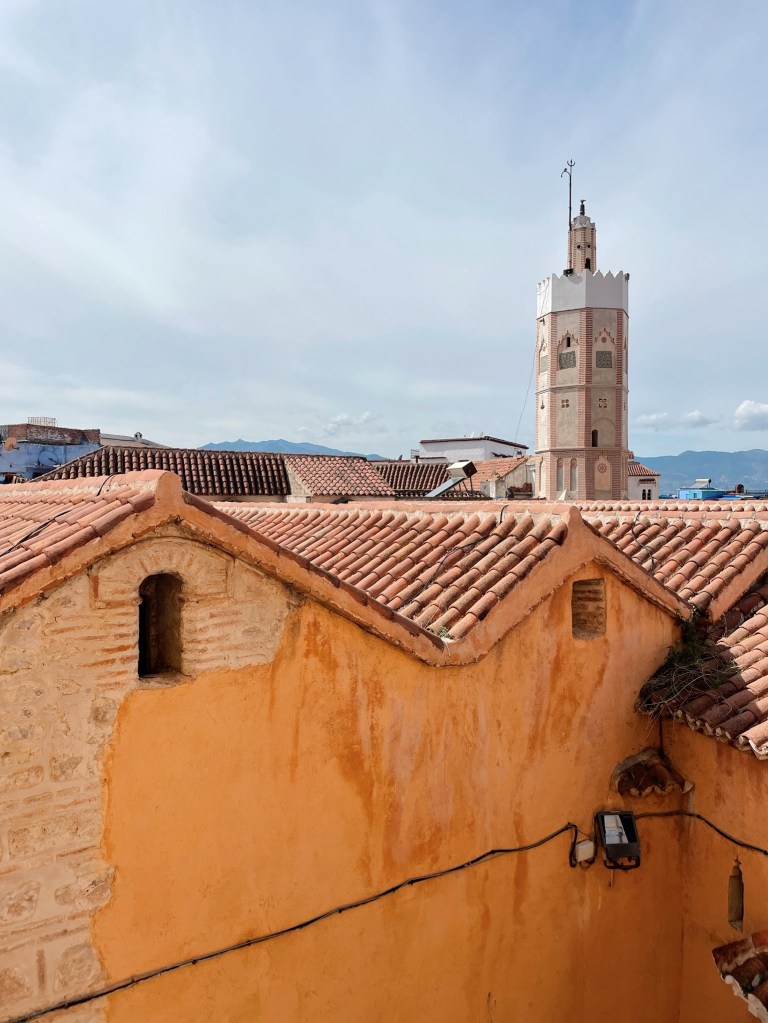
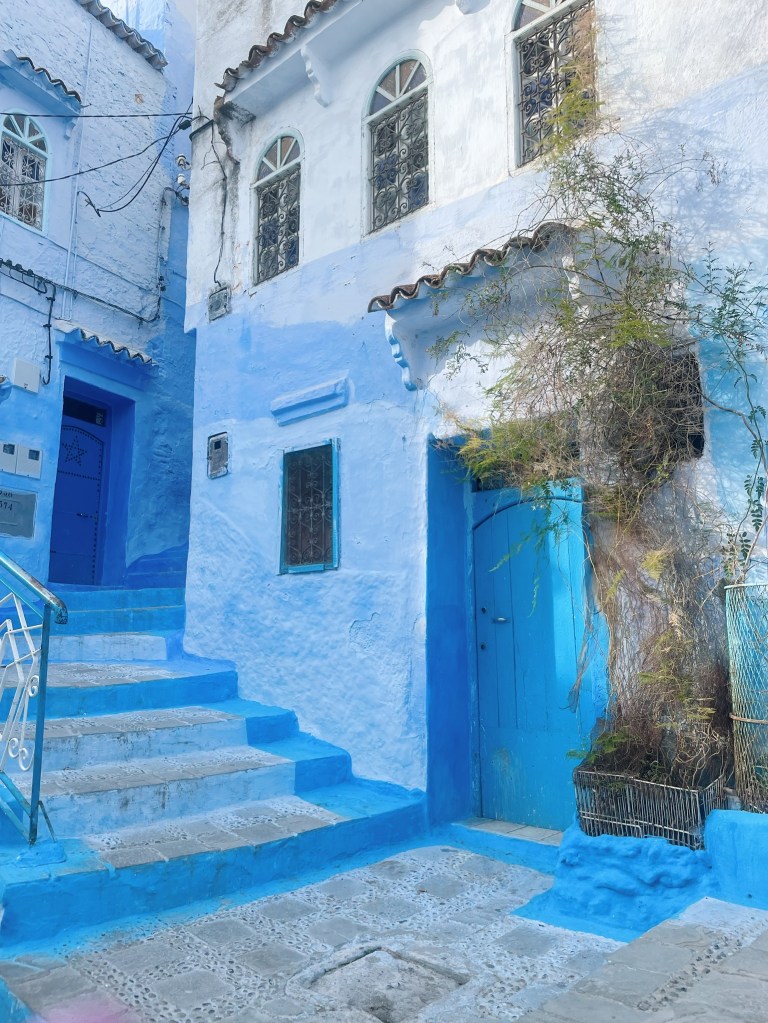
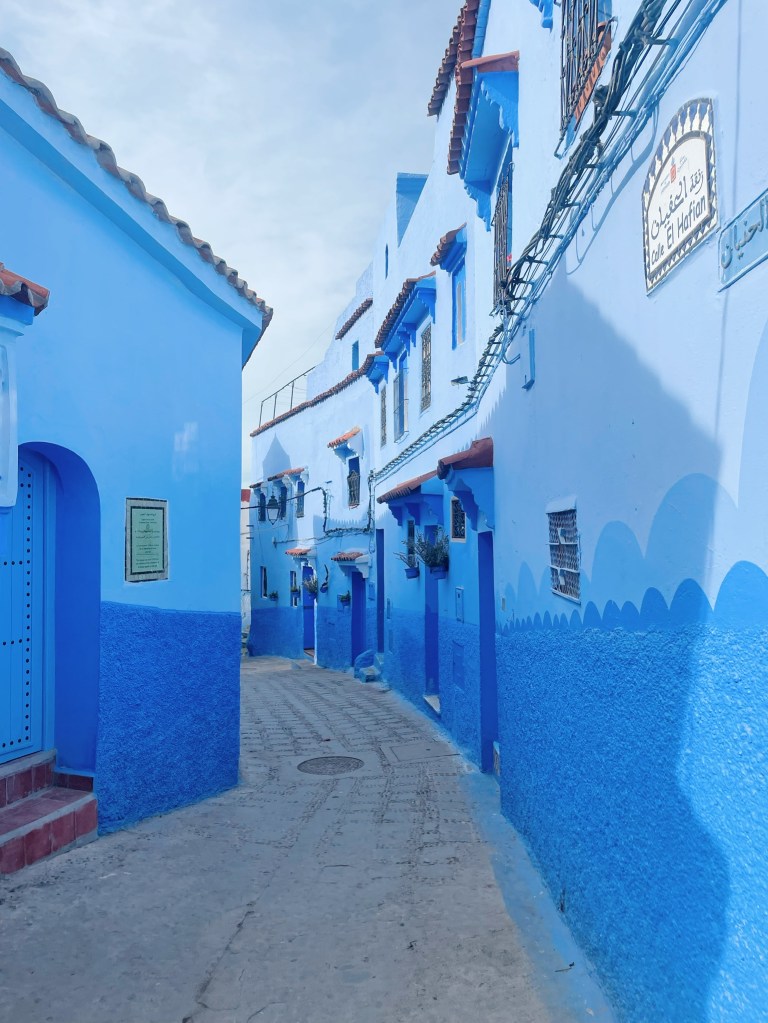
We spent the rest of the day wandering around the medina and finally getting to the enjoy the beautiful blues of Chefchaouen. It is truly remarkable how BLUE everything really is; the buildings, doors, roofs, stairs, flower pots, windows, everything truly is blue! There are several theories on why the consistent color usage: some say it’s to repel mosquitos, some say it’s to symbolize the sky or water. The most probable explanation is from the 1900s. During World War II, Chefchaouen became a popular refuge place for Jews facing persecution from the Andalusia in Spain due to its hidden location in the mountains. The Jewish community during this time had a strong tradition of painting things blue as a reminder of heaven and God. Their culture and heritage is still very much preserved by the vibrant presence of this color which is impossible to miss. While pictures don’t capture the full-scale of how immersive the blue felt, I tried to capture small unique sights:

the camel burgers

It was so fun to just wander the streets and leisurely shop around the medina which was significantly kinder and more relaxed than Marrakech. I had to buy a little painting of the blue streets and mountains because I never want to forget how pretty this scenery is. We had a late lunch at Cafe Clock, a popular restaurant known for their signature camel burgers. Again, we sat on their rooftop which had a spectacular, sunny view of the city. We all decided to be adventurous and try the camel burgers, which weren’t bad! I definitely prefer beef but it was neat to try one for the experience.

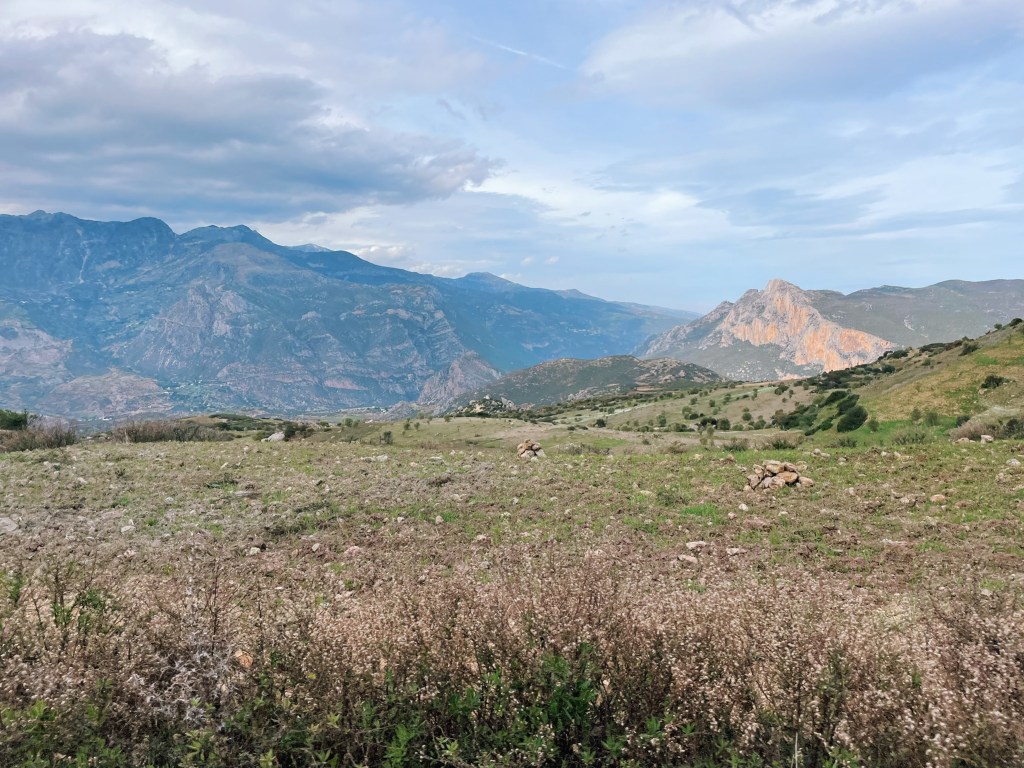
The next morning we coordinated a taxi to take us about 45 minutes outside of Chefchaouen to Akchour, a small village known for its rivers and waterfalls. When I tell you this was by far the most beautiful taxi ride I’ve ever taken…. travelling on winding cliffside roads we passed deep valleys, forests, mountain faces, grassy plains, and lakes surrounded by villages. Pictures truly don’t do the scenery justice at all, so I spent a lot of time just soaking everything in and trying to internalize mental images of how incredible the drive was.

the drive to Akchour
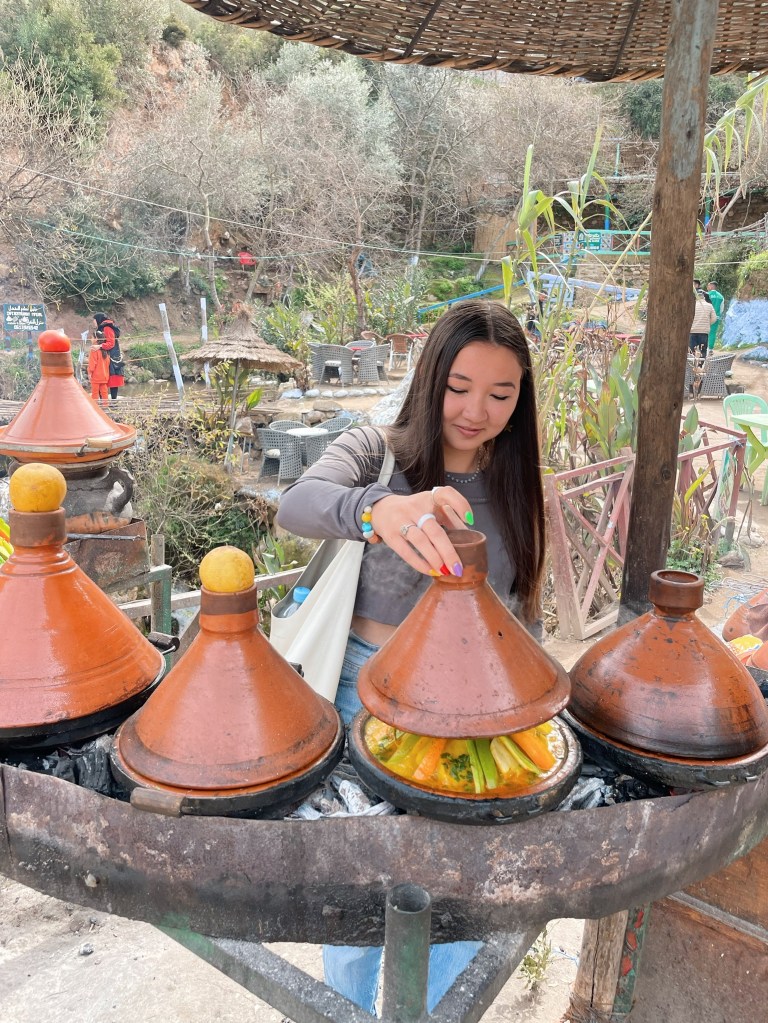
pretending like I can cook tagine

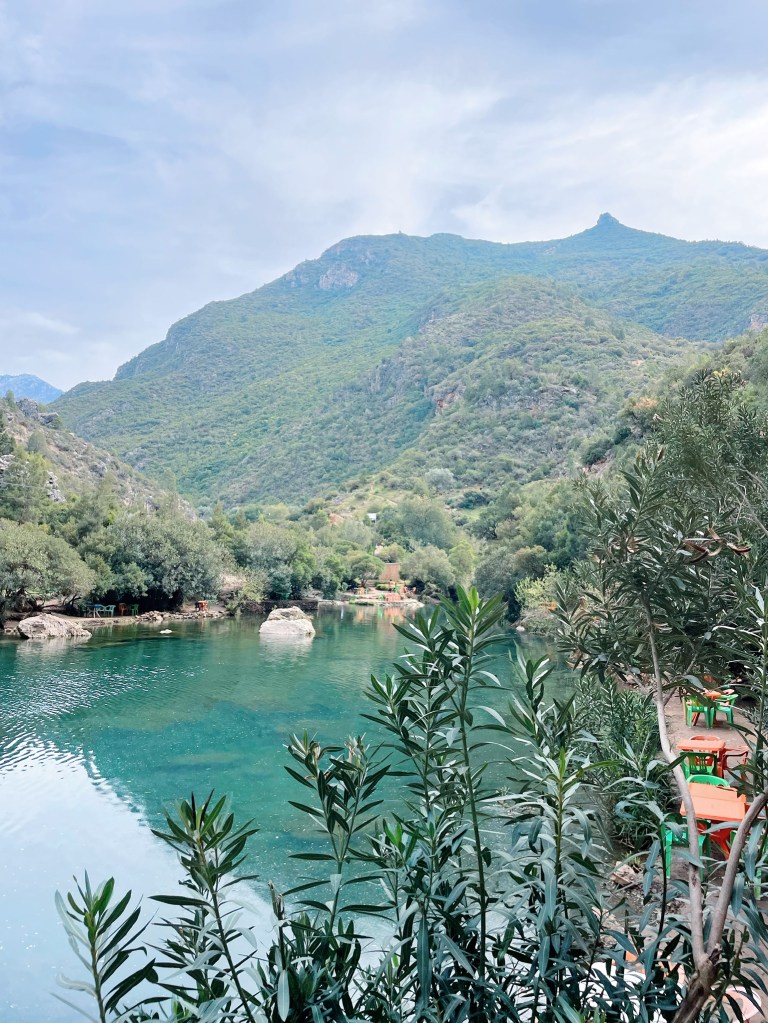
When we arrived in Akchour, we started off with a traditional breakfast overlooking the mountains. We decided to turn down hiring a guide and attempt the hike on our own, not really knowing what to expect. The hike began at a dam where two of the valley rivers come together, one trail veering left towards a small waterfall and one trail veering right towards The Grand Cascades and the God’s Bridge point. We decided to go all in and take the long route to the upper falls and cascades. The base of the hike was really fun with plenty waterside cafes grilling tagine, offering tea, and providing a place to swim. The water was SO blue and clear but still a bit too cold to swim in. As we climbed increasingly higher the views became even more spectacular. Certain points on the trail were pretty steep and rocky and I fell probably four or five times oops.

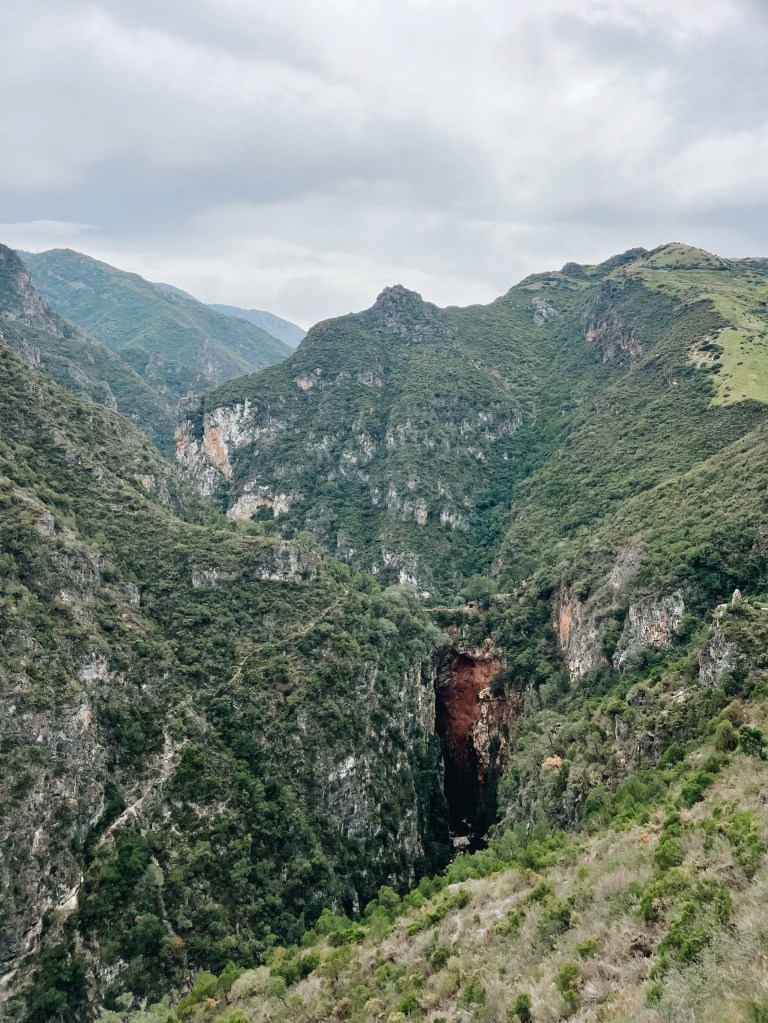
We stopped at several outlook points to look down and see how far we had come and look around at how beautiful the view was. I always take pauses in moments like this to really just appreciate where I am and the true solitude of being in the middle of nowhere. While I love the craziness of urban environments, moments like this always remind me of the rare, indescribable peace and beauty of rural settings. Places like this feel untraveled and unseen, and always give me a deeper appreciation for the seemingly secret beauty of North Africa that isn’t typically shared when people think of this region of the world. In the midst of the surrealness, I always take a moment for gratitude and recognize that I’m very lucky to have these experiences.

much needed mint tea break

After about two hours of hiking, we finally reached God’s Bridge, a 100 meter high natural rock bridge formed above a running river below. While the trail down to the water below was closed, we were still in awe of how beautiful the view was from the bridge. The scenery was entirely worth all of the sweating, slipping, and falling. After making the long journey back down, we stopped by the rocky edge of a water pool for a glass of mint tea and to rest our feet. It felt great to get outside of Chefchaouen for the day and be truly immersed in the lush, green mountains in nature. Not to mention the hike was a great workout! I would love to come back to this region in the summertime to enjoy swimming in the wading pools and perhaps eating tagine at a waterside cafe.

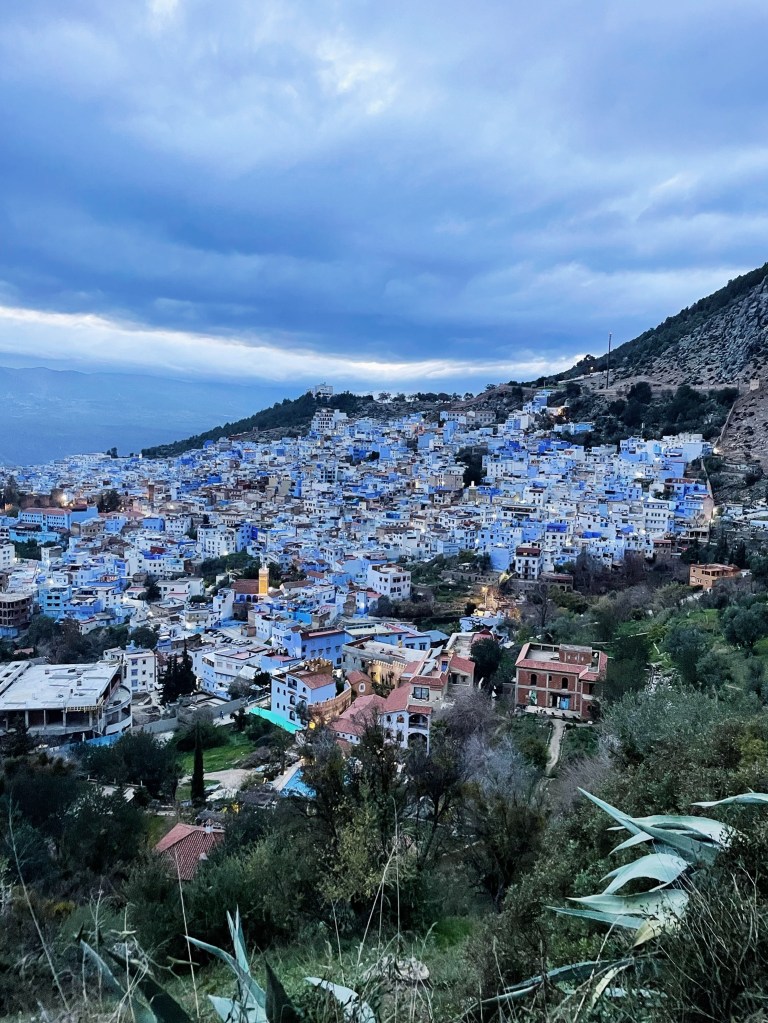
view from the Spanish mosque in the evening

On our last evening in Chefchaouen, we took a hike up to the Spanish mosque for a great overlook of the city. The mosque was constructed in the 1920s during Spanish colonial rule of the region, and was built to try and gain support of the local Muslim population. The mosque was actually boycotted and never attended by the residents of Chefchaouen, and today it is restored as a scenic tourist attraction. After a short fifteen minute walk up the hill we reached the mosque which had the most spectacular view of the blue city. It was really incredible to see the distinct blue houses built right into the side of the mountains. Sadly it was pretty cloudy so the sunset wasn’t anything special, but the view was still just as lovely to enjoy.

Overall I had an AMAZING weekend in Chefchaouen! The mix of the city and mountains was a perfect balance of spontaneity and relaxation. I would absolutely recommend a visit to this region if you are looking for unique, quirky sights, time away in nature, or a good calf-workout from all the stairs. The beautiful blues created such a bright, calming atmosphere that undoubtedly reflects the deep Jewish and Moroccan heritage that has stood the test of colonialism, persecution, and time. Chefchaouen is truly a hidden treasure of Morocco!

An Escape to Essaouira

Here is truly a piece of paradise on Earth! I spent this past weekend soaking up the sun, sitting by the water, and wandering around the streets of Essaouira – one of the most wonderful places I’ve ever traveled to. I had heard from many people that Essaouira was a hippie, beach-lovers dream, and the perfect place to unwind. As a UNESCO World Heritage site, filming location for Game of Thrones, and the inspiration for Jimi Hendrix’s music, I knew it had to be one of my first weekend trips from Marrakech.

goats in the tree

I booked myself the earliest bus possible on Saturday morning so that I could spend the maximum amount of time in Essaouira. It was an easy bus ride, with a brief stop to see the famous argan trees filled with goats! Supposedly this is a natural phenomenon as the goats are attracted to the fruit produced by the trees… however something has me thinking it is a bit more curated as a tourist attraction now 🙂 Either way it was still a very unique sight to see.

Hostel La Smala

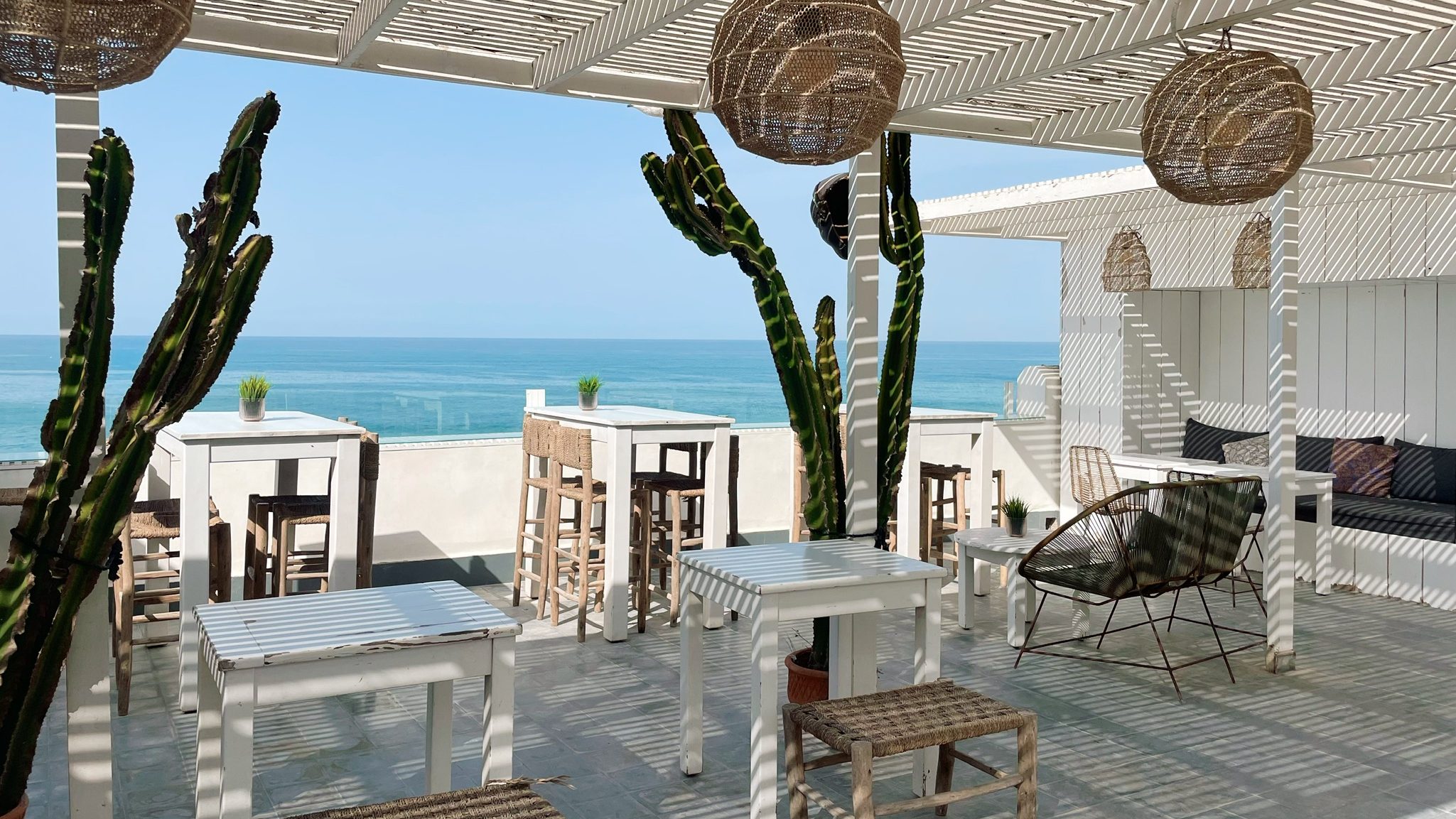
The moment I stepped off the bus in Essaouira I could immediately see, smell, hear, and feel a difference from Marrakech. The buildings were a beautiful white and blue, you could smell the salt water from the ocean, and hear the seagulls by the beach. The energy felt noticeably different than the hustle and bustle of Marrakech; it was much more calming, quiet, and peaceful. I headed to La Smala, which was an EXCELLENT hostel recommendation. Not only was in interior exceptionally well decorated to fit the beachy vibes, but the rooftop had a stunning, sunny view of the water.

the hostel rooftop! paradise!
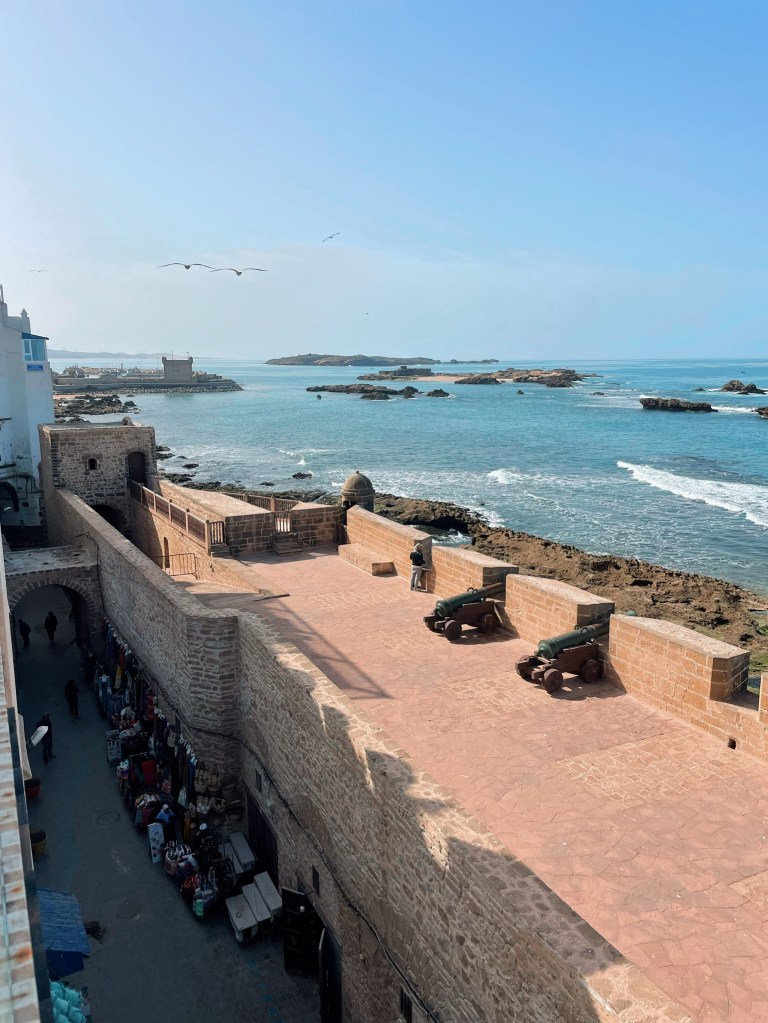
a view of the shops below and the sea beyond

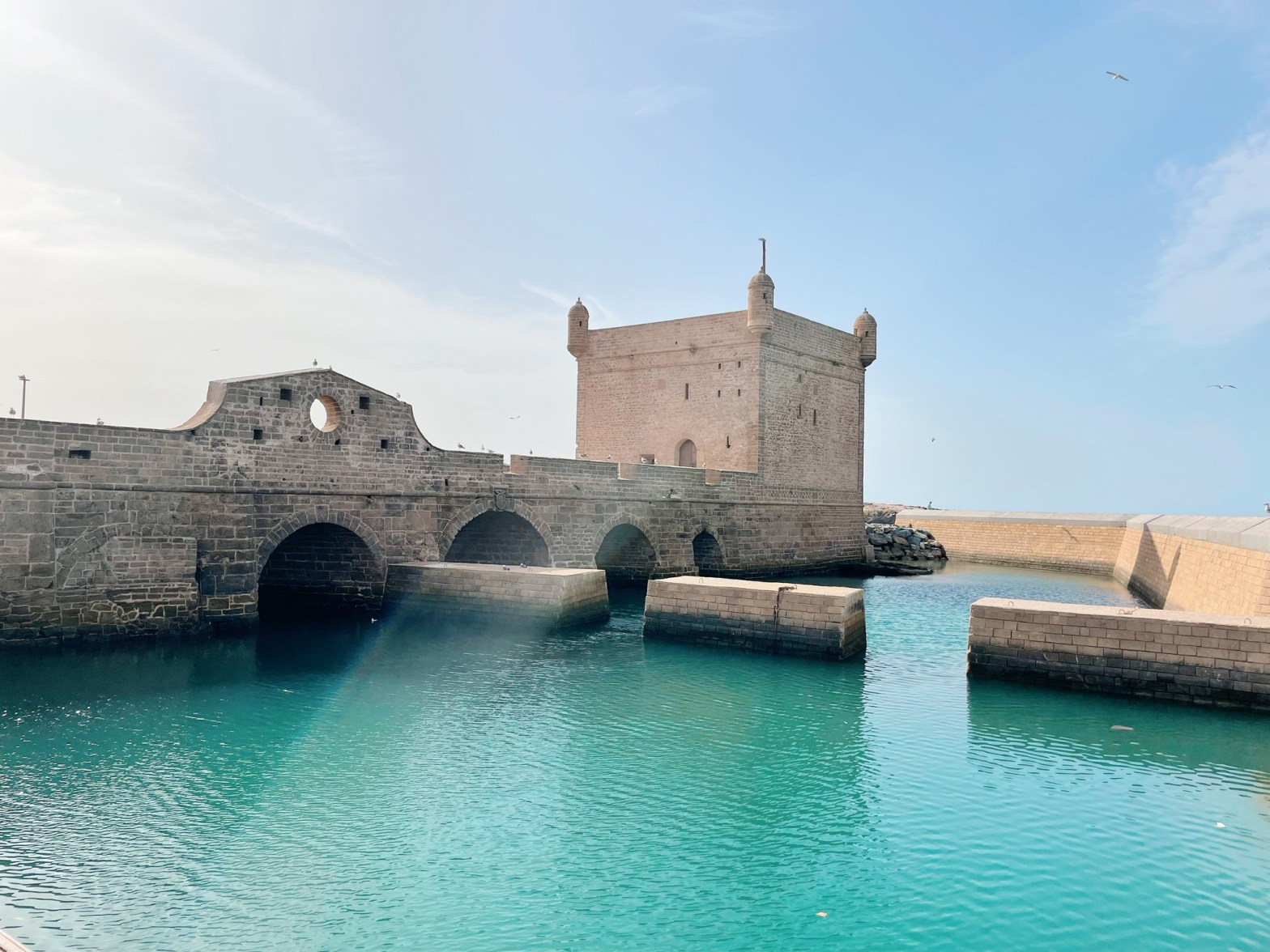
I started my exploring by wandering around Skala du Ville. For context, Essaouira is surrounded by a seafront fortress built by the Portuguese in the 1700s. The ground level is filled with little shops that used to be military storage areas, and the top level still contains huge defensive cannons and amazing views of Île de Mogador. Walking on the ramparts was my first real taste of being by the ocean in Morocco and it was much needed! The air was cleaner, the sun felt warmer, and the area wasn’t congested with crowds of people. The atmosphere was perfectly laidback, with every visitor and local adopting a common attitude of nonchalance.

lots of blue and white

From there I set out to find lunch in the Medina. The consistent whitewashed buildings with blue doors, shutters, and décor made me feel like I was walking around an island somewhere off the coast of Greece. I learned that the mixture of majorelle, cerulean, and ultramarine blue tints actually comes the pigment of murex mollusks shells harvested in the surrounding Purple Islands of Morocco. This region has been using a range of indigo, royal blue, and purple hues for over 3000 years as seen throughout the city. As a lover of the color blue, the aesthetic of Essaouira scratched the perfect spot in my brain.

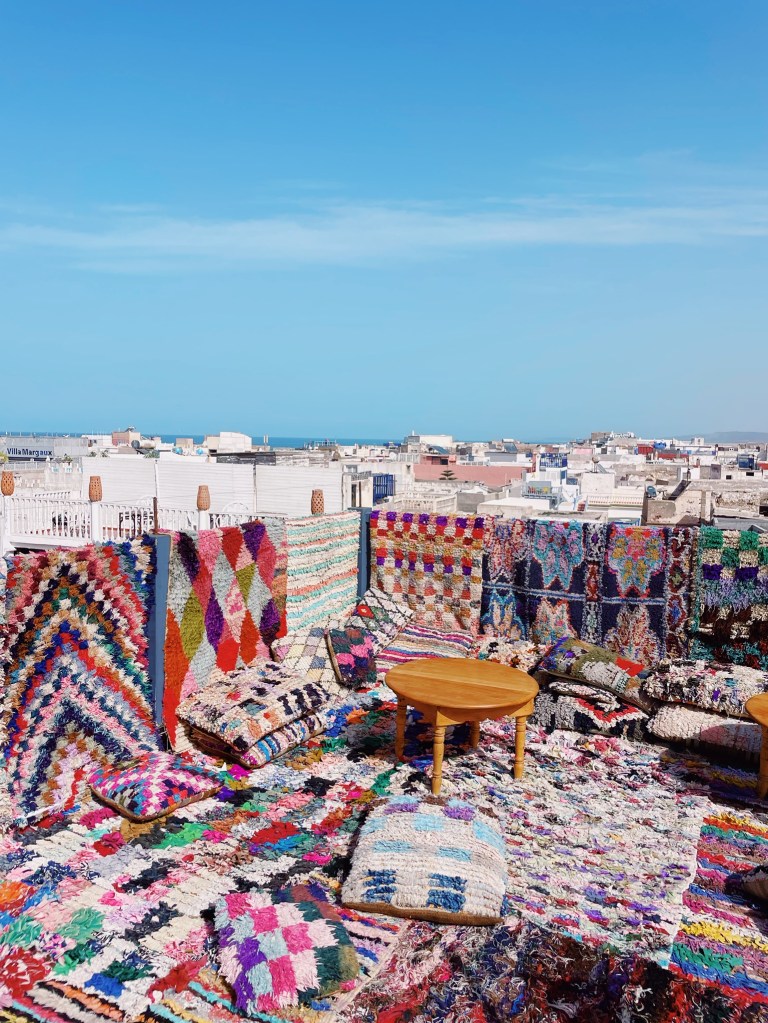
As I’ve learned in Marrakech, when looking for food AND views – you have to look up! I spotted a potentially interesting rooftop and wandered up to it. I stumbled into Mega Loft one of my favorite spots I’ve found! The first two floors were impeccably decorated with a vintage Moroccan art style, and the rooftop was completely covered in carpets and pillows. It was the PERFECT place to relax in the sun and I enjoyed a delicious chicken pané while overlooking the Essaouira Medina.

a beautiful view as I relaxed

I think I spent the next three hours just sitting on the rocks by the water and listening to music. This was the highlight of my whole weekend! There are few things that make me happier than sitting by water, people watching, listening to my favorite playlists, and just soaking in the scenery around me. I didn’t realize how much I missed being by the water, so I took advantage of every second I was here in Essaouira.

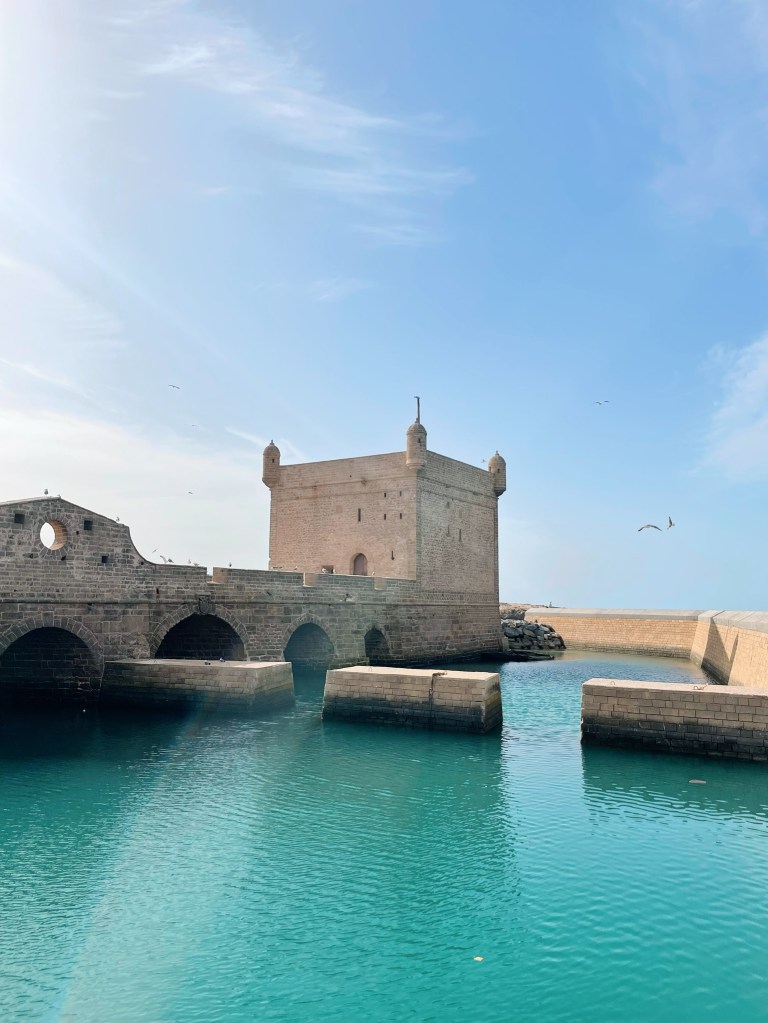
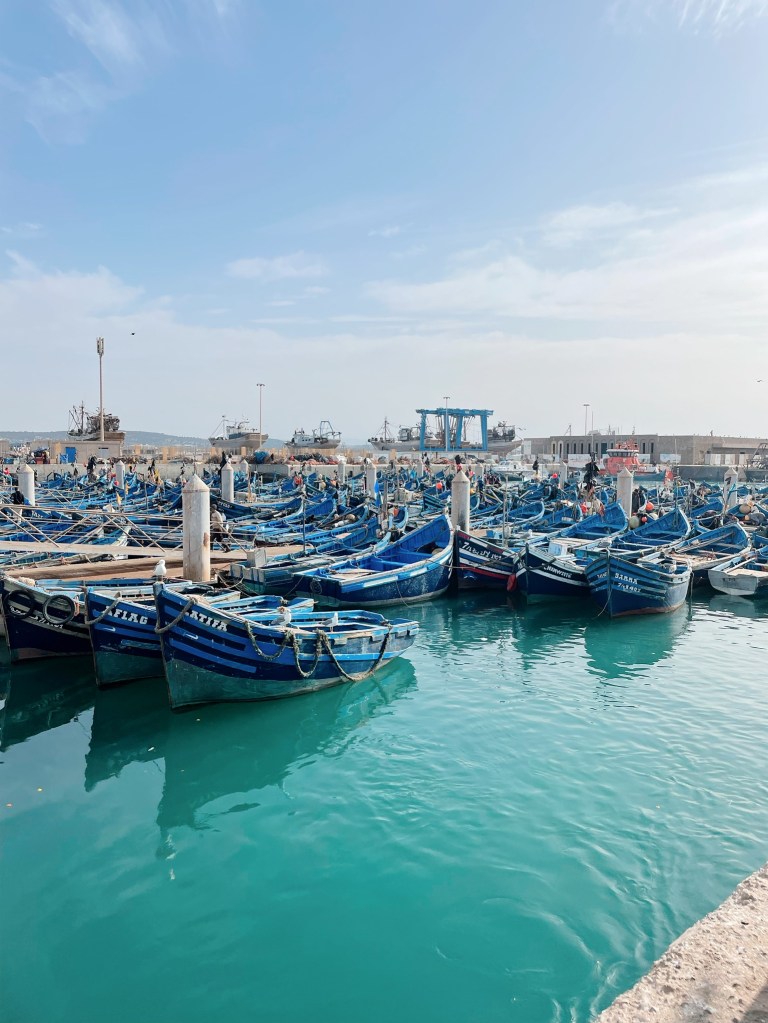
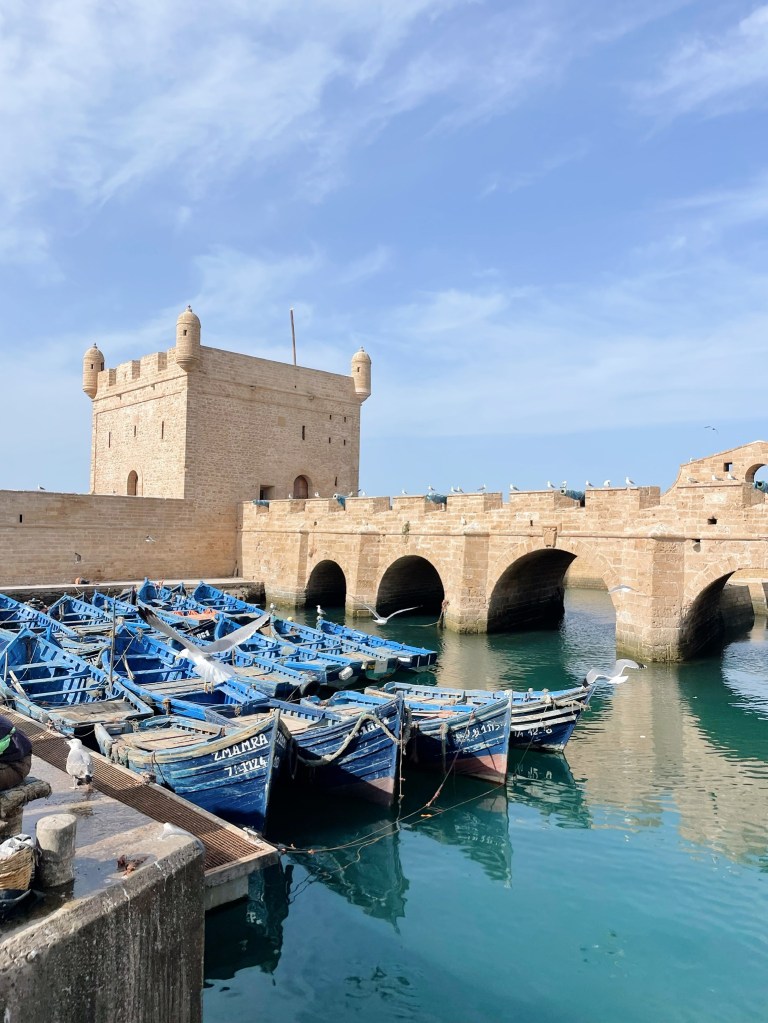
Although I prefer to keep a significant distance between me and any type of birds, I knew that I had to brave through the seagulls to explore the famous fishing port of Essaouira. At the entrance is Skala du Port, an iconic photo spot. The light bricks contrast beautifully with the blue water, and the even bluer snail-pigmented boats.

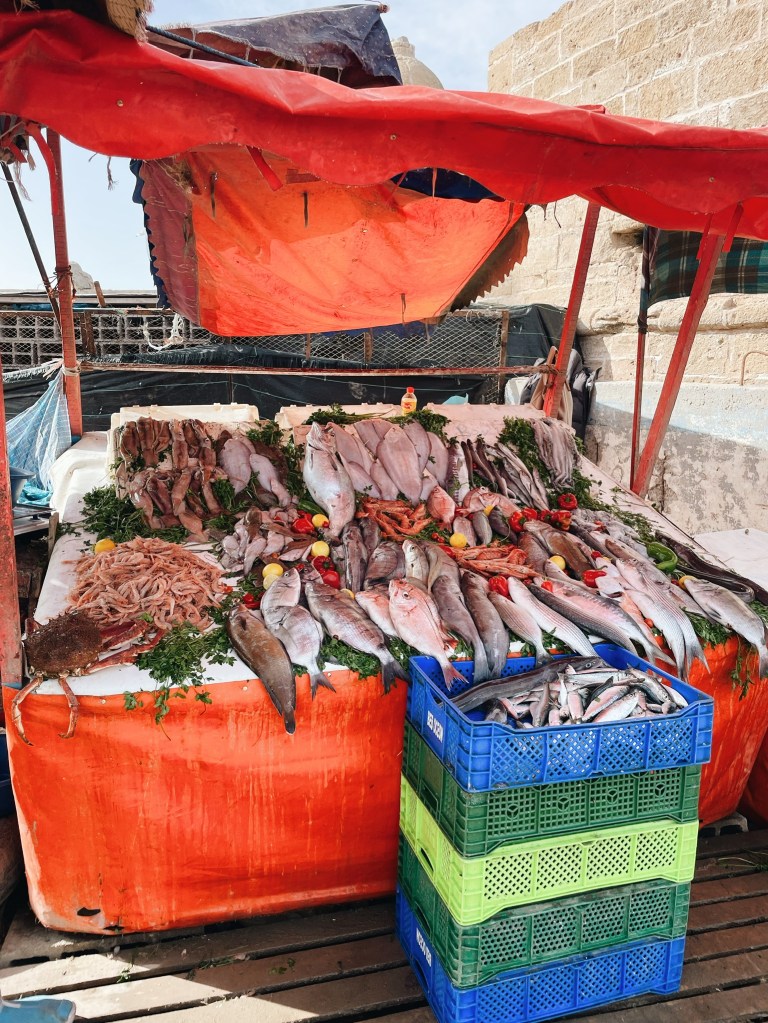
lots of seafood for sale

I wandered further into the fishing port which was lined with fresh seafood stands and filled with all the real smell, noise, and bustle of a fish market! What felt like hundreds of seagulls were circling the area, screeching at people, and hunting for unattended seafood to steal. Fisherman were running around between boats and stands with nets and freshly caught fish. While the atmosphere was quite loud and chaotic, it was exhilarating to walk through and experience a working fishing auction amongst the locals.

dinner with a view!

After a long day of travel and sightseeing, I set out to stake out a rooftop table for dinner and the sunset. My coworkers had recommended Taros, a restaurant/bar with live music and a great view of the ocean. While watching the sunset and enjoying a glass of wine, I tried their fish and chips which were delicious! I hadn’t had seafood in forever and knowing that it had come from the port I just visited made it all the more enjoyable. Just as I was starting to wish that my friends from back home were here to enjoy such a fun restaurant with me, I started chatting with another girl nearby who was also from Marrakech! We spent the rest of the evening hanging out, and it was a wonderful ending to such a fun day.

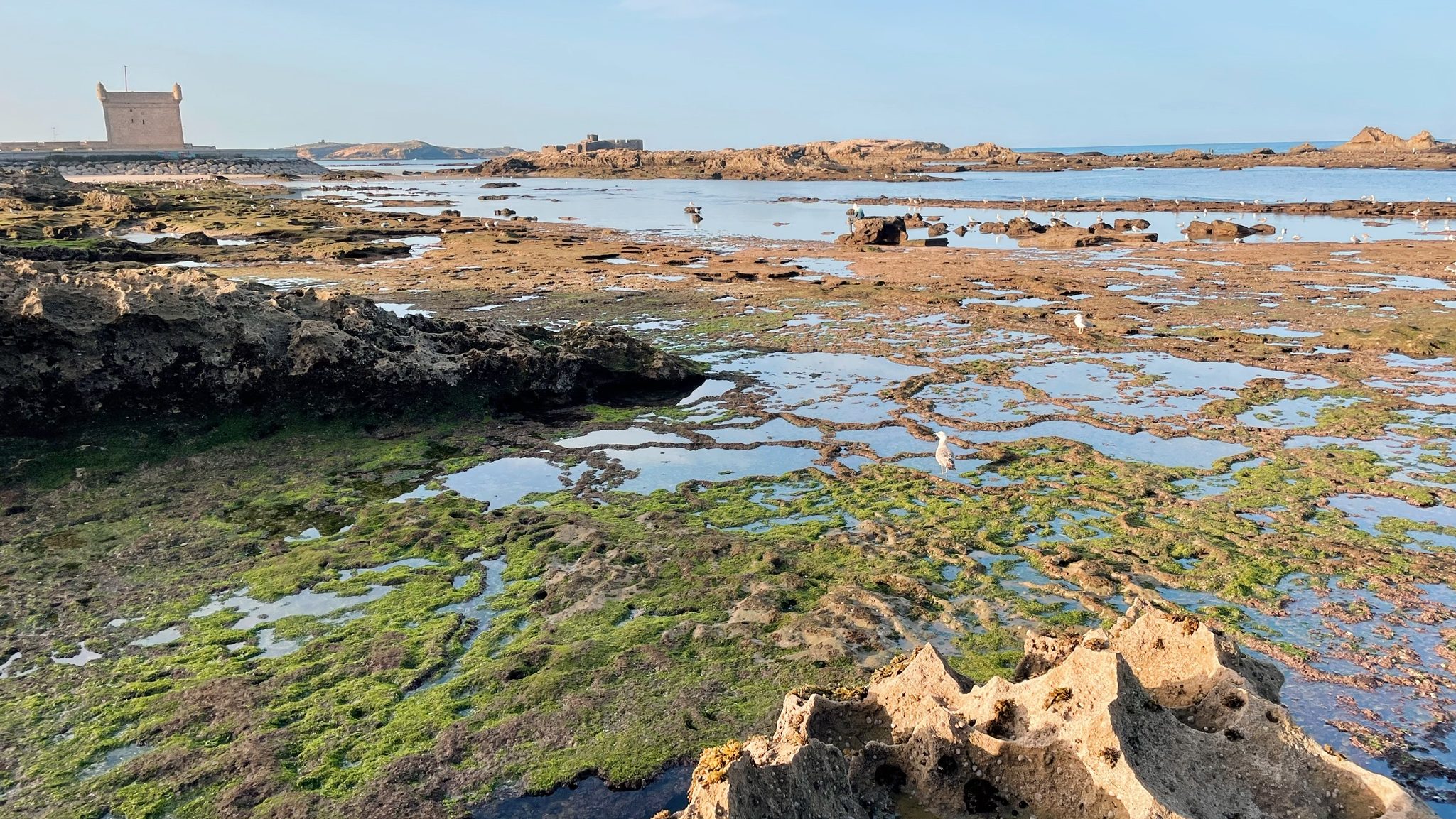
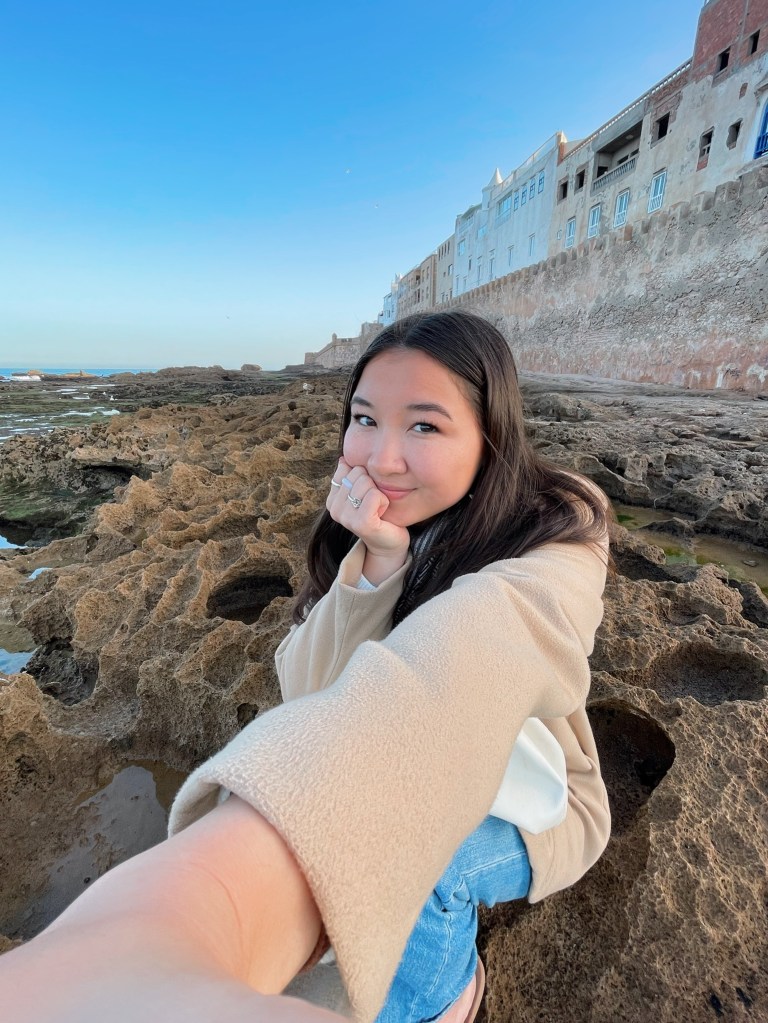
The next morning, I woke up just as the sun was rising since I wanted to get out by the water again and enjoy the peace and quiet alone. As I suspected, I was the only person on the beach with the exception of a few fishermen out for an early catch. Additionally, the tide was very low, so I wandered further out on the rocks and sat as the sun rose behind me. It was such a peaceful, quiet morning that really set the tone for the rest of my day in Essaouira!

a beautiful morning on the water
the breakfast I’d been craving

For coffee and breakfast, I ate at Mandala Society, a plastic and meat free, organic, locally sourced cafe. Since being abroad, the #1 thing I’ve been craving is a good breakfast sandwich, so I was so happy to see one on the menu here. It was delicious and I’m always more than happy to support businesses founded on fair trade and sustainability like Mandala Society.

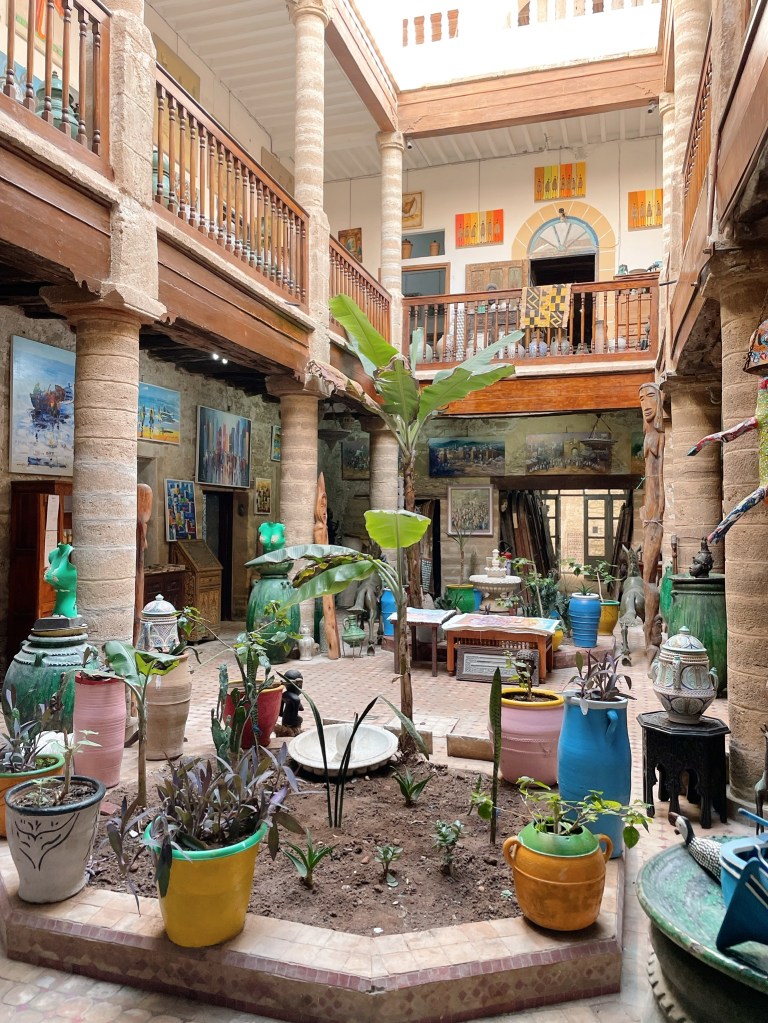
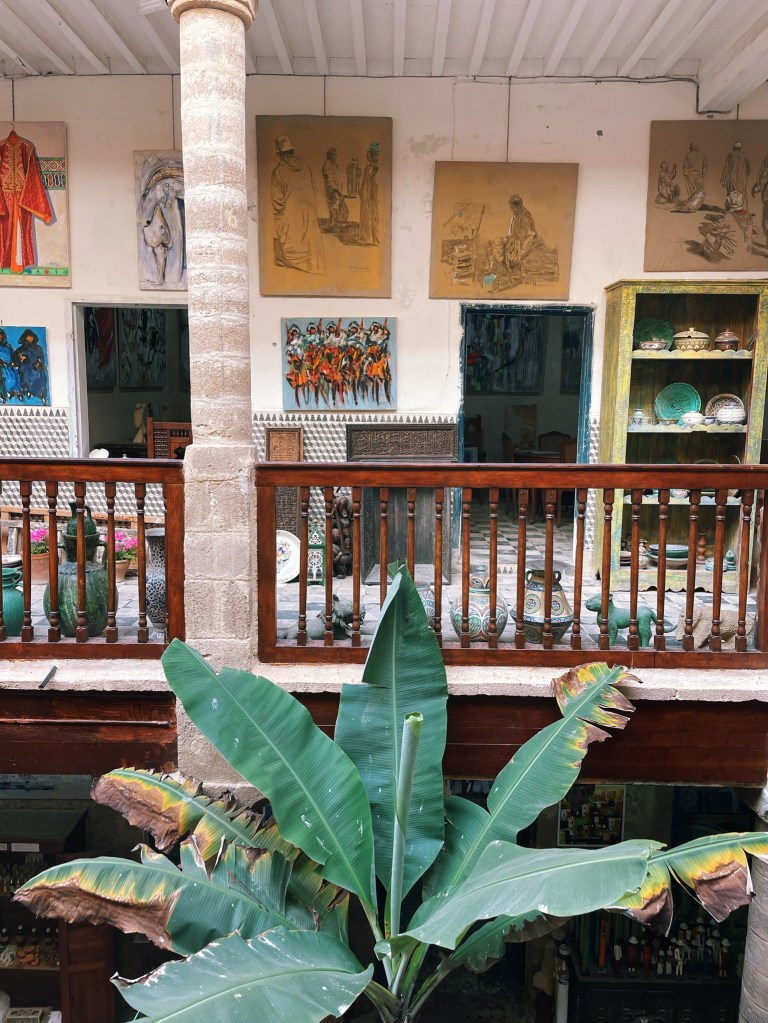
I dedicated the rest of my day to walking around the Essaouira Medina exploring the winding streets and shops. Of course, I couldn’t leave without a few pieces of art to remember Essaouira by, so I haggled for a beautiful handmade bracelet and a small watercolor painting of Skala du Port. I wandered into Galerie la Kasbah, a 18th century riad that is now restored into a beautiful art gallery. There were over four floors of incredible pieces of art including paintings, sculptures, rugs, books, pottery armoires, plants, tiles, tables, and cutlery. It was fascinating to see such a unique collection of art from around the world and it made it even better that I had the whole place to myself!

Il Mare restuarant

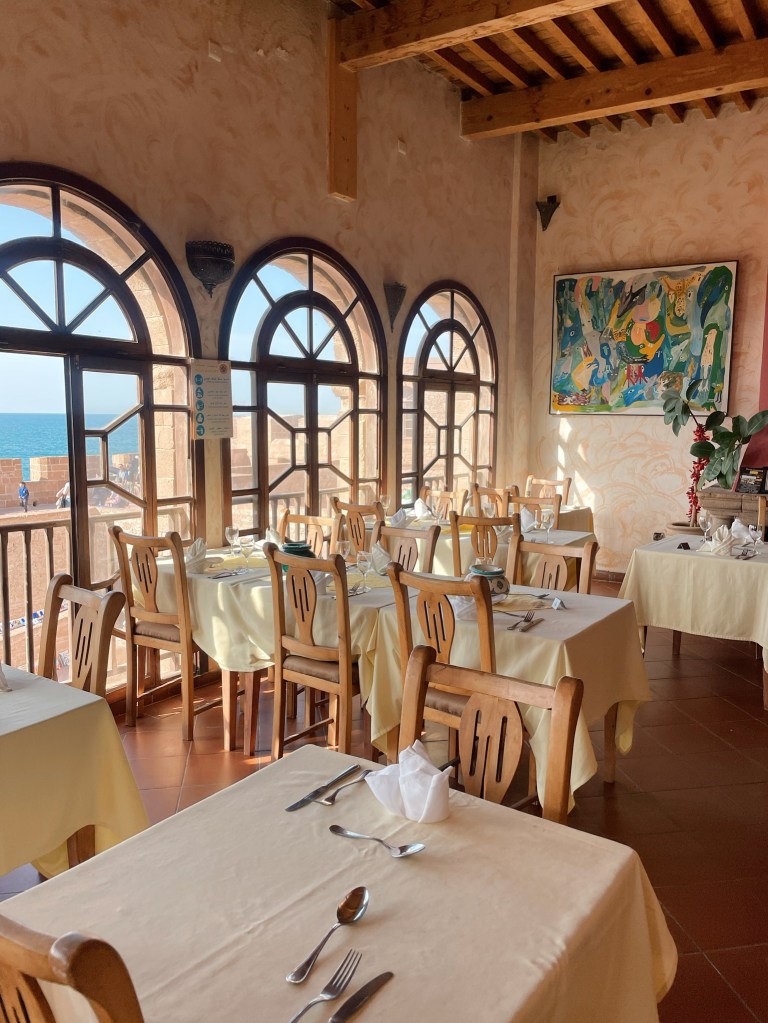
In the afternoon, I had lunch at Il Mare, a beautiful seafood restaurant right on the coast. This was the perfect spot to relax at before the bus ride back. The friend I made the previous night ended up joining me for lunch as well and we both headed back to Marrakech together that evening! It was so nice to have some company in the midst of being fairly alone the whole weekend, and I’m grateful to now have another friend to hang out with in Marrakech.

thinking about my next trip back!

While my time in Essaouira was actually quite short, it felt like time had slowed down over those two days. Here was much needed time to relax, recenter myself, and just enjoy the beauty and atmosphere of Morocco’s coast. I’m so grateful to have been able to experience another side of Morocco, which now gives me something to compare to the busy, red city of Marrakech. I was sad to leave, and I think I would’ve booked another night at La Smala if I could. But I’m very confident that this won’t be my last time in Essaouira and I’m already thoroughly looking forward to going back!

Mastering the Medina

Every single time I’ve read a travel website or blog about Morocco, it ALWAYS describes the endless maze that is the Medina of Marrakech – infamous for its winding streets, aggressive haggling, and overstimulating nature. While initially intimidating, I was determined to explore the Medina and see if I could really master the shopping and navigation in such a unique environment. My first experience in the Medina was with a local guide, making for a very easy, enjoyable experience. This past weekend I spent almost three whole days traversing the Medina and I think I can now say I’m finally getting the hang of things.

the Dar el Bacha riad

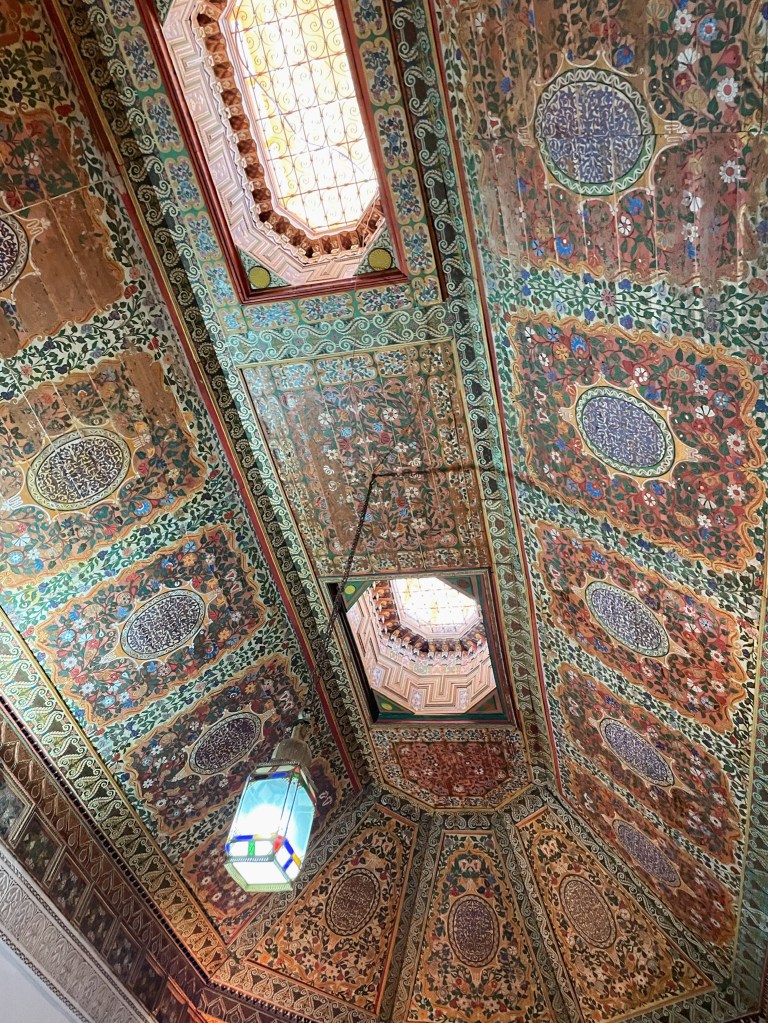
One of my coworkers is local to the area and was kind enough to take a few of us around the Medina to his favorite places. It was incredibly helpful to have a local Moroccan walk us around and I’m so grateful for such a personal Medina tour! We started off at Dar el Bacha, translating to “house of the pashsa” (governor). It was built in 1910 and was the residence of pasha Thami El Glaoui until its renovation in into the Musée des Confluences in in 2017. Dar el Bacha reminded me so much of Bahia Palace with its gorgeous architecture, tile work, and riad filled with orange trees. There were several museum exhibits in the side rooms, which displayed a lot of neat artifacts from Muslim, Christian, and Jewish history. We also stopped in the Bacha Coffee House which had an incredible coffee selection from around the world.

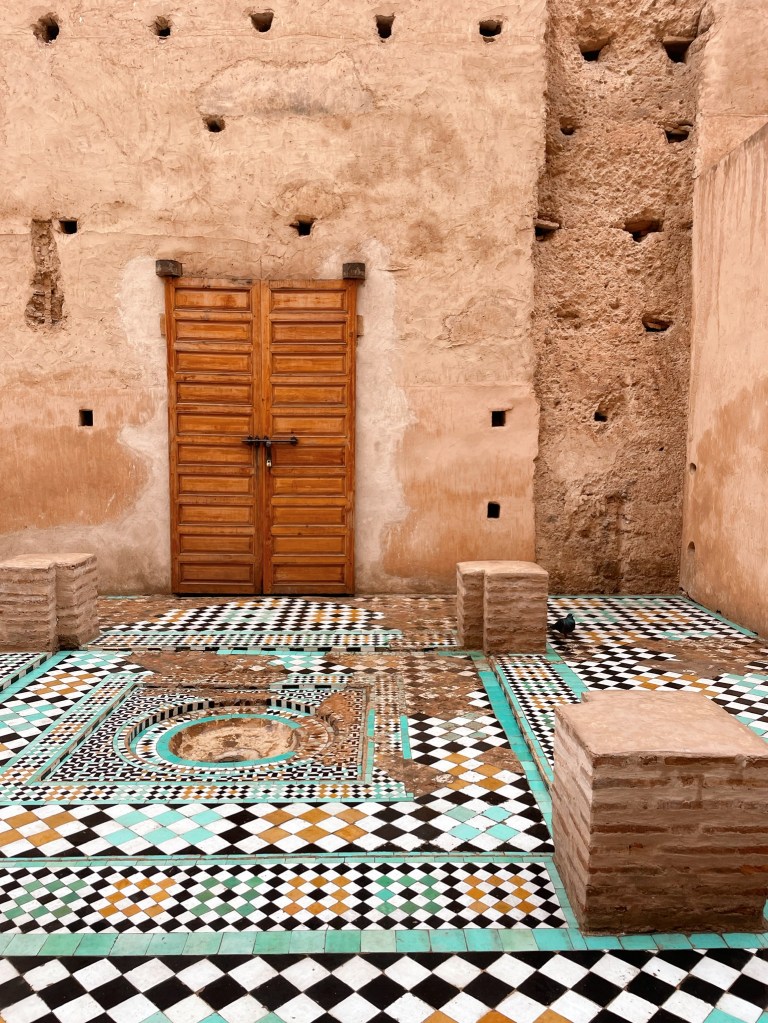
tile work and ruins at El Badi

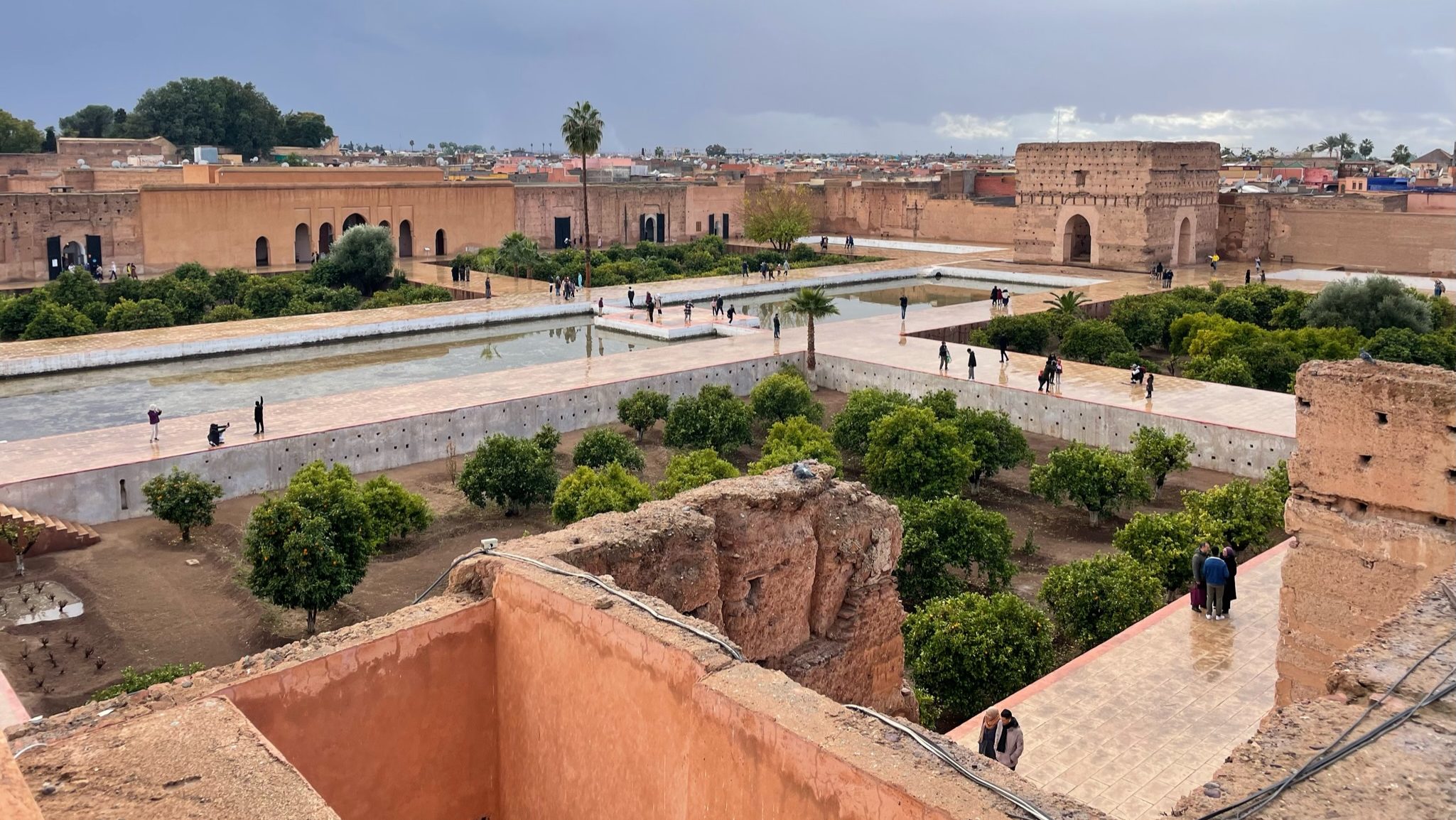
From there we walked towards the southern end of the Medina to the Mellah or Jewish Quarter of Marrakech. The Jewish population in Morocco grew during the 1400s, and Jews were protected in the Mellah as non-Muslims living in an Islamic State. Here, we visited El Badi Palace, translated as the “Palace of Wonder” in Arabic. Today all that remains of the palace is ruins, but it was still incredible to walk amongst such old history. The views from the top of the ramparts were unbelievable as you could look out over the old palace as well as all of the Medina. We also walked down into the subterranean chambers which are now converted into a photographic history museum.

overlooking the gardens of El Badi Palace

After a busy afternoon of soaking in Marrakech’s history, I was greatly looking forward to tackling the Medina at my own pace. I went back the following morning with no real plan in hopes of just wandering around and exploring. I entered the Medina at about 9:30am, which in my opinion is a pro-tip to a great Medina experience. The souks were open and I was pretty much the only person walking around, making for a significantly more quiet, relaxing and enjoyable experience.

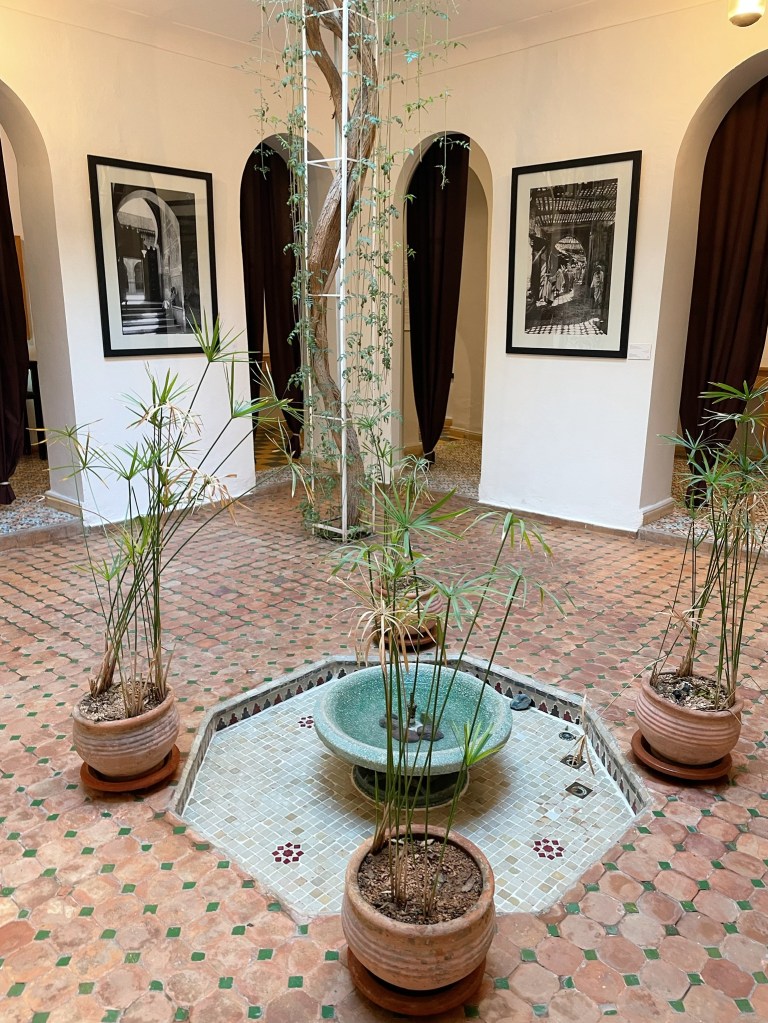
center of the Maison de la Photographie

I was given the recommendation to go to the Maison de la Photographie (thank you Annie) which was SO worth a visit! It is a riad converted into a private photography collection with amazing shots of Morocco throughout the years. The walls are filled with portraits, landscapes, and photos of street scenes and daily life in cities like Marrakech, Fez, Tangier, Casablanca, Meknes, and Tétouan. It was also neat to read about the different photographic techniques used throughout history. Because I got to the museum so early, I had the entire place to myself which was amazing.

the best rooftop cafe!

My absolute favorite part was the rooftop cafe, which has one of the best views of the city. It was breathtaking to look out over the Medina, and I could even see views stretching as far as Guéliz. Initially, I was so focused on immediate landscape that I didn’t even notice the INCREDIBLE, panoramic view of the High Atlas Mountains in the distance. One of my favorite things about Marrakech is contrasting environment; living in a bustling city, but being able to look outside and see the mountains in the distance at almost any perspective. I enjoyed a coffee and the views for probably an 1.5 hours, with the entire rooftop to myself. It was the most peaceful experiences I’ve had in a long time, and was truly beautiful to enjoy.

After a lovely morning at the museum, I began wandering throughout the Medina some more, making smaller stops. To me, it feels so freeing to not always have a plan or purpose, and just wander into anywhere that peaks my interest. With this mindset, I found some of the COOLEST spots. I ventured into several antique galleries with multiple floors of paintings, sculptures, beautiful rugs, and thousands of other vintage pieces. Additionally, many gallery owners were very kind and willing to let me onto the rooftop as well, making for more beautiful views. I also stumbled upon a women’s cooperative with tons of handmade products made my local female artisans. I love finding places like this that are focused on fair-trade and showcase the talents and arts of local women.

For lunch, I decided to stop somewhere random. Often, there will be staircases on the street leading up to rooftop restaurants or cafes; so I chose one at random and decided to check it out. Apparently, I had great luck that day because I had a wonderful experience at Terrasse des épices.

a refreshing lunch

Up until this trip, I would have never actively chosen to eat at a restaurant alone. Places like a restaurant are meant for socializing and community, so the potential for being lonely in a space like that is certainly intimidating. In this instance I didn’t have much of a choice, but sitting down at my table for one was surprisingly great. Being truly content with your own company is the BEST feeling, and those moments of empowerment remind me of how much I love my independence and where its taken me. There are definitely still moments that make me wish I could enjoy these experiences with my family and friends from home; but I do my best to appreciate those feelings of loneliness too because they make me cherish those times even more. I sat with these super fun thoughts throughout my lunch and enjoyed the views and listening to the live saxophone and guitar duo that played nearby.

In the afternoon I wandered around for a couple more hours, finding even more unique souks and shops. I haggled for a ring and pair of earrings which is always fun, and walked away with new jewelry that I still probably paid too much for. As the sun started to set, I decided to find one more rooftop cafe to relax and have a drink at. I wandered upstairs into Chinguitti Cafe, a little rooftop with couches to lounge on and a huge talking bird in a cage. Here, I sat overlooking the Rahba Kedima square which made for great people watching. This was the perfect end to the day as I soaked in the setting sun while listening to music and watching the bustling square below me.

At this point you would think I’d be sick of the Medina, but Sunday morning rolled around and I was on my way back. This time I spent the day with my coworkers as we casually shopped around explored some more. We visited Amazir, a tiny shop in Souk Chérifia I had briefly checked out the day before because I loved its aesthetic and decor. This time I got talking with the shop owner, who was was a Moroccan woman about my age. She had only opened up her shop a month ago, and it was really exciting to see a young, women-owned business in a heavily male-dominated space like the Medina. I was MORE than happy to support her business and she even offered to work together to create a custom rug for my apartment in Boston. Moments like that make my heart so happy.

coffee and chicken pastilla

For lunch, I was DETERMINED to find a rooftop cafe I had quickly visited the day before. I’ll admit that this was the only point of frustration I had in the Medina as I walked in circles for probably 15 minutes until I found the correct alleyway that led me to where I wanted to go. But the hunt was well worth it, as my coworkers and I sat and enjoyed a beautiful, sunny, private couch space and lunch at Soul Food for about three hours. It was so relaxing and I’m very grateful for the opportunities I have to socialize and be with other people my age in a new country. We pretty much sat and chatted here for the rest of the day, and finally walked back to Guéliz as the sun was setting.

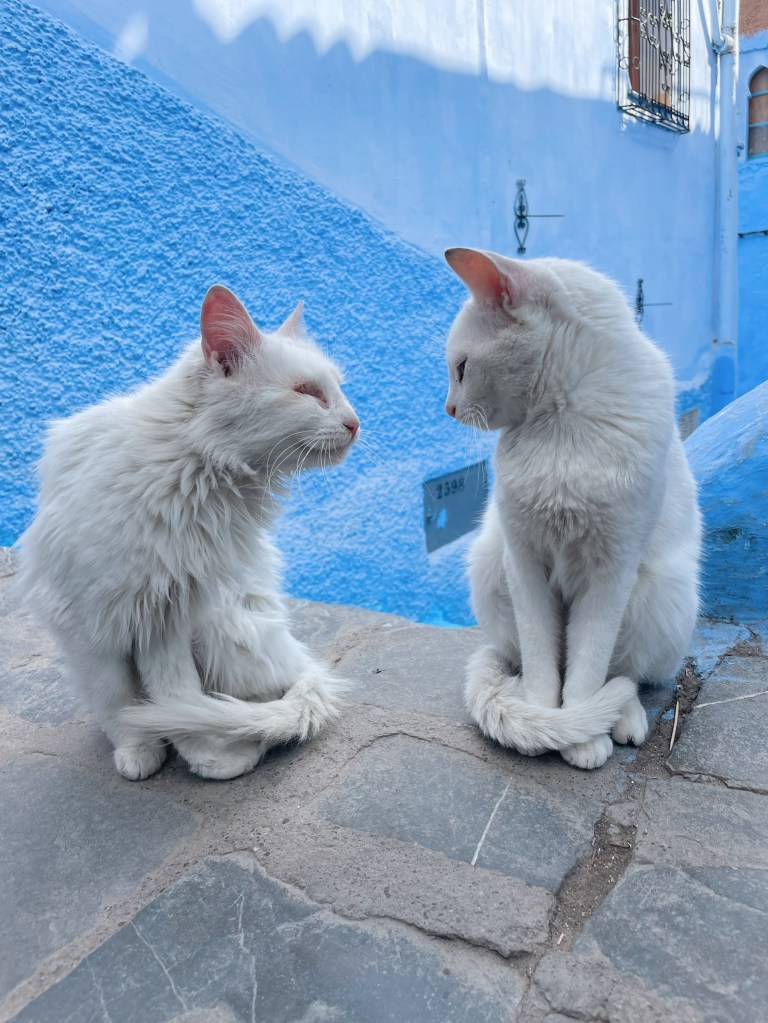
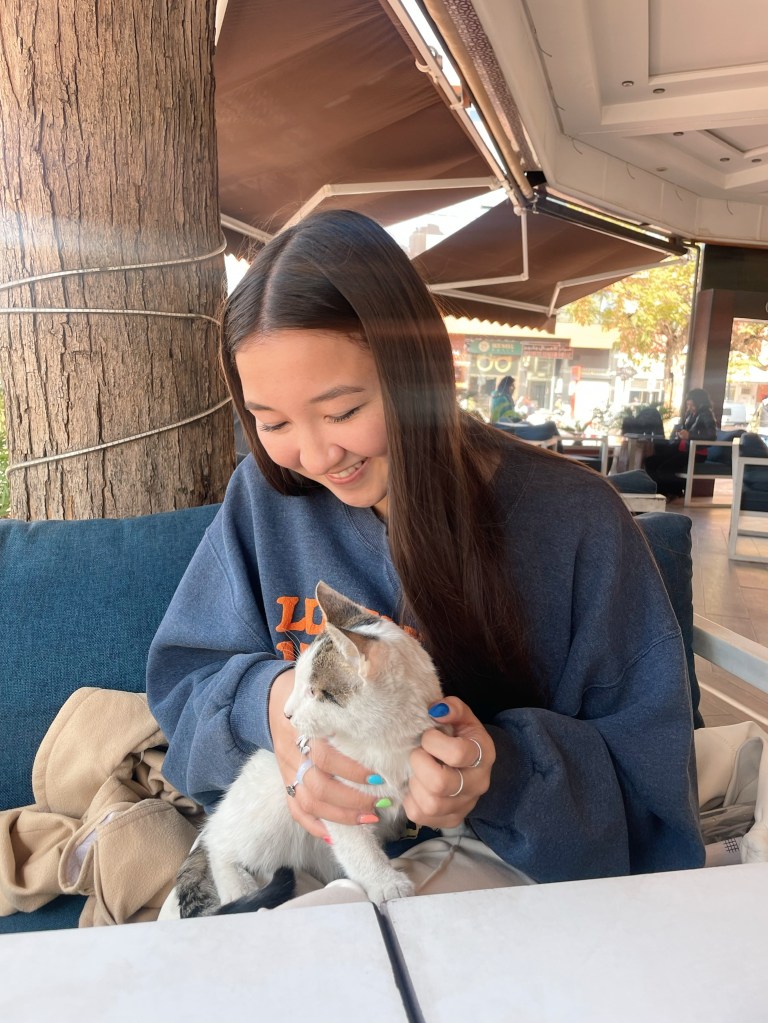
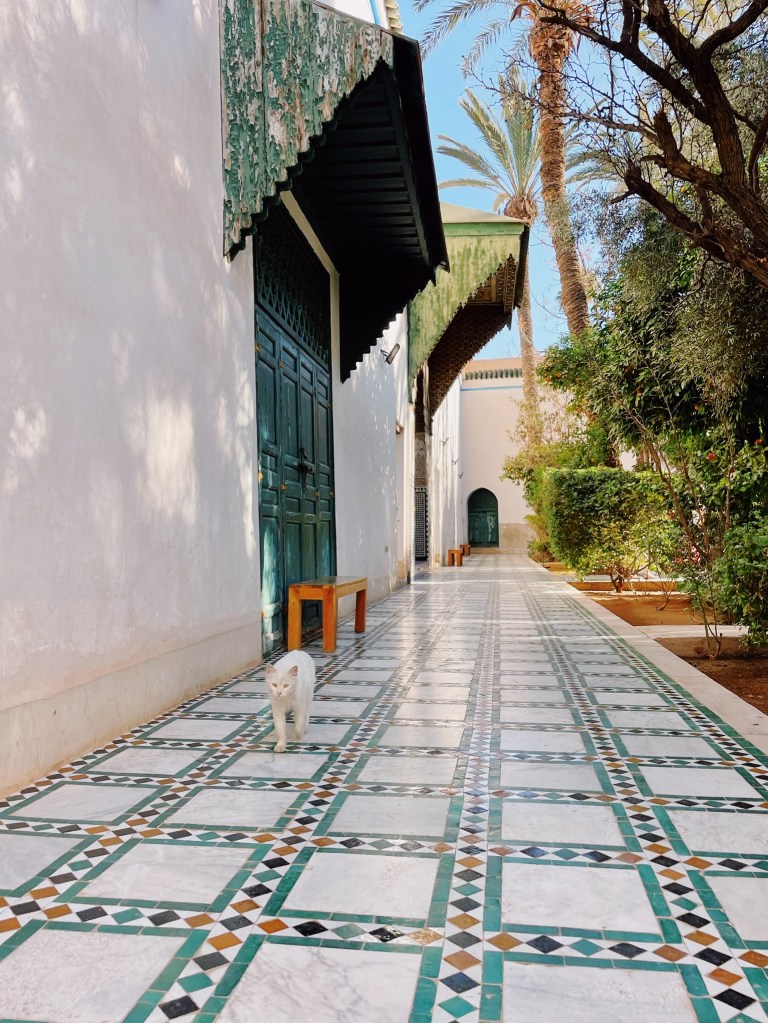
I WILL. play with every stray cat.

It was truly a great weekend filled with simultaneous excitement, relaxation, and introspection. This weekend helped me to realize how incredible, yet temporary my current state of life is, and how important it is to take advantage of EVERY single opportunity that comes my way. It also encouraged me to continue challenging myself, testing my capabilities, and embracing my independence. Choosing to step outside my comfort zone on Saturday and explore such a new environment alone certainly paid off and made for one of the most fulfilling days I’ve had in a very, very long time. And those feelings of empowerment make every anxiety or worry I had about working abroad so worth it!

First Taste of Marrakech

My first few days in Marrakech were a blur of jet-lag, apartment hunting, and adjusting to a new environment. Despite the busyness, we were able to enjoy a morning of touring around Marrakech and seeing some of the popular sites!

the main villa

We started out at the Jardin Majorelle which was created by French artist Jacques Majorelle and architect Paul Sinoir. In the 1980s, the property was bought by Yves Saint-Laurent and Pierre Bergé who worked to maintain the garden and villa as a museum, open to the public today. We actually visited the museum at the perfect time, since it was early morning and the garden was practically empty.

I think that if I had the ability to create my dream garden, it would pretty much look like Jardin Majorelle. The stunning cobalt blues, contrasting bright yellows, and cacti collections created such a peaceful, colorful oasis in the middle of the otherwise consistent reds and browns of Marrakech. Every plant, pot, window, pond, fountain, and building was so bold, making it impossible to miss. One of my favorite things in the world is places or art that were created/curated so intentionally. And Jardin Majorelle is a perfect example of that. I could spend forever in this garden and it’s beauty reminds me so much Gardner museum in Boston and my grandparent’s garden back at home.

the Koutoubia Mosque

Next, we drove over to Koutoubia Mosque, the largest mosque in Marrakech. It was built in 1147 and is a beautiful and important landmark that is impossible to miss in Marrakech. The minaret (tower) is 77 meters tall, and is actually wide enough for someone to ride a horse up to the top to announce daily prayers! In Morocco, non-Muslims are not allowed to enter mosques, so we observed this historical monument from the outside.

We then headed over to Bahia Palace! It was built in the 1800s for a Grand Vizier of the Sultan, and has over 150 rooms. The corridors, riads, courtyards, and private gardens were stunning to walk through, and it was a beautiful display of Moroccan royalty, architecture, and elegance. Seeing the insanely intricate tile work and stucco carvings in every single room, ceiling, and floor was unbelievable, since the entire palace was built in just ten years! One of the residents, Bou Ahmed had four wives and 24 concubines, each with their own sections of the palace, however most of those spaces were empty, leaving any furniture or decorations to the imagination. During the French Protectorate, any residents were forced to leave, and parts of the palace were physically altered (typical colonialism), but the magnificent artwork and style of the palace still shines through today. The private gardens were my favorite, and I can only imagine how relaxing and peaceful they were compared to the hustle and bustle of the Medina right outside the doors of the palace.

We capped off our morning by taking our first stroll through the infamous Marrakech medina. This is an enclosed section of the city filled with cobblestone streets and souks (marketplace) containing artisan crafts, leather, spices, jewelry, carpets, textiles, and just about every kind of good you can imagine. Marrakech’s medina is actually a UNESCO World Heritage Site, so I was super excited to see what it was about. I can understand why people stress that you enter the medina with a trusted tour guide because the amount of unfamiliar, winding streets would definitely be overwhelming to try and navigate alone. Luckily we were able to just follow in the footsteps of our guide, who showed us through a few of the souks and Berber pharmacy. The amount of goods and souvenirs you can find here are truly endless. I’m hoping to explore more of the medina, cautiously, as I’m not really looking to get lost in such an overstimulating environment.

In the center of the medina is Jemaa el-Fnaa, a large plaza with henna artists, snake charmers, performers, and fortune tellers. While we didn’t experience Jemaa el-Fnaa in the evening, it apparently transforms into a busy food market. This is definitely on my list to explore at some point soon.

views from day 1 of my co-op!

It amazes me that we did all of this in just one morning! It’s clear that Marrakech has so many incredible places to explore with so much history and culture. While it felt like we just dipped our toes into the excitement of this city, I feel so grateful to be here and have so much time to do everything. I cannot wait to take time, go at my own pace, and really get to sit and learn about these places and historical landmarks!

Lastly, a special thank you to my Dad for helping me move and adjust to such a new environment across the world! I’m so glad that we got to experience this day together and none of what I am able to do here would be possible without him or the support from my family. ❤

3 Days In Maasai Mara

Masai Mara Elephants | Leopard Masai Mara | Governors Camp

To end my time in Kenya, my family and I enjoyed a 5-day game drive in two of the most beautiful reserves in the country. Maasai Mara is located in Narok, Kenya and is mainly populated by the Maasai people. It is a largely important region for wildlife conservation and an incredible ecosystem of lions, elephants, giraffes, wildebeests, hippos, birds, and so much more.

Ilkeliani Camp

We set off on a 4 hour drive from Nairobi to Narok, and entered the gates of the national reserve. Driving through the park to get to our camp felt like an impossible maze of tall grasses and bumpy roads, yet our driver navigated it flawlessly. Arriving at the Ilkeliani Camp, we were greeted by the Maasai staff who showed us to our tent. Our accommodations FAR exceeded the few expectations I had going into this game drive and brought such a unique feel to our trip. Not only was our family sized-tent by far the coolest “hotel” room I’ve ever stayed in, but the hotel lobby, eating area, and patio was a glamping dream. It was certainly a unique experience to have to be escorted to your tent due to a risk of dangerous animal encounters!

sunrises and hot air balloons
breakfast picnic in Maasai Mara

We spent the next three days exploring the reserve through early morning and afternoon game drives. While waking up at 4am to hop in our jeep isn’t my typical routine, seeing the breathtaking views, sunrises, and waking animals was all worth any exhaustion. There was something so peaceful about slowly driving around the plains, stopping to observe an animal, and sitting in complete silence and isolation. As the sun would rise, so would the hot air balloons, and we noticed lions, elephants, zebras, and cheetahs migrating, perhaps to find their next feeding spot. One morning we stopped for a breakfast picnic in the middle of the park, laying out a blanket and enjoying the warm sun and endless views. There wasn’t a single sign of other people or animals as far as I could see, making this one of the most memorable picnics I’ve ever had.

Perhaps the highlight of my time in Maasai Mara was the observing a pack of lions enjoy a midday lunch. For the majority of our animal viewings, we were accompanied by 10-20 jeeps of tourists also searching for animals or looking to get the best photographic shot. However, this particular time our jeep was completely alone and we were able to sit for around an hour and observe a family of lions. There were two lionesses who had just previously killed a gazelle and several cubs by a watering hole waiting to eat. The mother lions were dragging their newly captured meal while their little cubs were playfully scampering after them. Every so often they would get tired and stop to rest or drink from a watering hole, and we would silently follow behind them. Getting to watch these lions interact as the only observers in the area was such a once-in-a-lifetime experience that felt like I had walked onto the set of a National Geographic shoot.

thirsty lion cubs stopping for a drink
a mother a baby hippo through the lens of my binoculars

On our third day of the game drive and last day in Maasai Mara, our guide took us to the Kenyan-Tanzanian border. Looking out over the Serengeti was breathtaking, and it was incredible to see how expansive the plains and rolling hills were. Near the border runs Sand River, where we briefly stopped to get a great view of a bloat of hippos. Hippos fascinate me since they are blubbery yet vicious animals; so viewing them from a distance was perfect.

enjoying the beauty of Maasai Mara

Overall, I thoroughly enjoyed our brief stay in Maasai Mara. The observations we were able to have of animals in their natural habitat was incredible and beats any zoo experience by far. This environment has some of the most peaceful views I’ve ever seen; they honestly remind me of the desktop screensaver views that look fake. Just beautiful rolling hills, African trees, and thick brush. Additionally, our guide, hotel staff, and every person we came into contact with was extremely friendly, welcoming, and kind. People were so eager to share pieces of their Maasai culture with our family and show a hospitality and warmth that was unmatched to any other place I’ve visited. It was not just the animals, and views, but the people who truly made our experience in Maasai Mara one to remember.